8 Essential Change Management Skills for Successful AI Adoption
change management skillsAI adoptionchange leadershiporganisational readinessAI transformation
A technically capable AI tool can create little value if people don't trust it, understand where it fits, or use it consistently. That's the uncomfortable reality behind AI adoption. UK evidence shows only 18% of respondents said their organisation manages technology-led change effectively, while 76% said their wellbeing had suffered because they were tired from too many changes at work (ManpowerGroup UK's 2025 Talent Shortage Survey). The problem isn't always the model, integration, or dashboard. Often, it's the way the change reaches people.
The most useful change management skills therefore work as an integrated AI adoption system. Leaders and delivery teams need to assess readiness, understand operational impact, involve users, lead visibly, build capability, and use evidence to adapt. AI implementation isn't a software launch with a training email attached. It's a redesign of how people make decisions, complete tasks, share information, and measure performance.
These eight skills apply whether you're introducing an AI agent for administration, automating a workflow, building a dashboard, or connecting AI to existing business systems. The practical test is simple: does the solution fit real work, and do people have the confidence, time, and support to use it?
Table of Contents
- 1. Stakeholder Engagement and Communication
- 2. Emotional Intelligence and Resistance Management
- 3. Change Impact Analysis and Planning
- 4. Inclusive Design and User-Centred Adoption
- 5. Change Leadership and Visibility Management
- 6. Learning and Enablement Strategy
- 7. Data-Driven Progress Tracking and Adaptive Course Correction
- 8. Organisational Culture and Readiness Assessment
- 8-Point Change Management Skills Comparison
- Turn Change Management Skills Into Adoption
1. Stakeholder Engagement and Communication
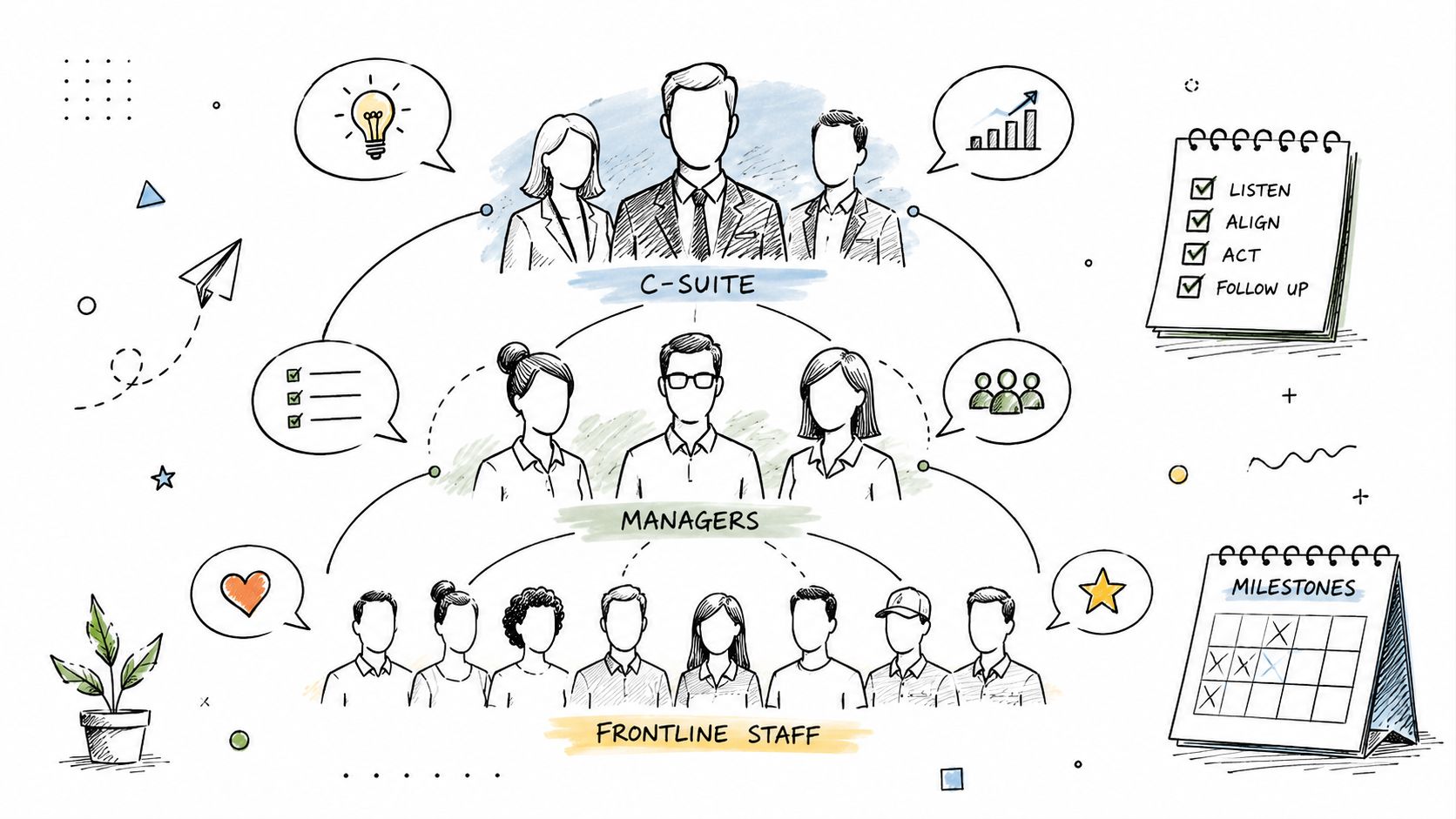
AI adoption starts before anyone opens the new tool. Leaders need to understand who will be affected, what each group cares about, and how their concerns may shape implementation. A finance director may focus on cost and control. An operations manager may care about throughput and exceptions. A frontline employee may want a direct answer to a more personal question: what does this mean for my role?
Good communication translates technical decisions into workplace consequences. Instead of explaining model architecture, describe which tasks will change, which decisions will remain with people, and what support will be available. A bespoke AI consultancy such as InnovaAI Integration Ltd can help maintain that connection by combining technical delivery with plain-English advisory throughout discovery, build, and rollout.
Build a communication rhythm
A single announcement rarely creates confidence. Stakeholders need a predictable way to ask questions and see how their feedback affects the work.
- Map influence and impact: Identify executives, managers, process owners, users, compliance stakeholders, and people who support the current workflow.
- Tailor the message: Explain business value to senior leaders, workflow changes to operations, and role implications to affected employees.
- Use real examples: Demonstrate the tool with actual work, rather than polished scenarios that hide exceptions.
- Create feedback points: Hold regular check-ins during the build and continue updates after launch.
- Show visible learning: Share what changed because users raised a concern, not only what went well.
The trade-off is speed versus involvement. A leadership team can move faster by deciding privately, but it may discover late that the tool conflicts with a necessary workaround or creates an unanticipated approval burden. Early involvement takes effort, yet it exposes those problems while they're still cheap to fix.
A useful communication plan answers three questions every time: why are we changing, what will change in daily work, and what won't change? If people have to infer the answers, informal rumours will fill the gap.
2. Emotional Intelligence and Resistance Management
Resistance isn't automatically a sign that people are difficult or unwilling to modernise. It may indicate that employees can see a risk the project team has missed. They may fear job changes, distrust the accuracy of AI output, resent another tool added to an overloaded process, or feel that leaders have already decided without listening.
Emotional intelligence helps a change leader respond to the concern beneath the objection. Defending the technology too quickly usually makes the conversation worse. Listening doesn't mean promising to accept every request. It means creating enough psychological safety for people to explain what would make the change workable.
Treat resistance as operational evidence
During discovery, give employees a dedicated space to raise concerns without turning every conversation into a sales pitch. Ask, “What would need to be true for this to work for you?” That question often produces more useful information than asking whether someone likes the idea.
A respectful response has three parts:
- Acknowledge the loss: Recognise that an existing process may represent routine, expertise, or control, even if it looks inefficient from outside.
- Separate fears from facts: Clarify what the implementation will do, what it won't do, and which decisions remain open.
- Turn concerns into tests: Convert worries about accuracy, workload, or role impact into pilot scenarios and acceptance criteria.
A customer service team, for example, may resist an AI assistant because it appears to threaten quality rather than because employees dislike automation. A pilot can test whether the assistant drafts responses while staff retain approval, whether escalation rules work, and whether the tool removes repetitive administration without hiding difficult cases.
Practical rule: Don't ask people to become enthusiastic before you've made the change safe enough to examine honestly.
Peer advocates can help, but they should share real experiences rather than repeat feature lists. Leaders should also model vulnerability by admitting what they don't yet know and explaining how the team will find out. That approach takes longer than forcing compliance, but it produces better information and stronger adoption.

3. Change Impact Analysis and Planning
An AI opportunity becomes an implementation problem when someone asks what must change around it. A tool that drafts tenant messages may affect approvals, complaint handling, record keeping, customer expectations, and the way managers review work. An automated invoice process may require cleaner data, revised exception handling, new permissions, and a fallback route when the system can't classify a document.
Change impact analysis makes those consequences visible before the build creates commitment to a narrow solution. It connects the proposed technology to roles, processes, systems, skills, compliance, and culture.
Map the work, not just the system
Start with a matrix. Put affected teams and roles across the top. List processes, systems, data, skills, controls, and behaviours down the side. For each intersection, record the current state, the expected change, the risk, and the person responsible for mitigation.
Frontline interviews matter because employees know where workarounds and bottlenecks exist. A process map created only by management may show the formal route, while the workflow depends on spreadsheets, email approvals, or undocumented judgement.
Separate essential impacts from desirable improvements. Data migration, integration testing, permissions, compliance review, backup procedures, and escalation routes may feel less exciting than the AI demonstration, but they determine whether people can use the solution safely in normal conditions.
A property management business might expect AI-assisted tenant communication to reduce response effort. Impact analysis could reveal that faster responses would increase the number of complaints reaching a small team, creating a new capacity problem. The right answer wouldn't be to abandon the tool. It might be to redesign triage, clarify escalation, and change team responsibilities at the same time.
Allow room for unknowns. A plan that leaves no capacity for data quality issues or workflow redesign is optimistic, not controlled. Each identified risk needs an owner, a decision date, and a mitigation action.
The change impact planning guidance reinforces a practical distinction: technical delivery and organisational adoption are connected, but they aren't the same work. A project can be installed successfully and still fail to produce the intended behaviour.
The following video provides another way to think about the relationship between implementation activity and organisational change.
4. Inclusive Design and User-Centred Adoption
People adopt tools that help them complete real work with less friction. They avoid tools that force them to duplicate information, remember hidden steps, or change behaviour without a clear benefit. User-centred adoption makes those realities part of design rather than treating them as training problems after launch.
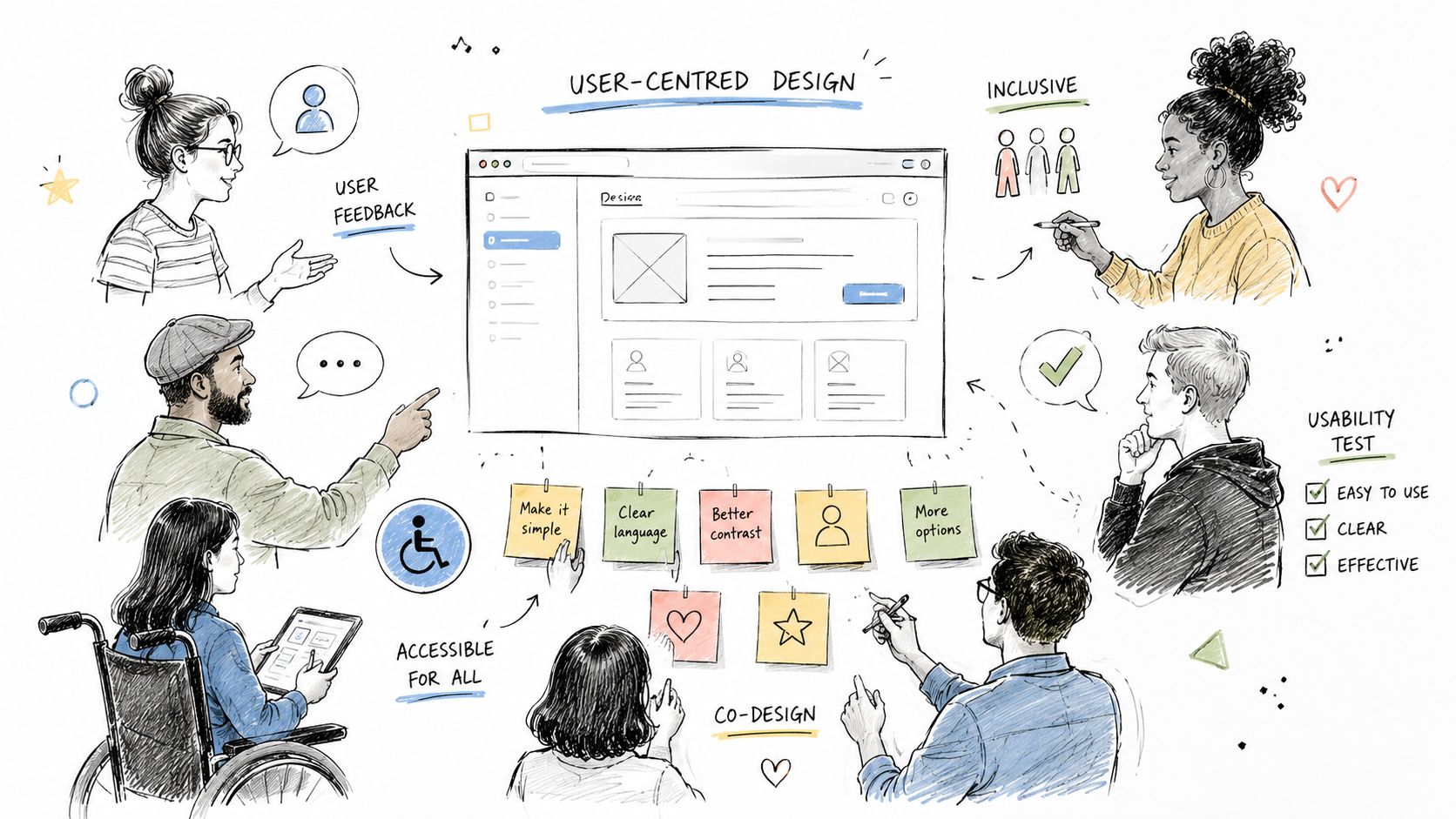
This skill requires more than inviting users to a demonstration. Users need opportunities to shape the workflow, challenge assumptions, test early versions, and explain why a seemingly minor feature matters. A receptionist, caseworker, administrator, or sales coordinator may identify a practical constraint that isn't visible in a process document.
Test behaviour in context
Use real work wherever privacy, security, and governance allow. If you're testing an AI email assistant, use representative enquiries with varied urgency, tone, and missing information. If you're testing a document workflow, include poor scans, unusual formats, duplicates, and exceptions. A smooth demonstration proves very little.
Include people with different levels of technical confidence and different accessibility needs. If the least confident legitimate user can't understand the next step, others may avoid the tool or create unofficial workarounds.
Useful design practices include:
- Recruit representative users: Include someone from each affected role and level, not only enthusiastic managers.
- Observe the workflow: Watch what people do, including where they leave the system and use another tool.
- Prioritise day-one fit: A technically elegant process that doesn't match the workplace will struggle to gain traction.
- Design support into the product: Use clear labels, sensible defaults, contextual help, and useful error messages.
- Pilot before scaling: Test with actual tasks, then revise the build and operating model.
The key trade-off is standardisation versus fit. Standardising processes can improve consistency, but forcing every team into an identical workflow may ignore legitimate differences. For SMEs, a custom build can be more appropriate when the business has a distinctive process or relies on existing systems that an off-the-shelf product doesn't handle well.
InnovaAI's publisher information describes its AI builds as custom solutions designed around how teams work. That principle matters because adoption isn't a reaction to technical quality alone. It reflects whether people can see themselves completing their jobs successfully with the new system.
5. Change Leadership and Visibility Management
AI adoption becomes credible when leaders' actions match their stated priorities. A managing director who approves a project but misses every key review sends a different message from one who asks what is blocked, protects staff time, and decides when priorities conflict.
Leadership visibility should focus on decisions, not supervision. Executives set direction, define acceptable risk, resolve competing priorities, and remove obstacles. The implementation team needs enough authority to solve routine problems without waiting for approval at every stage.
In an SME, commitment can be visible in practical moments: the founder or MD joins the launch meeting, attends an early pilot review, or explains directly how roles will be supported. These actions show whether the initiative is core work or another experiment competing with normal responsibilities.
Leaders need to make five behaviours observable:
- Explain the priority: Link the change to a business problem employees recognise.
- Decide promptly: Prevent unresolved questions from becoming a standing reason to delay.
- Protect capacity: Adjust workloads so implementation does not become unpaid overtime or hidden extra work.
- Acknowledge setbacks: Give honest updates when the rollout is difficult. Credibility grows when leaders describe problems clearly.
- Assign accountability: Name who owns decisions, training, support, and outcome measurement.
Consistency matters more than occasional speeches. If managers ask staff to use the new workflow while senior employees still request the old reports by email, the organisation has created competing systems. Employees will choose the route that appears to carry less immediate risk, especially when performance expectations still favour the old process.
Leaders should also set boundaries around their involvement. Staying close at decisions involving direction, funding, risk, and priority keeps the work moving. Taking over operational choices slows delivery and weakens ownership among the people implementing the change.
The same visibility should continue after launch. Leaders can review adoption evidence, ask which exceptions remain unresolved, and act on recurring barriers. That connects leadership with the wider change system: readiness shapes the plan, users reveal practical impact, and evidence shows whether the new way of working is taking hold.
Leaders create adoption by aligning time, incentives, decisions, and their own behaviour with the new way of working.
6. Learning and Enablement Strategy
Training alone does not change behaviour. Employees can attend a session, complete an exercise, and still return to the old process when an exception appears or a customer is waiting. Enablement must connect learning with the decisions people make during daily work.
Start with the workflows that matter most. Before go-live, run practical sessions using realistic scenarios. An accounts team could classify invoices, handle an ambiguous supplier, correct an extraction error, and route an exception. A professional services team could draft from a realistic client document while practising review and confidentiality requirements.
Build support around those workflows:
- Peer champions: Prepare respected users early so colleagues have nearby help after launch.
- Short job aids: Provide checklists, decision trees, examples, and troubleshooting notes for common tasks.
- Protected time: Schedule learning during working hours. Optional training is easily postponed.
- Follow-up sessions: Revisit the tool after employees have faced real questions and edge cases.
- Usage review: Check confidence and practical use, rather than treating attendance as proof of readiness.
AI enablement also needs clear operating boundaries. Users should know when an output requires verification, what information must not be entered, how to report uncertainty, and who owns the final decision. These rules are easier to apply when they appear inside the job aid and practice scenario, not only in a policy document.
The main trade-off is depth versus disruption. A long course can cover more features, while a smaller programme may establish the few behaviours employees need immediately. Begin with workflows that create clear value, then add capability as users gain confidence and support teams see recurring questions.
InnovaAI Integration Ltd states that its builds include training, workshops, and practical courses. Its AI training and advisory resources suit organisations developing capability alongside software delivery, rather than treating education as a separate purchase.
A law firm introducing AI contract review would need more than a product tour. Lawyers would practise on representative contracts, apply review boundaries, protect confidential information, and confirm who remains accountable for final advice. That approach changes how work is performed, so learning becomes part of adoption rather than a one-time event.
7. Data-Driven Progress Tracking and Adaptive Course Correction
A project can meet its delivery milestones while users avoid the new system. Change leaders need evidence of behaviour, work quality, and business outcomes, not just completed meetings or released features.
Set the intended outcome before choosing measures. Depending on the use case, success may mean fewer manual hand-offs, faster response preparation, clearer workload visibility, more consistent data capture, or less time spent searching for information. Each measure should connect to the reason the organisation approved the change.
Let evidence change the plan
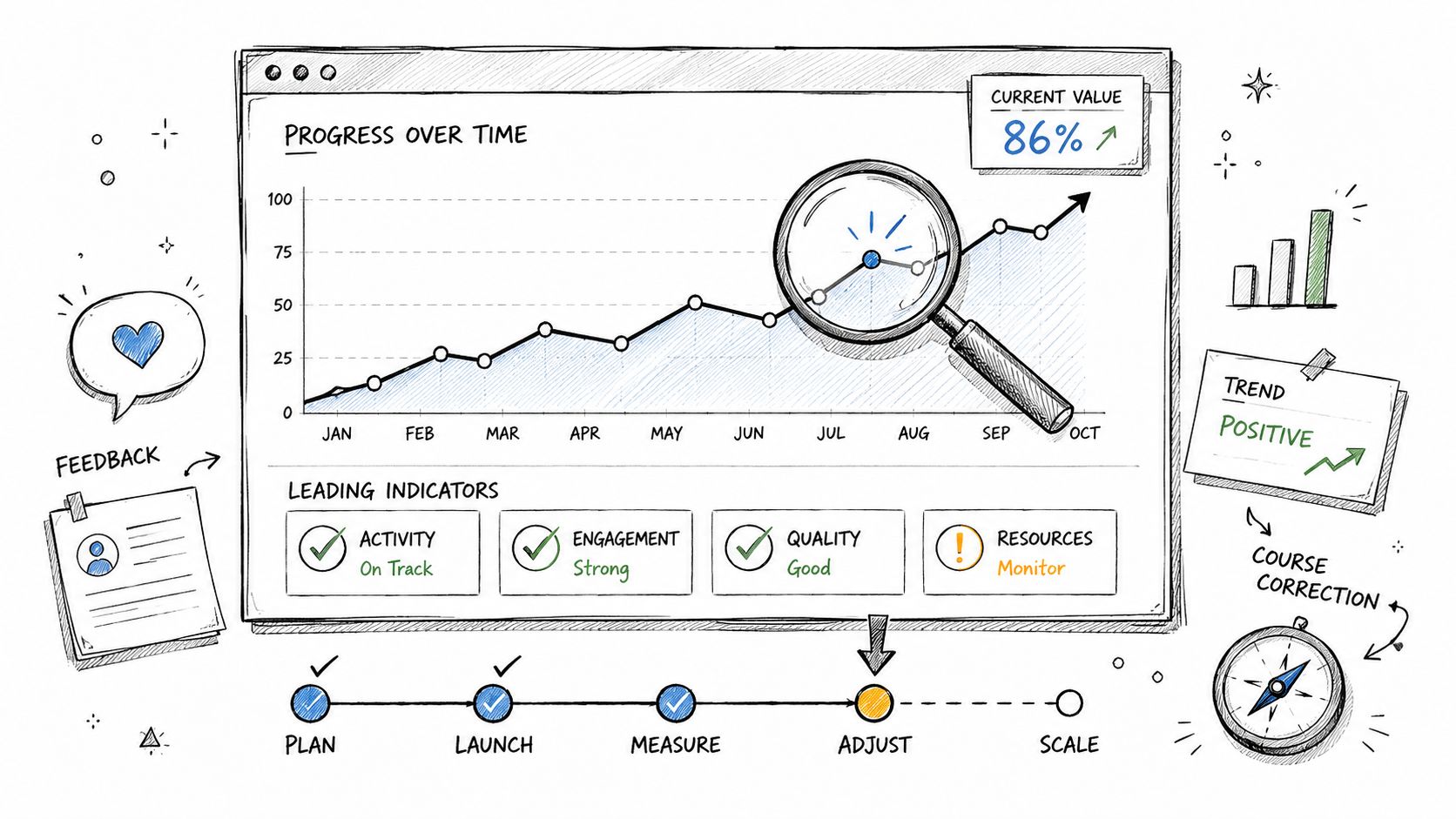
Build a small monitoring set around four questions:
- Is the organisation ready? Check training attendance, access provision, pilot completion, and unresolved support questions.
- Are users adopting the workflow? Review applicable use, repeat usage, completion of the new process, and cases returned to old methods.
- Is the work improving? Examine quality, cycle time, error patterns, staff capacity, customer experience, and management visibility.
- Is risk being controlled? Record incorrect outputs, inappropriate use, privacy concerns, and exceptions without a clear owner.
Increase review frequency after launch, when minor obstacles can become established habits. A weak adoption result needs investigation, not an automatic broadcast email. Speak with users to separate confusion, poor workflow fit, missing permissions, low confidence, and justified risk concerns.
The same figure can require different action. If users cannot find the tool, improve access and navigation. If they distrust its outputs, add examples, review controls, and clearer boundaries. If the tool creates duplicate work, redesign the process instead of blaming users.
A short review cycle should end with a decision: retain the approach, adjust the workflow, provide targeted support, or stop the use case. Record the reason and check whether the next measure improves. This turns progress tracking into an adoption system rather than a reporting exercise.
Measure the behaviour the investment is meant to create, then change the implementation when evidence contradicts your assumptions.
SMEs can use InnovaAI's AI Readiness Scorecard as a starting point for assessing opportunities and baseline costs. Leaders still need to connect each measure to a specific workflow and business outcome.
8. Organisational Culture and Readiness Assessment
AI adoption depends on organisational conditions as much as tool selection. A team that trusts its leaders, has time to learn, and can discuss failed experiments openly will approach a pilot differently from a team worn down by unsupported initiatives or worried that automation decisions are made without its input.
Readiness assessment examines those conditions before the rollout adds pressure. Check employee capacity, manager coaching ability, leadership tolerance for difficult questions, and unresolved frustration from earlier changes. A technically sound implementation can still stall if the operating environment cannot support new behaviours.
Readiness is an operating constraint
Begin with the organisation's recent history. Ask what it has tried, what produced value, what failed, and what support was missing. Repeatedly announced initiatives with little follow-through create a predictable response: employees treat the next launch as a temporary campaign rather than a change to daily work.
Use conversations across levels to test whether the stated culture matches actual behaviour. Leaders may describe the organisation as open to innovation, while frontline employees stay silent because earlier challenges were labelled negative. Both accounts should shape the rollout plan.
A useful review should test five areas:
- Change fatigue: Are teams still absorbing a recent system, restructure, or process redesign?
- Manager capability: Can line managers explain the change, coach users, and address weak adoption?
- Psychological safety: Can people challenge assumptions and report mistakes without fear?
- Trust and transparency: Do employees believe leaders will explain how AI affects their work?
- Pilot conditions: Which team has enough capacity and motivation to test the change properly?
The ONS Management and Expectations Survey's third wave covered about 55,000 businesses between November 2023 and March 2024, providing a broad UK benchmark for considering management practice alongside technology and AI adoption (survey context and management capability discussion). For SMEs, the practical question is not whether culture receives a high score. It is whether managers can coach, teams can coordinate, processes can change, and people have time to support adoption.
UK management capability also requires attention. Job-market evidence on change management roles shows why organisations should define responsibilities and assess available skills before rollout (UK change management vacancy and capability evidence). Managers should not be expected to absorb change duties automatically while maintaining existing workloads. Give them clear messages, coaching guidance, escalation routes, and time with their teams.
Use the assessment to choose the rollout conditions. If readiness is low, sequence preparation before wider deployment. Clarify roles, reduce competing work, train managers, or rebuild trust through a smaller pilot. Readiness is demonstrated by behaviour, not by agreement in a workshop.
8-Point Change Management Skills Comparison
| Item | Implementation Complexity 🔄 | Resource Requirements ⚡ | Expected Outcomes ⭐📊 | Ideal Use Cases 💡 | Key Advantages ⭐ |
|---|---|---|---|---|---|
| Stakeholder Engagement and Communication | 🔄 Medium–High, multi-level coordination and sustained cadence | ⚡ Moderate–High, practitioner time, workshops, ongoing reporting | ⭐📊 Higher adoption, reduced resistance, clearer expectations | Organisations with broad role impact or cross‑functional AI rollouts | Builds buy‑in, surfaces blockers early, accelerates time‑to‑value |
| Emotional Intelligence and Resistance Management | 🔄 Medium, skill- and relationship‑focused, ongoing practice | ⚡ Low–Moderate, trained leaders, time for coaching/1:1s | ⭐📊 Improved psychological safety, lower burnout, converted resistors | SME teams facing job‑security fears or high emotional friction | Validates concerns, preserves morale, enables de‑escalation |
| Change Impact Analysis and Planning | 🔄 High, systems thinking, mapping dependencies, detailed timelines | ⚡ Moderate–High, analysts, stakeholder interviews, mapping tools | ⭐📊 Fewer surprises, realistic budgets/timelines, prioritized scope | Projects with data migrations, process redesigns, cross‑system effects | Prevents rework, clarifies resources, reduces scope creep |
| Inclusive Design and User‑Centred Adoption | 🔄 Medium, iterative user research and testing cycles | ⚡ Moderate, designers, user time, pilot cohorts | ⭐📊 Higher voluntary usage, lower support/training burden, stronger UX | Daily‑use tools, diverse user bases, accessibility‑sensitive solutions | Improves usability, uncovers real needs, creates user advocates |
| Change Leadership and Visibility Management | 🔄 Low–Medium, requires visible executive commitment and decisions | ⚡ Moderate, executive time, governance and escalation paths | ⭐📊 Faster decisions, sustained momentum, clearer organisational priority | SMEs where founder/MD sponsorship determines adoption success | Signals priority, removes blockers, models commitment |
| Learning and Enablement Strategy | 🔄 Medium–High, layered, role‑specific, continuous learning design | ⚡ High, training content, peer champions, ongoing support resources | ⭐📊 Sustained usage, higher competence, reduced support demand | AI tools requiring new skills or changed day‑to‑day workflows | Embeds behaviour change, supports advanced use, builds confidence |
| Data‑Driven Progress Tracking & Adaptive Course Correction | 🔄 Medium, metric design, baselines, review cadence | ⚡ Moderate, analytics, data collection, review forums | ⭐📊 Early detection of issues, evidence for ROI, targeted fixes | Pilots needing scale justification or ambiguous success criteria | Enables evidence‑based pivots, transparent reporting, targeted support |
| Organisational Culture and Readiness Assessment | 🔄 Medium–High, cross‑level diagnostics and readiness scoring | ⚡ Moderate, interviews, surveys, cultural analysis | ⭐📊 Realistic readiness view, tailored sequencing, identified enablers | Organisations with mixed past change outcomes or unknown capacity | Prevents mis‑timed change, informs tailored interventions, reduces risk |
Turn Change Management Skills Into Adoption
These eight change management skills work as a cycle, not a checklist. Assess organisational readiness and the impact on roles and workflows. Engage stakeholders early, listen for emotional and operational resistance, and design the solution with the people who will use it. Leaders then need to stay visible, provide practical enablement, measure real behaviour, and adapt when evidence shows that the original plan doesn't fit.
The cycle matters because AI adoption rarely follows a clean sequence. A pilot may reveal a data problem that changes the impact assessment. A training session may expose a workflow conflict. A manager may report that employees understand the tool but don't have time to use it. Those findings aren't distractions from implementation. They are part of implementation.
UK evidence on digital adoption supports this broader view. Organisations adopting advanced digital technologies report a need for technical capabilities such as digital information literacy and cybersecurity, but also for non-digital capabilities including resource management and social skills (UK evidence on capabilities supporting digital technology adoption). AI adoption therefore depends on how people coordinate work, manage exceptions, communicate decisions, and build confidence, not merely on whether the software functions.
Start with one practical change rather than an organisation-wide ambition. Choose an AI or process improvement opportunity where the current workflow is visible and the pain is understood. Then take four actions:
- Identify the stakeholders: Name the leaders, managers, process owners, users, and support teams affected.
- Map the workflow: Record where information comes from, who makes decisions, where exceptions occur, and what systems are involved.
- Define three outcome measures: Choose measures that show whether the change improves the intended business result, not just whether people attended training.
- Schedule a listening session: Invite representative users before selecting a rollout plan, and ask what would make the change useful, safe, and realistic.
For an SME, an integrated partner can connect these activities. InnovaAI Integration Ltd combines discovery, strategy, bespoke AI builds, dashboards, integrations, advisory, and training for organisations across the UK. That model is relevant when the adoption challenge involves both software design and the way teams need to work around it.
Don't choose an AI tool first and hope change management will repair the rollout. Begin with the workflow, the people, and the outcome. Then select and build technology that earns a place in daily work.
InnovaAI Integration Ltd helps UK SMEs assess AI opportunities, design bespoke agents and automation, build dashboards and internal tools, and train teams to use them in real workflows. Visit InnovaAI Integration Ltd to discuss an AI adoption challenge and plan a practical next step.
Powered by Outrank tool