AI Adoption Training for West Midlands Property Firms
AI adoption trainingUK property SMEsAI trainingWest Midlands

Tuesday morning starts with the shared inbox, not the property system. A tenant's 8pm message is still waiting, a certificate renewal is marked on a wall planner, and someone is checking a spreadsheet because nobody trusts the date in the system.
That isn't usually a people problem. It's a process problem. Information sits across Reapit, Alto, Fixflo, Arthur, Qube, email and local spreadsheets, while each person decides for themselves what to check, what to copy and what needs approval.
Table of Contents
- What AI adoption training actually means for property SMEs
- Why your team needs structured AI training instead of ad hoc experimentation
- How to choose between doing nothing, hiring, switching platforms and structured training
- The practical steps of AI adoption training for letting, block management and serviced accommodation teams
- Measuring what good adoption looks like and how to spot misuse early
- How to evaluate training providers and local options in the West Midlands
- Where to start in your own operation
What AI adoption training actually means for property SMEs
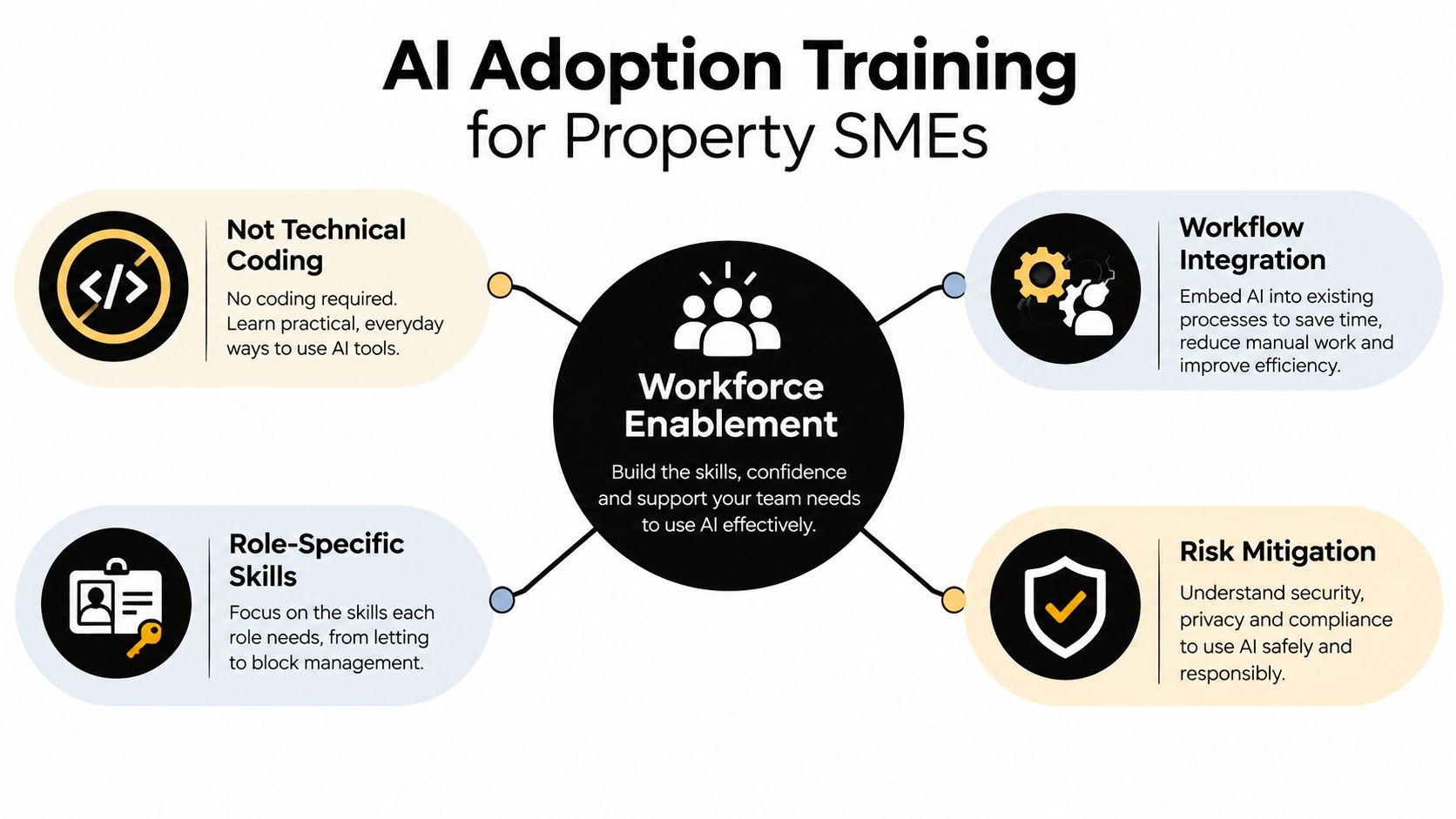
AI adoption training isn't a prompt-writing workshop. It's the practical work of teaching a team how to use AI inside the workflows they already run, without losing ownership of the final decision.
For a lettings team, that might mean sorting a maintenance message from Fixflo, identifying whether it needs an emergency response, and preparing a draft reply. For block management, it could mean finding upcoming certificate renewals, grouping contractor updates or preparing a draft communication about a Section 20 process. For serviced accommodation, it may involve checking booking messages, identifying a turnaround issue and preparing an action for the right person.
The system can prepare, classify and suggest. A named member of staff still checks the output before anything reaches a tenant, landlord, contractor, regulator or client account record.
UK government research found that only 11% of UK employers had arranged AI training for staff during the previous 12 months. That figure rose to 48% among organisations with AI specialists or implementers, showing that training tends to appear after a business has already committed to implementation, rather than before it. The employer survey findings point to a capability gap that matters for property SMEs.
The training should match the role. A property manager needs verification and escalation skills. A maintenance coordinator needs triage rules and contractor hand-offs. A negotiator needs to know which viewing follow-ups can be drafted and which conversations require personal judgement. A director needs visibility over risk, cost and accountability.
The useful question isn't “Who knows how to prompt?” It's “Who owns the next action, and what must they verify first?”
That's workforce enablement. It helps staff use an approved process consistently, rather than giving everyone another tool and hoping good habits appear.
Why your team needs structured AI training instead of ad hoc experimentation
Ad hoc experimentation feels harmless. Someone opens ChatGPT, pastes in a tenant message, gets a reasonable-looking draft and tells a colleague it could be useful. Another person tries a different prompt. A third copies the result into an email without checking the tenancy details.
That creates inconsistency before it creates value. Nobody knows which information can be pasted into a public tool, which wording is approved, who checks the result or where the final record belongs.
The alternatives are understandable:
- Do nothing: You keep the current backlog, manual checks and spreadsheet work. That may be sensible where a process is low-volume, highly judgement-based or already under control.
- Hire a specialist: A specialist can help with technical delivery, but one new hire won't automatically understand tenancy progression, service charges, client money or the way your team operates.
- Switch platforms: Moving from Alto to Reapit, or between property and block-management systems, may address a genuine platform limitation. It won't repair unclear ownership or a broken approval process.
- Give everyone ChatGPT: Useful for isolated drafting and brainstorming, but weak as an operating method. It lacks your role boundaries, record-keeping rules and connection to the systems where the work starts.
UK firms most often report difficulty identifying a practical business use case before they report difficulty with the technology. In 2023, 39% cited difficulty identifying activities or business use cases as a barrier to adoption, compared with 21% citing cost and 16% citing insufficient AI expertise or skills. The Office for National Statistics analysis supports starting with the workflow, not the tool.

Training works when the examples are familiar. Use anonymised tenancy enquiries, inspection notes, contractor updates, arrears chasers and booking messages. Let staff test the output, find the mistakes and correct the process while the trainer is present.
The change management guidance for property teams matters because adoption is a behaviour change. Staff need to know what's changing in their day, what isn't changing, and where they go when the system produces something uncertain.
UK employers report that practical and contextual training matters more than generic instruction. More than half of organisations reported increased productivity and efficiency after training, and training enabled new responsibilities or projects, according to government employer evidence on what works for AI upskilling.
How to choose between doing nothing, hiring, switching platforms and structured training
The right choice depends on the operational constraint. If a team cannot judge whether a repair is urgent, changing platforms will not fix the decision. If certificate renewals are scattered across inboxes and spreadsheets, hiring an AI specialist may cost more than defining one controlled workflow.
Doing nothing can be sensible when a task is occasional, sensitive or already reliable. It becomes costly when one person repeatedly checks the same information, staff absence creates a backlog, or growth requires another salary for work that follows a clear pattern. Keep the process manual where risk is high and volume is low.
Hiring fits when you need lasting technical capability across the business. An independent agency rarely needs a machine-learning department. It may need a person who can connect an approved process to Reapit, Alto or Fixflo, or link block-management work across Arthur and Qube, then train the people using it.
Switching platforms is justified when the current system cannot support a requirement that affects tenancy progression, service charges, maintenance records or certificate renewals. Migration still means checking data, retraining staff and accepting disruption. A cleaner interface will not repair unclear ownership or unreliable records.
Structured training with targeted integration is often the practical middle option. Keep the existing system of record, select a small number of role-specific use cases and define approval before AI-generated messages reach a tenant, landlord, leaseholder, contractor or regulator. Staff should know what AI may draft, what requires human review and what remains manual. As noted earlier, identifying the right business activity is a major adoption barrier, so begin with the work, not the tool.
The practical steps of AI adoption training for letting, block management and serviced accommodation teams
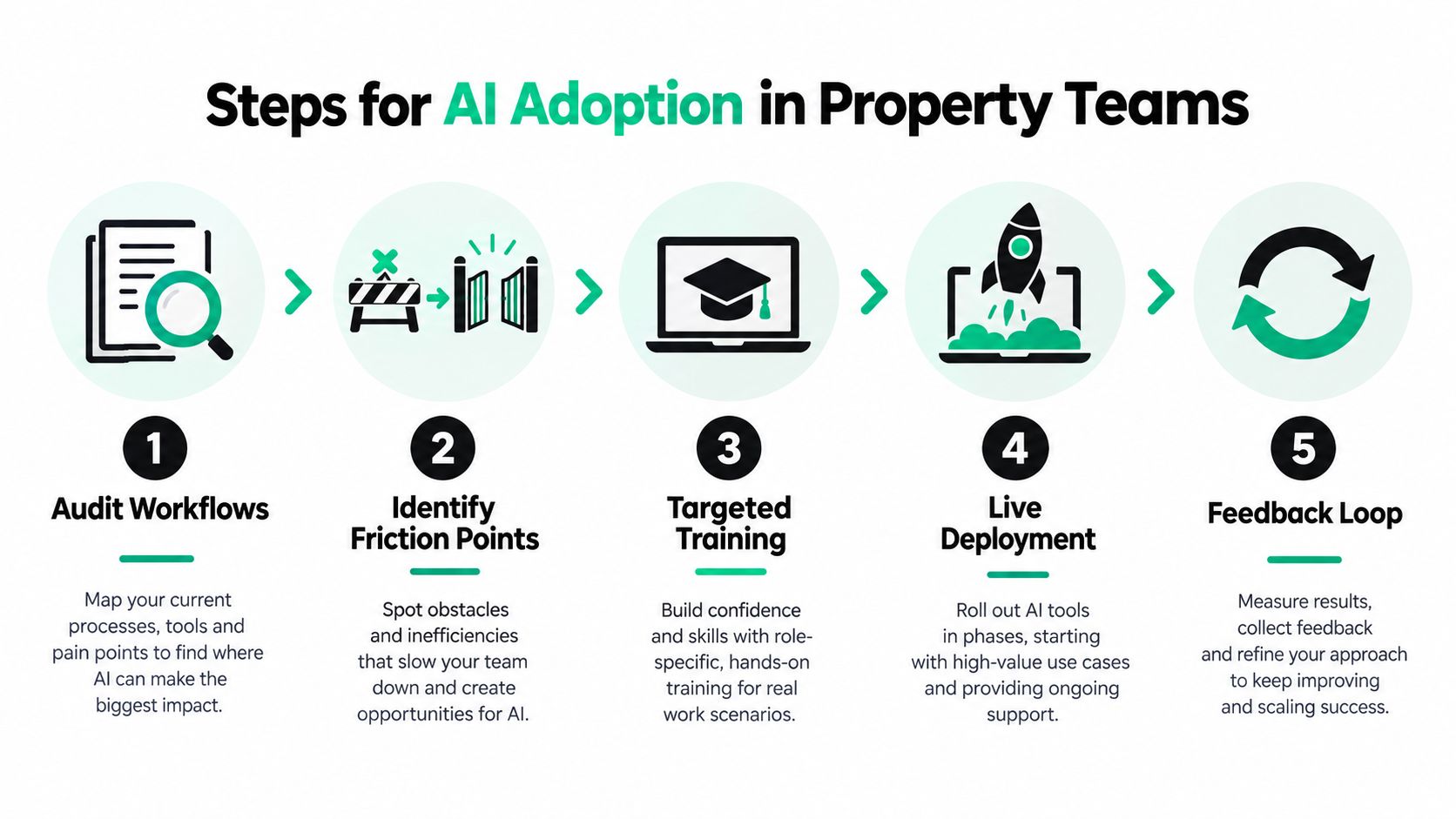
Training should begin before anyone opens a new tool. I'd start by following one process from the first message to the final record, including every spreadsheet, inbox and hand-off.
Audit the work before selecting the use case
Choose a repeated bottleneck. Good candidates include maintenance triage, viewing follow-up, invoice processing, compliance-date monitoring, void coordination and booking-message handling.
Write down who receives the information, who checks it, who decides, who updates the system and who tells the customer. If those roles aren't clear, AI will expose the weakness rather than remove it.
Set the boundary before the exercise
Define what the system may do and what it must never do. It can extract a renewal date, classify an incoming repair or draft a follow-up. It shouldn't decide a legal position, approve expenditure, determine a client-money action or send a compliance statement without review.
For anything sent to a tenant, landlord, leaseholder, contractor or regulator, name the approver. The approval should happen before sending, and the approved version should be retained in the relevant record.
Train against the real work
Use anonymised examples from the actual operation. A letting negotiator should practise with viewing enquiries and tenancy progression messages. A block manager should work with service-charge correspondence, contractor updates and Section 20 administration. A serviced-accommodation team should use booking changes, guest messages and turnaround notes.
The session should include mistakes. Staff need to see how an incomplete inspection note, ambiguous date or missing unit reference affects the result.
Run a small live pilot
Don't roll it across every branch, block or booking channel at once. Test one workflow, one responsible owner and one approval path. Connect the process to the existing platform where appropriate, rather than asking staff to maintain another disconnected queue.
Skills gaps can delay projects and prevent further investment, according to the UK government rapid evidence review. A live pilot helps expose those gaps while the scope is still manageable.
Review and adjust
Measure repeated usage, manual rework, missed hand-offs, error patterns and changes in responsibility. Give staff a route to report bad outputs and unclear instructions. Training shouldn't end when the workshop finishes.
Measuring what good adoption looks like and how to spot misuse early
Usage alone doesn't prove adoption. Someone can generate dozens of drafts and still create more work if every draft needs rewriting or if staff stop checking the details.
Look for behaviours that show the process is working:
- Repeated role-specific use: The maintenance coordinator uses the approved triage workflow, rather than inventing a new prompt each time.
- Consistent verification: The property manager checks names, unit references, dates and proposed actions before approval.
- Cleaner hand-offs: The person receiving the output knows whether to update Fixflo, Reapit, Alto, Arthur or Qube.
- Less rework: Staff correct fewer avoidable omissions in tenancy messages, contractor instructions and renewal records.
- Visible exceptions: Unclear or high-risk cases reach a named senior person instead of being pushed through automatically.
The warning signs are just as useful. An unverified draft reaches a tenant. A staff member bypasses the approval step because it feels slow. A team uses generic prompts for a process that should have defined fields and rules. Initial enthusiasm fades because the system sits outside the working platform.
Recent UK evidence suggests that AI use is spreading faster than structured capability. Many organisations remain at awareness or exploration stages, fewer have reached scaling, and a large share rely on on-the-job training rather than structured education, as reported in the UK insight briefing on AI upskilling.
Governance should be practical. Set rules for personal data, confidential landlord and tenant information, record-keeping and escalation. AI agent governance guidance is useful when a workflow starts taking actions across more than one system.
How to evaluate training providers and local options in the West Midlands
Ask what the provider will connect to. A credible discussion should include your actual stack, whether that's Reapit, Alto, Fixflo, Arthur, Qube, a channel manager or a collection of spreadsheets around the main platform.
Ask where approval happens. If the answer is “the system sends it automatically”, press for detail. Anything reaching a tenant, landlord, leaseholder, contractor or regulator needs a named human check, especially where the message concerns compliance, money, access or a disputed decision.
Good delivery uses your documents, anonymised properly. It should cover tenancy enquiries, inspection notes, service-charge messages, certificate renewals, contractor updates or booking communications, not generic examples from another industry.
Training is more useful when the provider can show you the hand-off, not just the prompt.
Look for support around the build as well as the workshop. UK AI training course guidance should help you test whether a course includes exercises, templates and post-session support rather than ending when the slides finish.
West Midlands delivery can be useful because the provider understands local operating patterns, but geography isn't enough. Whether you run a letting agency, block-management operation or serviced accommodation business, the partner should be able to phase work around inspections, month-end, renewals and busy booking periods.
I'm Cameron Atwal, founder of InnovaAI Integration Ltd in Wolverhampton. I build and connect working systems for property operators, and I run a portfolio myself. I'm not interested in forcing AI into a process where a spreadsheet, a clearer rule or a better use of Reapit, Alto, Fixflo, Arthur or Qube would do the job.
Where to start in your own operation
Start with Tuesday morning. Find the task that repeats, the document that causes the most correction, the approval step that currently lives in someone's memory and the team member who spends the most time handling it.
Then trace the work from the first inbox message to the final update in the system. That will tell you whether you need training, a workflow change, an integration or nothing at all.
InnovaAI Integration Ltd builds and connects practical AI systems around the platforms and processes property teams already use, with training based on real messages, documents and decisions. Visit InnovaAI Integration Ltd for a free discovery call to work out whether it's even a fit, and if it isn't, I'll say so on the call.