AI Agents Governance: A Practical UK Business Guide
ai agents governanceai governance frameworkagentic ai securityuk ai regulationai risk management
ai agents governance has moved from policy decks into production risk. The sharpest UK reality is that 89% of UK and Ireland organisations deploy AI agents, but only 54% have a centralised governance framework with formal oversight (Computer Weekly). That gap matters because an agent doesn't just answer questions, it can browse, send, and act across systems in a chain of steps that your business still owns.
The practical problem in most firms isn't a missing AI policy. It's that nobody can reliably see what the agent did, which system it touched, or when to stop it. A policy document can say “use AI responsibly”, but production control means logs, approvals, action traces, escalation routes, and a way to kill a bad run before it spreads.
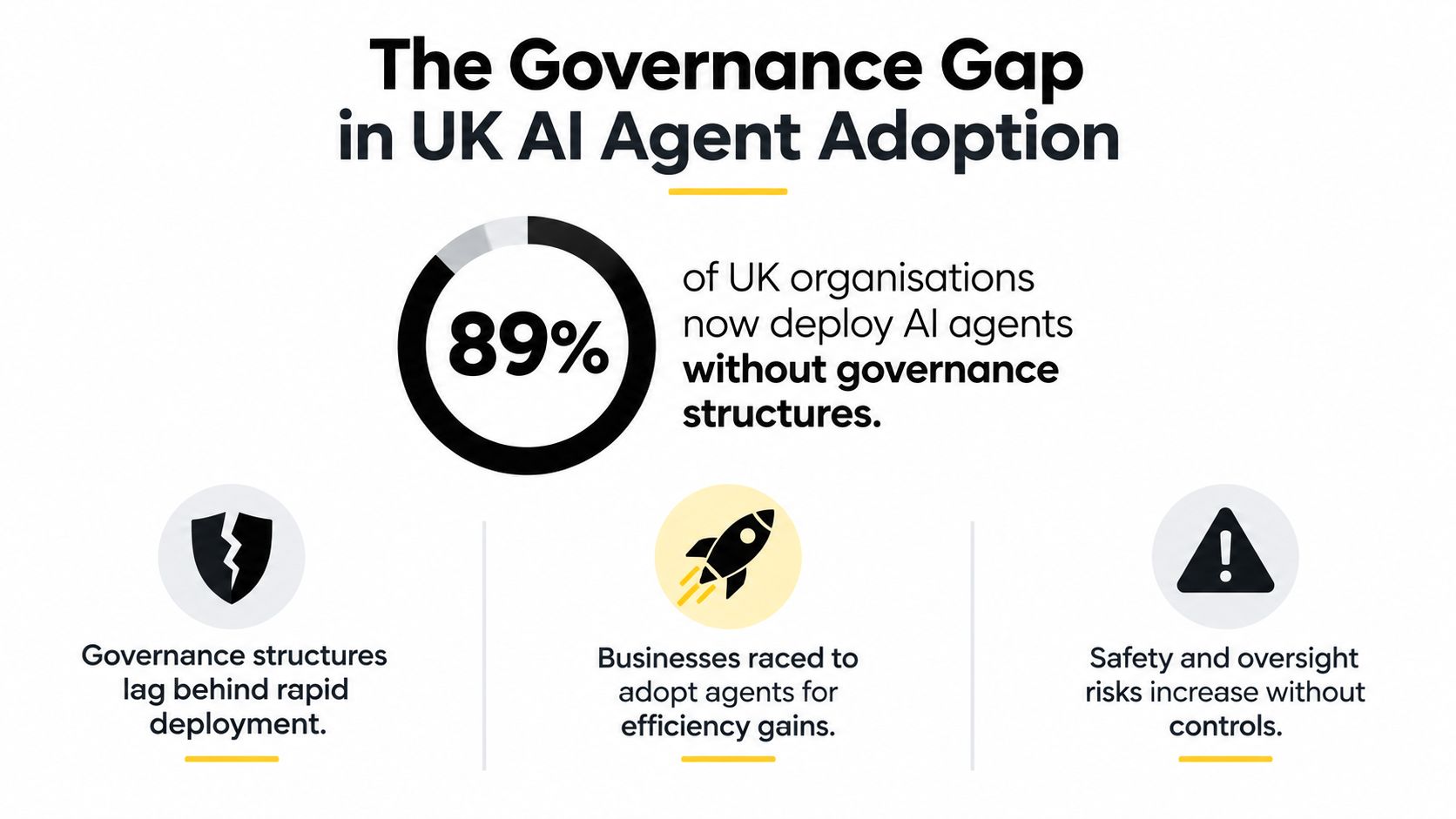
Table of Contents
- The Governance Gap in UK AI Agent Adoption
- What Makes AI Agents Different from Traditional AI Tools
- UK Regulatory Framework for AI Agents
- Building Your AI Agent Governance Framework
- Real-World Governance Scenarios Across Business Functions
- Security Controls and Incident Response for Agentic AI
- Implementing Proportionate Governance for Your Business Size
The Governance Gap in UK AI Agent Adoption
The adoption curve is already ahead of the control curve. Many UK businesses moved into agents because the upside is obvious, fewer manual hand-offs, faster workflows, less repetitive admin, and better availability across customer and internal operations. Governance, by contrast, often arrived as a policy document rather than an operating model.
A policy says the business intends to act carefully. Production governance shows whether the business can do that. In live deployments, the first failure is usually visibility. Teams know the agent exists and can name the use case, but they cannot reliably tell which prompts were used, which tools were called, or why the agent chose one path over another. Monitoring, audit trails, and kill-switch controls are the difference between a managed system and one that can only be reviewed after something goes wrong.
Practical rule: if you can't reconstruct an agent's last meaningful decision chain, you don't have governance yet, you have hope.
The UK guidance makes that operational gap harder to ignore because it defines AI agents as autonomous AI systems that perform multiple sequential steps, including browsing the internet, sending emails, or issuing instructions to equipment (UK government guidance). That matters because the risk sits in the chain, not just the output. A bad step can shape the next step, and the business still owns the result.
The clearest distinction is simple. A policy shows what the company believes. Governance shows what the company can prove.
What Makes AI Agents Different from Traditional AI Tools
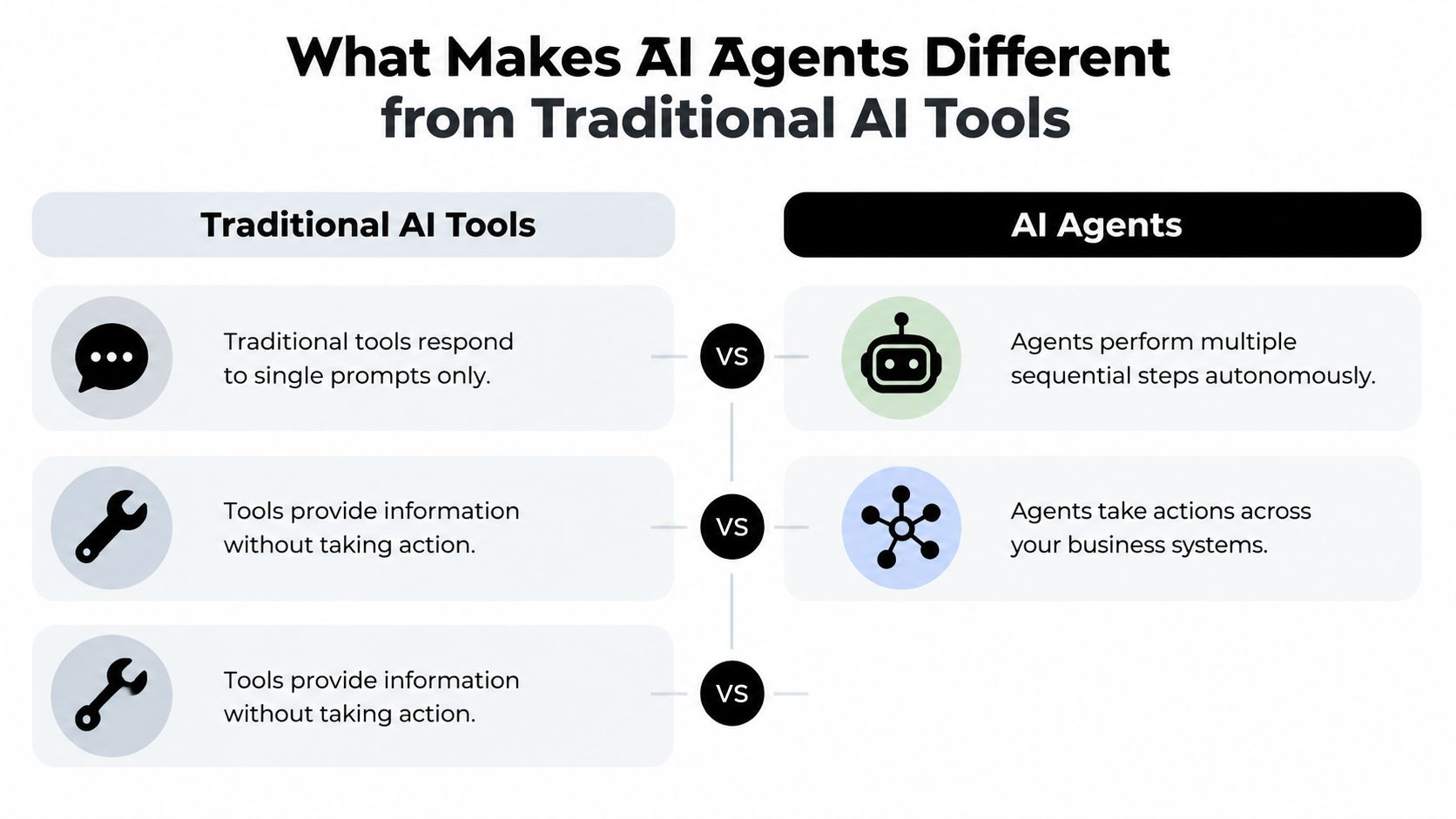
Traditional AI tools usually respond to a prompt, produce an output, and stop. AI agents keep going. They can chain actions together, move between systems, and make decisions that change the state of your business. That autonomy is useful, but it changes the risk profile in ways many teams miss until production exposes it.
Sequential steps are where the risk lives
A chatbot can draft a customer reply. An agent can draft the reply, send it, update the CRM, and trigger a follow-up workflow. That difference looks small in a demo, then becomes decisive in production because every action creates a new operational dependency. If the draft was wrong, the send was wrong too, and the CRM now holds a record your team may rely on later.
The UK government's guidance defines agents as systems that perform multiple sequential steps and may act on things like email or equipment control (UK government guidance PDF). That is the right mental model for governance. You are not approving a suggestion, you are approving a chain of actions that can cross departments, systems, and duties.
Accountability does not disappear just because the tool is autonomous
If an agent sends a customer message, updates a record, or issues an instruction, your business remains accountable for each step. Independence does not move legal or operational responsibility away from the organisation. It makes oversight harder if you have not designed it up front.
An agent should never have more authority than the process owner understands.
Use this split to classify deployments. If the system only recommends, you are in assisted-tool territory. If it can execute, notify, and continue without waiting for a human, you are in governance territory. That difference should drive approval thresholds, logging depth, and how quickly someone can pull the plug when the workflow misbehaves.
UK Regulatory Framework for AI Agents
The UK does not regulate AI agents through a single law. It uses a principles-based regulatory model, where existing regulators apply common duties inside their own sectors. The government's AI Regulation White Paper set out five cross-sector principles in March 2023, safety, security and reliability, transparency and explainability, fairness, accountability and governance, and contestability and redress (UK government guidance).
That matters because there is no single “agent law” to check off. Consumer law, data protection, equality, cyber security, and sector rules still govern the work. The practical question is which duty is triggered by a specific action, and who inside the business owns it.
Sequential steps are what make agents risky
A sales agent, a support agent, and a procurement agent may sit under the same AI policy, but each can trigger different duties in practice. Governance has to follow the workflow, not an abstract label.
The AI Safety Institute, launched on 2 November 2023, was created to provide technical tools for governance and regulation and to make sure developers were not “marking their own homework” on safety (UK government news release). The government later described its role as helping minimise “surprise” from rapid and unexpected advances in AI, while staying non-regulatory. That is a useful signal for businesses. The UK expects evaluation, testing, and coordination, not just paper compliance.
What that means inside your business
Consumer-facing guidance says consumer law applies whether decisions are made by people or AI, so the business remains accountable when an agent acts illegally, even if a third-party system caused the behaviour (DigWatch summary of UK materials). Internal ownership matters for that reason. Every agent should have a named business owner, a technical owner, and a clear escalation path when its actions touch customers, money, or regulated data.
The gap I see in production is simple. Many UK firms have an AI policy, but no live monitoring, no usable audit trail, and no kill switch that someone will use under pressure. That is where governance fails in practice, because the policy exists on paper while the agent is still free to keep acting.
Building Your AI Agent Governance Framework
A workable framework starts with named accountability, not committee theatre. UK guidance says governance should be handled through an AI governance board or equivalent expert oversight to provide accountability, strategic guidance, and informed adoption decisions (UK government guidance PDF). In smaller firms, that can be three people and a standing monthly review, as long as the decisions are real and documented.
Set decision rights before the agent goes live
Define who can approve deployment, who can expand permissions, and who can pause the agent. Then set thresholds by action type. A customer-service agent might be allowed to draft replies, but refunds, goodwill credits, and account closures should sit behind tighter controls. A procurement agent may suggest suppliers, but purchase commitments need a separate approval path.
The governance stack that works in production tends to include four things.
- Action logging: record prompts, tool calls, outputs, and final actions.
- Reasoning traces: capture enough context to explain why the agent chose a route.
- Human checkpoints: require approval for actions with financial, legal, or reputational impact.
- Emergency stop controls: make it possible to disable the agent immediately if behaviour changes.
Use auditability as a business control, not just a compliance artefact
Logs are only useful if someone reviews them. That means you need a weekly or monthly pattern of sampling agent activity, checking for unexpected tool use, and confirming that approvals happened where they should. If you can't show why the agent made a decision, customer disputes become much harder to handle and regulator questions become much harder to answer.
The article on system integration software at InnovaAI Integration's blog is a useful companion piece if your agents need to connect across CRM, finance, and internal workflow tools. Integration is where governance either becomes visible or disappears into a pile of undocumented automations.
Strong governance is boring in the best way. It makes each approval predictable, each escalation visible, and each failure containable.
Real-World Governance Scenarios Across Business Functions
Customer service is often where governance gaps show up first. A support agent may look harmless when it drafts replies, but once it can issue refunds or change account details, the control model has to change. Let the agent triage, draft, and classify, then require human approval for anything that affects money, service commitments, or complaint resolution.
Procurement raises a different risk. An agent can speed up shortlist creation and supplier comparison, but it can also create cost exposure or supplier risk if it is allowed to place orders or commit contract terms. Keep approval in the loop before any purchase order reaches the ERP, because that is a business control, not just a workflow step.
Sales outreach needs tighter review than many teams expect. An agent that drafts emails and sequences follow-ups can save time, but it can also create consent, accuracy, and brand issues if nobody checks the content or the audience list. Keep approval gates tight until the team trusts the agent's tone, targeting, and data hygiene. Exploring the best workflow automation tools can help you see how approval gates and audit trails fit into agent workflows.
The patterns that hold up in production are straightforward.
- Customer service: log every customer-facing message and review exception handling.
- Procurement: cap spend authority and require approval on supplier changes.
- Sales: review templates, audience sources, and opt-out handling before send.
- Operations: monitor scheduling changes and resource updates with rollback in mind.
If an agent can alter a shared system of record, it needs a named owner and a clear rollback path.
The failures I've seen most often are quiet, not dramatic. A team assumes an agent only drafts content, then later finds it has been pushing updates into a connected system. The teams that avoid this start with narrow permissions, visible logging, and a human who knows exactly when the workflow crosses a threshold.
Security Controls and Incident Response for Agentic AI
Agent security starts where permissions start. The NCSC guidance, as reflected in commentary on its agentic AI publication, emphasises least privilege, limited scope, temporary credentials, monitoring, threat modelling, and incident plans, with named individuals accountable (Bratby Law summary of NCSC guidance). That's the right posture because agents that can read personal data and call tools change the security baseline under UK GDPR Article 32.
Bound the agent before it can act
Give the agent access only to the systems it absolutely needs. Keep credentials temporary where possible, and isolate privileged actions from general analysis. If an agent is meant to create draft emails, it shouldn't also have access to unrelated admin controls just because the connector is available.
Threat modelling should focus on how the agent could be nudged into a harmful action. That includes prompt injection, malicious documents, poisoned context, and tool misuse. The important habit is to test the path from prompt to action, not just the model output.
Make incident response operational, not theoretical
You need a kill switch that someone can use fast, and that decision should be assigned to a named person before launch. The response plan should say who gets alerted, what gets suspended first, and how the team checks whether the agent already changed anything downstream. If rollback is possible, define how it works before you need it.
A simple incident workflow usually includes:
- Detect unusual tool calls, outputs, or repeated failures.
- Contain the agent through a kill switch or session revocation.
- Review the action trace and identify affected systems.
- Remediate permissions, prompts, and process gaps.
- Record the incident for future governance review.
Logging matters here because you can't investigate what you didn't capture. If a customer asks why an agent made a certain decision, or a regulator asks how the business handled a failure, your answer needs to come from records, not recollection. That's why observability is part of security, not a separate concern.
Implementing Proportionate Governance for Your Business Size
A lot of UK SMEs have AI policies on paper and still miss the controls that matter in production. The gap is usually not intent, it is operational discipline. If an agent can send an email, update a record, or trigger a payment, governance has to cover the action trail, the approval path, and the ability to stop it quickly.
Most smaller businesses do not need a heavyweight risk office. They do need controls that match what the agent can do. Advice-only tools can sit under lighter review. Agents that execute actions need tighter permissions, real-time monitoring, and a clean shutdown route when something goes wrong.
The recent UK direction on automated decision-making under the Data (Use and Access) Act 2025 and the ICO's updated guidance work both point to the same operational split. Low-risk assistance can be governed lightly. Higher-risk autonomous action needs stronger safeguards, clearer accountability, and evidence you can retrieve later if a customer, auditor, or regulator asks what happened. DigWatch summary of UK materials
Minimum viable governance for a smaller team
Start with the controls that stop avoidable failures.
Log the agent's actions in a form someone can review. Require human approval for anything with financial, customer, or legal impact. Set a review rhythm that does not depend on one busy manager remembering to check the system. If your logs are buried in a tool nobody opens, you do not have governance, you have storage.
The human side matters too. A rollout can fail even when the technical controls are sound if managers keep bypassing the workflow to save time. That is why change management skills are part of agent governance, not a separate training topic. The process has to be understandable enough that people use it under pressure.
Scale only when the risk scales
Start small for a low-risk internal helper. As autonomy increases, add stronger identity checks, better anomaly monitoring, more granular approval paths, and a tested kill switch. That gives you room to grow without importing enterprise bureaucracy before it is justified.
The practical test is simple. If a customer, auditor, or internal manager asks what the agent did, why it did it, and who could stop it, you should be able to answer from records, not memory. If you can do that, the controls fit the business. If you cannot, the policy is still too thin for production.