AI Readiness Assessment for Property Operators
ai readiness assessmentproperty operationsai readinessletting agentsautomation

Tuesday morning starts with thirty unread messages in the shared inbox. One gas certificate has expired, a maintenance photo needs triaging, a landlord wants an update, and an arrears query has been waiting for two days. Somewhere in that queue, a tenant's message from 8pm is still waiting for a person to decide what happens next.
That backlog usually isn't caused by slow staff. It comes from repeated manual triage, copy-paste between Reapit, Alto, Fixflo, Arthur, Qube, email and spreadsheets, plus missing triggers that should tell someone when an item needs attention.
For a property operator, an AI readiness assessment should answer one practical question: which process can be improved safely using the systems you already pay for? It shouldn't produce a maturity badge or push you towards replacing your property platform.
Table of Contents
- Where the Backlog Actually Comes From
- The Four Readiness Checks That Matter
- What a Useful Score Actually Looks Like
- Where Human Approval Has to Stay
- What AI Will Not Fix in Your Operation
- What to Look at First This Week
Where the Backlog Actually Comes From
The expired certificate is a good example. A renewal date might sit in a certificate tracker, while the property record lives in Reapit or Alto and the landlord's contact details sit somewhere else. The team member checking the list has to find the right record, confirm the date, draft a message, attach the relevant information and create a follow-up task.
None of those actions is especially difficult. Together, they create a queue of small decisions that compete with tenancy progression, voids, maintenance and client money work.
The maintenance photo has the same problem. A tenant sends an image through Fixflo or the shared inbox. Someone reads the description, works out whether it's urgent, checks the property history, decides who should attend and then copies the summary into another system. If the issue is unclear, the job waits for a call or another email.
The bottleneck is usually the decision layer between systems and people, not the software itself.
A landlord chasing an update creates another loop. The information may already exist in the property management platform, but nobody has prepared it in a form that can be checked quickly and sent for approval. The arrears query then remains open because a person has to assemble the context before responding.
That's why adding another inbox, chatbot or spreadsheet rarely solves the underlying issue. A useful system would connect to the workflow already running, collect the relevant information, prepare the next action and put a clear approval point in front of the right person.
The first task in a readiness review is therefore not “find an AI use case”. It's to identify where work repeatedly stops.
The Four Readiness Checks That Matter
A useful review looks at data, people, processes and technology. These checks belong to the individual workflow, not to the business in the abstract.
Data has to be usable for the job
Start with the records behind the process. For certificate renewals, that means property addresses, doors, units, blocks, certificate types, expiry dates, responsible contractors, landlord details and tenant contact information.
Ask whether those fields are captured consistently and whether a person or system can query them without opening several files. The UK government's dataset guidance recommends cataloguing data sources, testing quality, accuracy, consistency and timeliness, checking the legal basis and UK GDPR position, then assessing each use case against the available pipelines, metadata and governance controls. It also recommends a structured self-assessment using a 4-point readiness scale across foundational pillars. See the UK government guidance on building AI-ready datasets for the underlying approach.
The issue isn't whether you have plenty of records. It's whether the records needed for one process are complete, accessible and owned.
People decide where the system can act
Someone must own the process and someone must approve anything that reaches a tenant, landlord, contractor or regulator. A draft reply can be prepared automatically, but the property manager still needs to review it before sending.
Look for staff who already review suggested wording comfortably. If the team doesn't trust the draft, the workflow will revert to copy-paste. That's a people problem, not a model problem.
Processes need a repeatable route
Write the steps down as they happen. Don't describe the ideal procedure from an operations manual.
For a renewal, you might find that the process changes depending on the property type, contractor, certificate category or landlord preference. That judgement may be necessary, but it needs to be visible. A system can handle consistent steps and route exceptions to a person. It can't reliably automate a process nobody has agreed.
Technology should expose what you already own
List the systems already being paid for:
- Property platform: Reapit, Alto, Arthur or Qube, and the records it holds.
- Maintenance system: Fixflo or another repair workflow, including photos, descriptions and status changes.
- Communication: shared inboxes, tenant portals, SMS and landlord email.
- Calendar and tasks: renewal dates, inspections, follow-ups and escalation points.
- Accounts: service charges, landlord statements, client money records and reconciliation data.
- Certificate tracker: documents, expiry dates, contractor details and evidence of completion.
Then separate what each tool does from what it can expose through an integration. The system should connect to those platforms rather than replace them.
For gas certificate renewals, all four checks can be assessed together:
| Dimension | Question to answer | Evidence to look for | Readiness signal |
|---|---|---|---|
| Data | Are expiry dates, property details and contacts recorded consistently? | Structured fields, current documents and clear ownership | Green when the renewal record can be found and checked without manual searching |
| People | Who reviews the draft and confirms the certificate? | Named approver and an agreed escalation route | Green when approval happens as part of the workflow |
| Process | Do renewals follow the same route with exceptions identified? | Written steps, deadlines and escalation rules | Green when routine work follows a repeatable path |
| Technology | Can the existing tracker and property platform share the required information? | Available exports, integrations or controlled access | Green when the workflow can connect to existing records |
The wider UK picture supports this process-specific view. Government research found that around 15% of all UK businesses, equal to about 432,000 companies, had adopted at least one AI technology, with adoption at 68% of large firms, 34% of medium-sized firms and 15% of small firms. The same research recorded 2% actively piloting AI and 10% planning future adoption, so readiness includes the pipeline as well as current use. Those figures are reported in the UK government's AI activity in UK businesses research.
What a Useful Score Actually Looks Like
A readiness score should help you choose the next process to improve. It isn't a certificate saying the whole agency is ready for AI.
A generic maturity model might label a business as foundational, operational or advanced. That can sound tidy, but it often leaves the owner with no decision about certificate renewals, maintenance triage or landlord updates.
A process-by-process score is more useful. Put each process in a short list and mark data, people, process and technology as green, amber or red. Add one recommended next step to each row.
For example, maintenance triage might have green technology because Fixflo already captures the request, amber data because property history is incomplete, green people because a manager reviews every job, and red process because urgent repairs aren't classified consistently. The next step is then clear. Define the categories and escalation route before building anything.
Don't score the entire business at once. A single organisational score hides the difference between a clean certificate workflow and a fragmented arrears process. Don't score from gut feel either. Compare what the team assumes with what is documented and visible in the systems.
You can use this AI readiness scorecard for property operations as a working tool, then discuss the result with the people who handle the process daily. It should guide a conversation, not become a report that sits in a folder.
Where Human Approval Has to Stay
Any system that touches a tenant, landlord or regulator needs a named human approval step. That isn't a brake on automation. It's the audit trail that protects the business when someone challenges a decision or a message.
Take certificate renewals. A system can flag that a Gas Safety certificate expires in 21 days, draft a reminder to the contractor and prepare the renewal pack. A named person still has to confirm that the certificate is valid before it goes to the landlord or tenant.
Maintenance triage follows the same rule. The assistant can read the tenant's description, classify the issue as urgent or routine and suggest the next action. A manager should decide whether to instruct a contractor where the job involves a significant spend, uncertainty or risk.
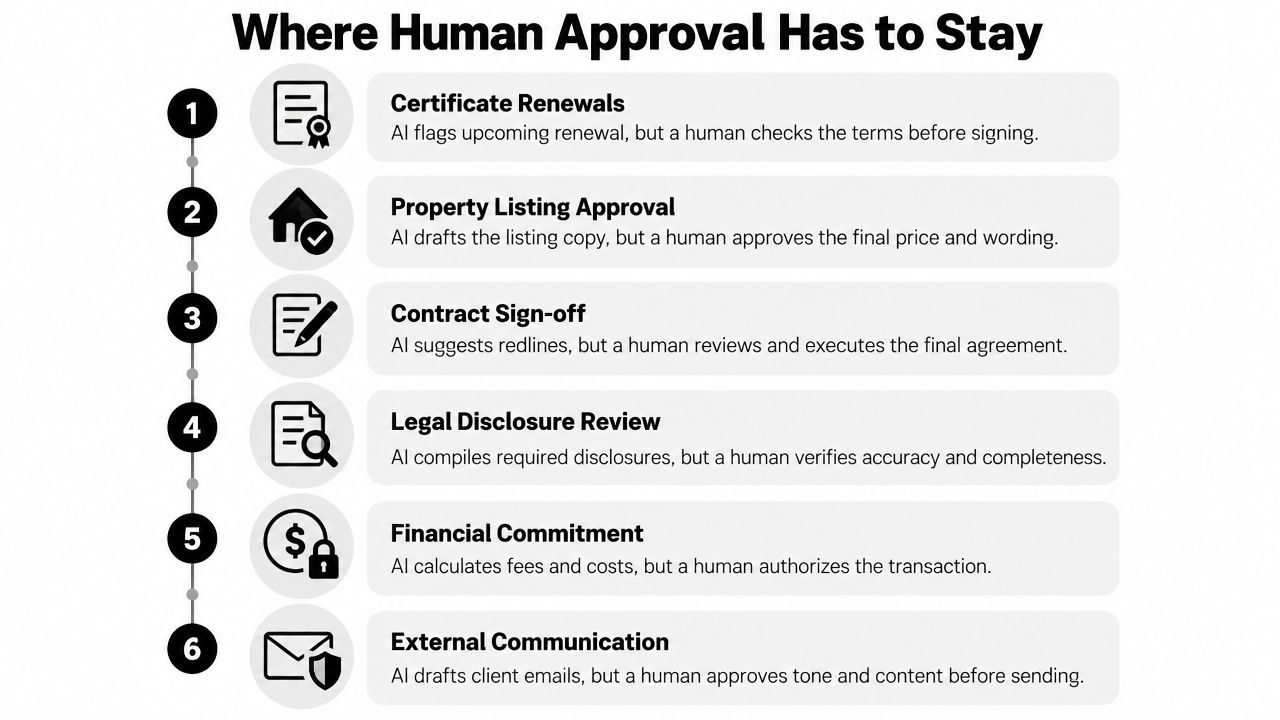
Keep approval points explicit for:
- Deposit release: A person checks deductions, evidence and the proposed outcome.
- Rent arrears letters: A person confirms the account position and wording before sending.
- Right to Rent checks: A person verifies the evidence and follows the approved procedure.
- Legal or regulatory communication: A person reviews anything referring to a court, solicitor, regulator or statutory requirement.
- Contractor instruction: A person confirms the scope, authority and financial commitment.
- Landlord and tenant messages: A person approves the final content before delivery.
The ICO says organisations should use appropriate and proportionate technical and organisational measures to manage risks created by AI processing, as reflected in its guidance on AI and data protection. The ICO also says that guidance is under review following amendments made by the Data (Use and Access) Act, so your compliance assumptions need a current check. A solicitor or compliance adviser should confirm how the relevant requirements apply to your operation.
A system can prepare work. It shouldn't make legal, financial or compliance decisions.
For practical implementation, see these change management strategies for introducing workflow changes. The approval route has to be understood before the automation is switched on.
What AI Will Not Fix in Your Operation
A clean readiness review will mark some processes do not automate. That's a useful result.
Don't use a system to interpret tenancy agreements where a misread clause could expose the business to a claim. Don't automate the wording or timing of statutory notices such as Section 21 or Section 8. Those decisions depend on the facts, current law and case law, so a solicitor or compliance adviser should confirm the position.
Disputes heading towards litigation also belong with a person and the appropriate professional advice. The system can organise documents and produce a chronology, but it shouldn't decide the legal position or send a final response.
Some work looks repetitive but relies on judgement built over years:
- Rent negotiations: A long-standing tenant's history and circumstances matter.
- Complaint escalation: The right response depends on risk, tone and relationship.
- Contractor selection: A sensitive job may require experience that isn't captured in a database.
- Agreement interpretation: The cost of a confident but wrong answer sits with the operator.
The issue isn't that AI can never assist with these tasks. Your licence, insurance and reputation are tied to the outcome. The right system may prepare information for review, but the decision stays human-led.
A clean readiness assessment says no as clearly as it says yes.
What to Look at First This Week
Pick one recurring process and score it before touching anything else. Start with the workflow that consumes the most staff attention, such as chasing certificates, logging maintenance calls or reconciling landlord statements.
Use four checks:
- Data: Is the information in one place, or does someone search across Reapit, Alto, Fixflo, Arthur, Qube, email and spreadsheets?
- People: Does everyone know who reviews the draft and who owns the exception?
- Process: Are the steps written down, including the points where judgement interrupts the normal route?
- Technology: Can the system holding the data expose what's needed through an existing integration or controlled export?
A practical first week is enough to expose the gap. On Monday, choose the process. On Tuesday, write the steps on paper. On Wednesday, identify which system holds each piece of data. On Thursday, mark every approval point. On Friday, choose one small automation to trial, with a human reviewing every output.
Track the baseline alongside the workflow rather than guessing at benefits. An operational KPI dashboard for property teams can help you see whether the queue, exceptions and approvals are changing.
The right starting point isn't the most impressive use of AI. It's the process where the data is accessible, the route is repeatable and one person can approve the result.
I build custom systems that connect to the platforms property operators already run, including workflow automation, dashboards and approval-led AI tools. Visit InnovaAI Integration Ltd for a free discovery call to work out whether your process is a fit, and if it isn't, I'll say so on the call.