Letting Agency Software UK: A Buyer's Guide for SME Owners
letting agency software ukuk letting softwareagency compliance softwareai for letting agentssme property software
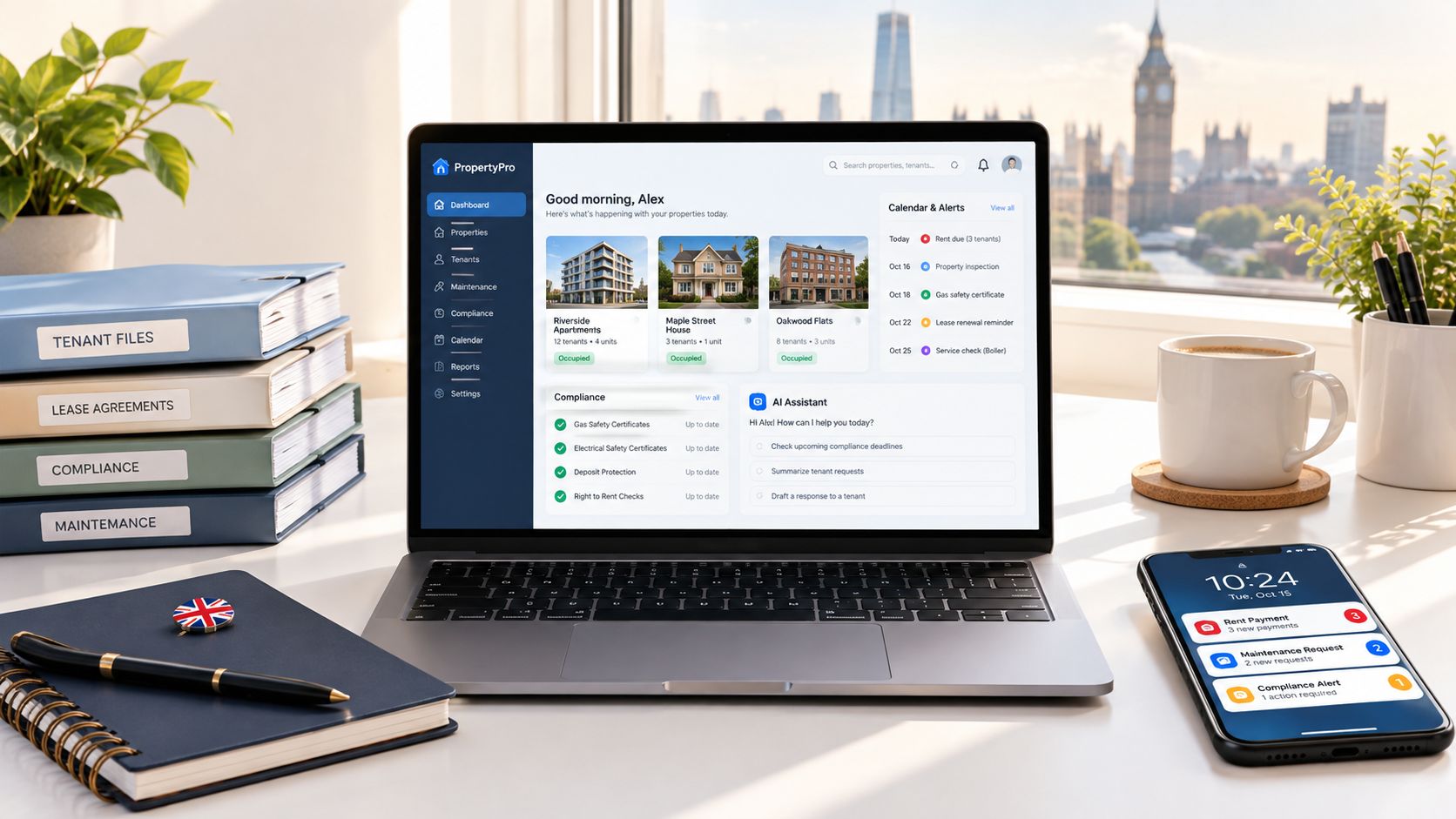
Tuesday starts with the shared inbox already full. The gas certificate nobody chased was due last week, and the tenant message sent at 8pm is still unread at half past nine.
That scene usually gets blamed on staff effort. In practice, the cause sits lower down. Reapit, Alto, Fixflo, Arthur or Qube may each handle part of the operation, but a spreadsheet holds the exceptions, a wall planner carries certificate dates, and someone still has to copy information from one place to another.
Tuesday Morning for an SME Letting Agency
The problem isn't that your property manager doesn't care. They are moving between tenancy progression, maintenance, landlord updates, arrears, renewals and new instructions. Each hand-off creates another opportunity for a date, message or document to disappear.
A tenant reports a leak through one channel. The maintenance team sees it in Fixflo. The property manager checks the tenancy in Arthur or Qube. The landlord wants an update by email. If those records don't share a reliable property and tenancy identifier, the team spends time matching the case rather than progressing it.
The same issue appears in compliance. A certificate is uploaded, but the expiry date isn't connected to a reminder. A reminder is created, but nobody owns the escalation. A task is marked complete, but there is no clear record showing who checked the evidence and when.
Table of Contents
- Where the hand-offs create the backlog
- The tenancy lifecycle in working order
- The SME test
- What not to automate
- Build a compliance operating model
Where the hand-offs create the backlog
A typical tenancy journey crosses several operational stages:
- Instruction and marketing: Property details are entered, amended and published.
- Applicant onboarding: Enquiries, viewing requests and documents arrive through different channels.
- Tenancy progression: Referencing, Right to Rent, deposits, agreements and move-in tasks need a clear sequence.
- Property management: Repairs, rent, renewals, inspections and landlord reporting continue after move-in.
- Tenancy ending: Notice, possession, check-out, deposit deductions and re-letting create another cluster of deadlines.
A platform can contain every one of those modules and still leave the owner with a fragmented operation. The question is whether the same property, landlord, tenant and tenancy record drives each stage.
Practical rule: If a member of staff has to re-key the same fact, copy it into a spreadsheet or search three systems to confirm its status, the process isn't connected enough.
The cost is mechanical rather than dramatic. Staff wait for missing information, then chase it. Managers review work that should have been visible earlier. Landlords receive updates assembled manually. Tenants wait because the message is sitting in an inbox that isn't linked to the repair, tenancy or escalation rule.
That also makes growth expensive. Taking on more doors adds volume to every hand-off. Hiring another coordinator may clear some tasks, but it won't remove the duplicate records, unclear ownership or missing audit trail. Switching platform may help if the current system cannot support the operation, but migration alone doesn't redesign the process around it.
This is the starting point for evaluating letting agency software UK. Don't begin with the feature list. Begin with the case that goes wrong on a Tuesday and trace every person, system, document and decision involved.
What a Connected System Actually Does
A connected system doesn't remove the property manager. It gives them a reliable sequence, shared records and controlled exceptions.
The useful distinction is between deterministic automation and assistive generation. A deterministic rule can calculate a rent schedule, flag a certificate expiry, route a repair by severity or remind someone about deposit protection. A generative tool can summarise an email chain or draft a reply. The first should run predictably. The second must be reviewed before anyone relies on it.
The principles of system integration for property operations are straightforward. Connect the systems you already use, give each record a consistent identifier, and make the hand-offs visible.
The tenancy lifecycle in working order
A practical flow looks like this:
- Instruction to marketing: The system takes the approved property record and passes agreed details to the relevant marketing channels. A person approves material information and the final listing before publication.
- Applicant to application: Enquiries and viewing requests are classified and attached to the correct property. Staff review the applicant's circumstances and decide what happens next.
- Referencing and Right to Rent: Documents, checks and outcomes are stored against the applicant and tenancy. A human reviews unusual, incomplete or adverse results and makes the decision. The system must not turn an opaque score into an automatic refusal.
- Tenancy setup: Once approved, the workflow creates the tenancy tasks, agreement pack, deposit protection reminder and move-in checklist. A person confirms the terms before they reach the tenant or landlord.
- Compliance events: Gas safety, EPC, electrical and licensing records carry dates, evidence and escalation rules. The system reminds the named owner, but a person checks the certificate and signs off the task.
- Maintenance triage: Incoming descriptions and images can be classified as critical, urgent or routine. The coordinator confirms the severity, contractor and tenant message before dispatch.
- Rent and client accounting: Rent schedules, arrears prompts, repair transactions and landlord statements use the same identifiers. A finance team member reviews exceptions and reconciles the output.
- Renewal and tenancy ending: The system surfaces upcoming decisions, gathers the required records and prepares drafts. A qualified person approves any notice, rent communication, possession action or regulator-facing document.
Many advertised AI features get the emphasis wrong. Drafting a reply is useful. Sending a rent increase, possession message or compliance response without review isn't a safe operating model.
A good system should show the source data used for a draft, the person who approved it, the final version sent and the time of approval. It should also preserve the original record when somebody changes a status or overrides a recommendation.
The right automation shortens the route to a decision. It doesn't decide who carries legal responsibility.
Comparing UK Letting Agency Platforms
Reapit, Alto, Fixflo, Arthur and Qube can all make sense in different operating models. The sensible choice depends on your portfolio, property-management depth, accounting requirements, existing integrations and the quality of the data already held.
The weak comparison is a long list of modules. The useful comparison asks whether the platform can act as the operational record, whether other systems can read and update it, and whether your team can prove what happened after an exception.
The SME test
| Platform | Core strength | Best fit | Integration posture |
|---|---|---|---|
| Reapit | Broad agency CRM and property workflow capability | Agencies wanting a substantial central platform across sales and lettings | Assess available APIs, permissions and the exact records exposed before building around it |
| Alto | Agency workflow and property-management operations | Independent agencies seeking a recognised platform for day-to-day lettings work | Test how data moves into maintenance, communications, accounting and bespoke workflows |
| Fixflo | Repairs reporting, routing and maintenance visibility | Agencies with a high volume of maintenance cases or contractor coordination | Strongest where repair data connects back to the tenancy and property record rather than sitting separately |
| Arthur | Property-management operations and portfolio control | Managed portfolios needing structured tenancy and landlord processes | Confirm which events can trigger external actions and how audit records are exported |
| Qube | Property and block-management administration | Businesses managing blocks, units, service charges and related records | Check connections between units, leases, repairs, client money and landlord or freeholder reporting |
The table isn't a ranking. It is a prompt for a live test. Take one anonymised case from offer accepted to move-in and ask the vendor to show every status change, document, reminder, message and approval.
Then test a maintenance case. Can the repair be linked to the correct unit, tenancy, contractor, landlord and transaction without copying identifiers? If a manager overrides the suggested urgency, is the reason retained?
For agencies managing blocks or service charges, the test needs to include units, leaseholders, contractors, budgets and Section 20 records. A general lettings CRM may not provide the depth required. If block management is your core operation, the block management service context should shape the evaluation rather than being treated as an add-on.
API access matters, but an API badge isn't enough. Ask for documentation, rate limits, webhook behaviour, authentication, error handling, sandbox access and data-export formats. A bespoke workflow built on a narrow or unstable interface can create another fragile dependency.
The right platform is the one that reduces hand-offs in your operation. It might be the system you already have, with better connections around it. It might be a replacement where the current data model cannot support your work. Don't pay for migration before proving which problem migration will solve.
What Bespoke AI and Automation Are Actually Good For
AI earns its place when it handles volume, finds patterns and prepares work for a named person. It doesn't earn its place by making a risky decision look modern.
A maintenance message is a good example. A system can read the tenant's description, identify likely severity, find the property and tenancy, check relevant notes, and prepare a suggested acknowledgement. The property manager confirms the classification, contractor and wording before anything is sent.
The same approach works for:
- Long email chains: Summarise the history, outstanding questions and promised actions for a handover.
- Document classification: Identify whether an upload appears to be a gas certificate, EPC, insurance document or tenancy file, then ask staff to confirm the classification.
- Certificate monitoring: Extract dates, link evidence to the correct property and create deterministic reminders.
- Arrears surfacing: Highlight cases that need attention, without deciding what legal or contractual action follows.
- Tenant enquiries: Draft replies from approved information, with a person checking tone, accuracy and any financial or legal wording.
- Landlord reporting: Assemble a draft update from repairs, rent and compliance records, then require approval before delivery.
The human approval point isn't a disclaimer added at the end. It belongs in the workflow design. Every message reaching a tenant or landlord, and every document reaching a regulator, needs an accountable reviewer.
What not to automate
Automated tenant referencing needs particular care. Research into England's private rented sector found that approximately 82% of 113 surveyed landlords used referencing firms, directly or through agents, and examined the bias and liability risks created by API-connected referencing services in its academic study of tenant verification and algorithmic decision-making.
A score can be evidence. It shouldn't become an unexplained decision. Your process needs a route for disputed information, manual review, adverse decisions, restricted access to sensitive documents, retention controls and an audit export.
I wouldn't let ChatGPT loose on a tenant inbox. It doesn't know which version of a policy applies, whether a landlord has approved a concession, or whether a sentence creates an unintended commitment. A connected tool can use your approved data and retain a review trail. A standalone chat window usually can't.
Doing nothing leaves the hand-offs in place. Hiring adds capacity but often preserves the same process. Switching platform may be justified, but only where the current system is the constraint. Bespoke work on top of Reapit, Alto, Fixflo, Arthur or Qube is often the better fit when the records are usable but the connections are missing.
InnovaAI Integration Ltd builds those connections, alongside custom agents, dashboards and internal tools, with training for the people who use them. The point isn't to replace your platform. It's to make the existing operation easier to control.
The Real Test Is Proving Compliance When Things Change
A compliance module is not proof of compliance. Proof means you can show the obligation, owner, evidence, deadline, escalation and final decision without reconstructing the story from inboxes.
For an England-based agent holding client money, membership of a government-approved client money protection scheme is required. The rules cover money held for landlords or tenants, and non-compliance can lead to a fine of up to £30,000. The agent also needs an authorised bank or building society arrangement, a membership certificate, and public display of that certificate. The government guidance on client money protection for property agents sets out the requirement and notes that Scotland, Wales and Northern Ireland have separate arrangements.
Software can remind you when a certificate needs attention and store the supporting evidence. It can't decide whether a particular document satisfies your obligations. A person must own the check.
Build a compliance operating model
For each obligation, record:
- Owner: The person accountable for action, not merely the team receiving an alert.
- Trigger: A tenancy event, certificate upload, expiry date, inspection result or payment.
- Evidence standard: The document, timestamp, approval or communication that proves completion.
- Deadline: The date by which the task must be finished.
- Escalation route: What happens when the owner misses the task or the evidence fails review.
- Landlord-facing report: What the client receives and how the agency can reproduce it later.
This matters as tenancy rules and agency processes change. The Renters' Rights Act is pushing agencies towards periodic tenancy models, Section 13 rent-increase processes and evidenced Section 8 possession grounds. The operational effect is a need for configurable workflows, not a fixed checklist built around older assumptions.
Referencing belongs in the same model. A person should be able to see the source data, recommendation, challenge, override and final decision. That record protects the tenant's right to have an error considered and gives the agency something coherent to review if a complaint follows.
Repairs need the same discipline. The Royal Borough of Kensington and Chelsea's published 2025 to 2030 repairs policy uses different targets for critical emergencies, urgent issues, routine repairs and planned work, including attendance targeted within four hours for critical emergencies, 24 hours for urgent issues, five days for routine repairs and 90 days for planned work in its repairs policy. The practical lesson is severity-based triage, deadline calculation, escalation and evidence of every contact. Your own policy and adviser should confirm the targets that apply to your operation.
The SME Procurement Checklist
Take this checklist into a vendor demonstration. Don't accept a yes from a salesperson. Ask them to show the record, the trigger, the approval and the export.
Can one record drive the whole tenancy?
Test a single property, tenant and tenancy from offer accepted to move-in, then through maintenance, rent, renewal and ending. Count every manual re-keying step. If a property reference changes between systems, ask how the connection prevents duplicate records.
Do rules handle predictable work?
Look for deterministic controls covering certificate expiry, deposit reminders, rent schedules, maintenance severity and bank reconciliation. Ask what happens when a date changes, a document is rejected or a task passes its escalation point.
Can the platform connect cleanly?
Request API documentation, limits, permissions, error handling, webhooks and export formats. Check whether the vendor supports read and write access where you need it, rather than offering a one-way report feed.
Is the audit trail usable?
Ask to see the history for a Right to Rent check, certificate approval, tenant message and landlord statement. The record should identify source data, changes, reviewer, approval and final output.
Does a person approve external communication?
Any message to a tenant, landlord or regulator should have a named reviewer. Ask whether generated drafts retain the source fields used, the reviewer, the approval time and the exact version sent.
Can the system cope with change?
Use anonymised cases covering arrears, repairs, renewals, compliance expiry and tenancy endings. Measure exception rates, audit completeness and the work still requiring manual handling. A good proof of concept exposes the awkward cases instead of hiding them.
What does implementation include?
Ask about training, data mapping, user permissions, support, fixed-price scope and payment terms. References should come from agencies with a similar mix of managed doors, blocks, units, bookings or client-money responsibilities.
The 2025 letting-industry survey reported that 22% of agencies used AI in daily operations and 47% were experimenting with it, while 52% prioritised improving compliance and 44% prioritised reducing administrative time in the industry report. Those figures show interest, not proof that a particular product will work for your team.
Use a system integration software checklist to keep the conversation focused on data movement and ownership. A solicitor or compliance adviser should confirm how each legal obligation applies to your specific operation.
What to Look at First in Your Own Operation
Pick the process with the most hand-offs, usually tenancy progression, maintenance triage or compliance renewal. Count the people, tools, spreadsheets, approvals and repeated entries involved, then use that case to test whether your existing platform needs better connections or replacement.
Doing nothing leaves another salary line to absorb the same backlog. Hiring adds hands without removing the hand-offs, switching platform is rarely the lever by itself, and ChatGPT alone won't connect your records. A quick self-serve read of where the biggest gains may sit is available through the AI Readiness Scorecard.
InnovaAI Integration Ltd builds bespoke AI agents, workflow automation, dashboards and integrations around platforms such as Reapit, Alto, Fixflo, Arthur and Qube, with human approval and training built into the process. Visit InnovaAI Integration Ltd for a free discovery call to work out whether it fits your operation, and if it isn't a fit, I'll say so on the call.