What Is System Integration: A Property Stack Guide
system integrationproperty softwareworkforce automationdigital transformationproperty technology

System integration connects separate property platforms so they exchange data automatically while people stay in control of tenant-facing outputs, a capability sitting inside a UK market valued at $29.737 billion in 2025. In practical terms, it joins the systems behind your doors, units, bookings and compliance work without requiring you to replace the platforms your team already knows.
It's Tuesday morning. A tenant's message arrived at 8pm and is still waiting for a reply. A gas certificate renewal is marked on the wall planner, while the team checks a spreadsheet alongside Reapit or Qube. Someone is copying maintenance details from Fixflo into another system because the two platforms don't share the same record.
That isn't a staff motivation problem. It's a process problem. Every manual handoff creates another place for information to be delayed, copied incorrectly or missed altogether.
Table of Contents
- The Tuesday Morning That Started This Question
- What System Integration Actually Means
- How Integration Works Step by Step
- Integration Versus the Alternatives
- Why Property Operators Choose Integration
- What Integration Does Not Fix
- Where to Start in Your Own Operation
The Tuesday Morning That Started This Question
In a property business managing 400+ doors, small gaps become part of the daily operating model. A new tenancy progresses in one system, the contractor sees a different version of the instruction, and the landlord receives an update only after somebody has gathered the details by hand.
The same pattern appears in block management. A Section 20 notice, service charge record or certificate renewal may be stored in separate places, with ownership depending on who remembers to check which screen. In serviced accommodation, a booking can sit in a channel manager while turnaround information, guest messages and maintenance tasks move through email, spreadsheets and phones.
The operational risk isn't the number of platforms. It's the number of manual decisions required to move one piece of information between them.
Each handoff adds friction. Someone must recognise the event, find the right record, copy the relevant fields, decide what happens next and remember to update the other system. If that person is busy with a viewing, a difficult landlord call or a contractor issue, the process waits.
That delay has a mechanical cost. A tenant waits longer for an answer. A maintenance issue remains untriaged. A renewal is noticed late. A manager spends time checking whether work happened instead of dealing with exceptions.
System integration removes those repeated transfers. It can detect a new Fixflo request, match it to the correct property record, prepare a triage summary and place the next action in the right workflow. A person still approves anything sent to a tenant, landlord or regulator.
This is how an owner can consider taking on another hundred doors without assuming the only answer is another administrator. The point isn't to remove judgement. It's to reserve human attention for judgement instead of using it to carry information from one screen to another.
What System Integration Actually Means
When people ask what is system integration, they often mean, “Can these two applications connect?” That's only the starting point.
Proper integration combines implemented system elements into a working whole. It includes resolving defects at the points where systems meet, testing the exchanges, agreeing who owns the data and checking that the result is acceptable before it reaches live operations.
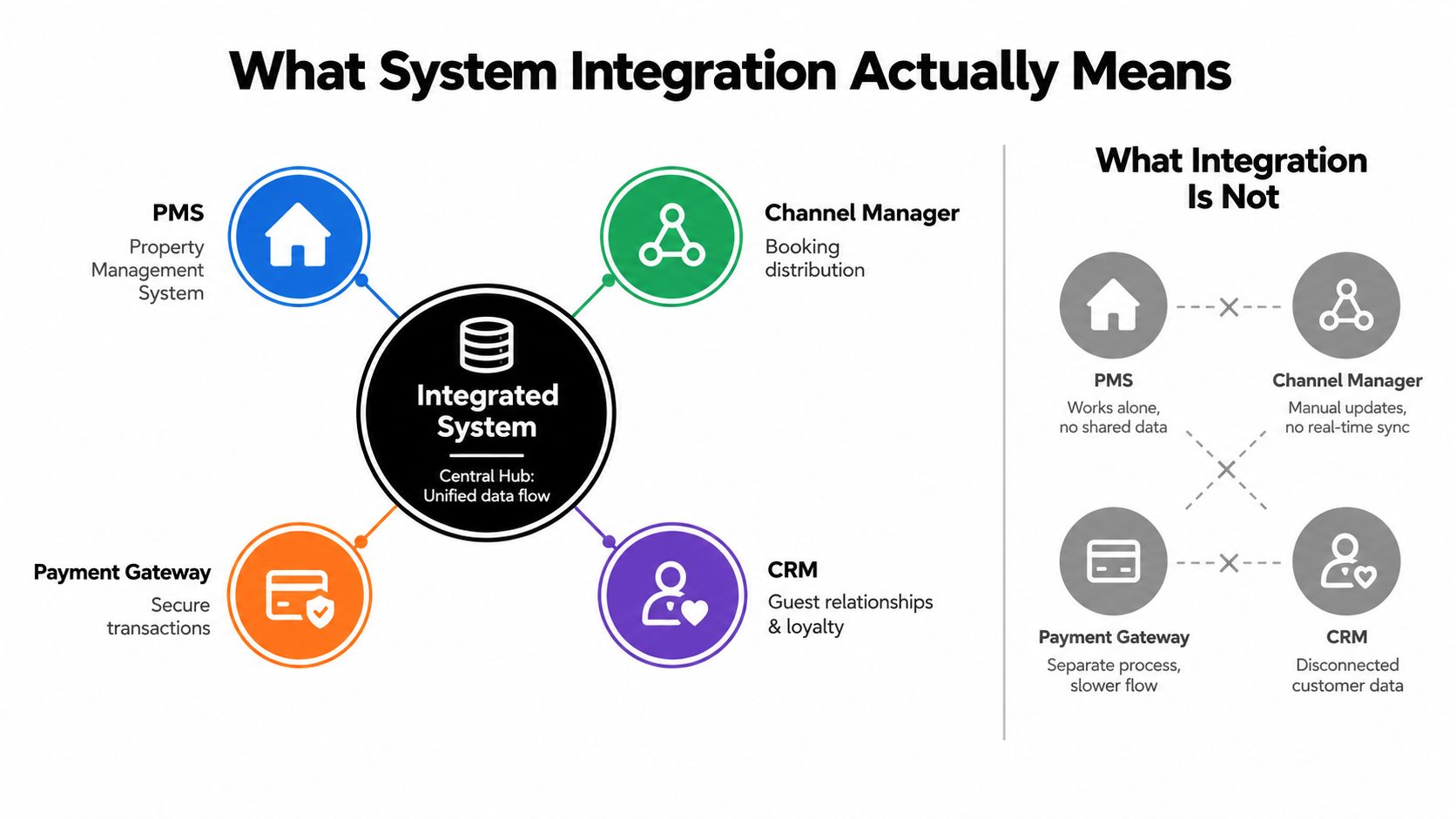
A business can own Reapit, Alto, Fixflo, Arthur or Qube and still have a disconnected operation. The software exists, but the information doesn't move reliably between it. The spreadsheet becomes the unofficial joining layer, and the wall planner becomes the compliance reminder.
The UK government's digital review found that only 27% of surveyed respondents believed their current data infrastructure enabled a complete view of operations or transactions. 70% said their data environment wasn't well coordinated, interoperable or a unified source of truth. Those findings describe the difference between having digital tools and having operational visibility, as set out in the State of Digital Government Review.
Integration is more than an API
An API is an agreed way for systems to exchange information. It doesn't decide whether the landlord record is correct, whether a certificate belongs to the right unit or whether a drafted tenant message should be sent.
A useful plain-English explanation of API integration is helpful for the technical foundation, but the operator's concern is wider. You need reliable ownership, sensible rules, exception handling and an approval point before an external communication leaves the business.
The UK system integration services market is estimated at $29.737 billion in 2025, rising to $42.8761 billion by 2030, implying a 7.6% CAGR, according to MarketsandMarkets' UK market estimate. That scale reflects integration's role in cloud migration, cybersecurity and enterprise modernisation. For an independent agency, the relevant point is simpler. Integration is a foundation for making existing software work as one operating process.
How Integration Works Step by Step
A practical integration normally follows four stages. The labels sound technical, but the decisions are operational.
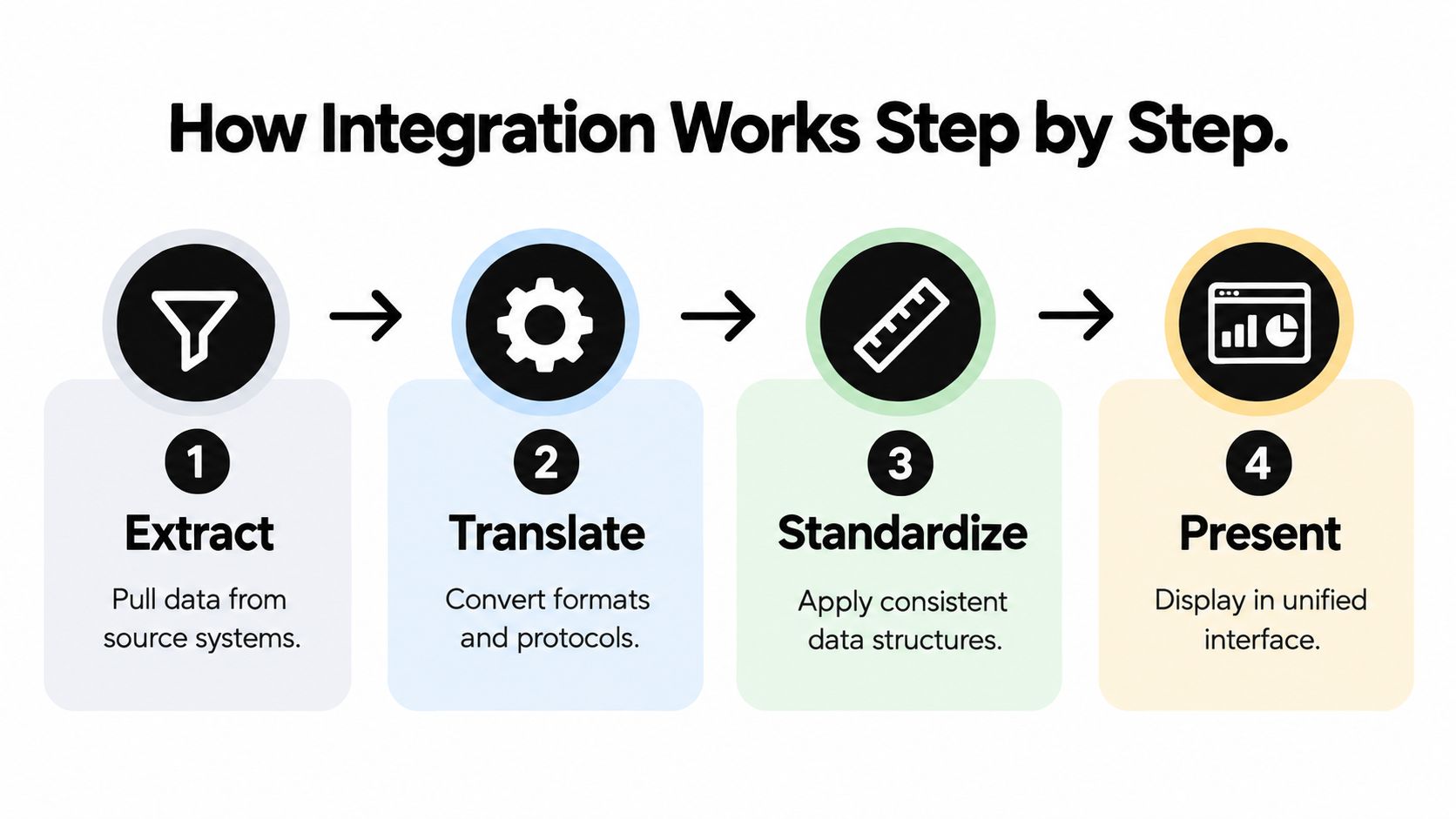
- Extract: Pull the relevant event or record from the source system. That might be a new maintenance request in Fixflo, a booking change from a channel manager or a certificate date held in a property platform.
- Translate: Convert different field names, formats and protocols into information the receiving system can understand. “Property reference” must mean the same thing everywhere.
- Standardise: Apply agreed rules to names, addresses, units, statuses, priorities and ownership. This is the step where duplicate records and inconsistent identifiers are dealt with.
- Present: Put the result into the dashboard, task queue or existing platform where the team acts on it.
A UK government finance and performance tender describes this same operating challenge. Data must be extracted through APIs, then translated, standardised, harmonised and presented in near real time, with ETL capability across legacy and newer IT systems and centrally held datasets. The government integration programme specification is a useful benchmark because it treats data preparation as part of the integration, not an afterthought.
The control points matter
Middleware can sit between systems so one failure doesn't bring down every connected workflow. Standardised interfaces and documented access rules make it clearer what each system can send, receive and reject.
UK government API guidance expects RESTful services to follow OpenAPI standards and use clear HTTP methods. It also calls out pagination, filtering and rate limiting, while recommending open standards in IT requirements unless there's a clear reason not to. The Ministry of Justice interoperability guidance shows why integration is also a procurement and governance decision.
Nothing that reaches a tenant, landlord or regulator should be sent solely because a connector succeeded. The system can prepare the information, flag missing fields and route it to the responsible person. That person checks it, approves it and remains accountable for the output.
This short walkthrough gives a visual example of the process:
HMRC illustrates why one connection rarely covers every case. Third-party software may use JSON RESTful APIs through the HMRC Developer Hub, while specific services still support XML as the only available method. The HMRC standards guidance confirms that the route and service determine the integration requirements.
Integration Versus the Alternatives
Doing nothing is a valid choice, but it leaves the existing backlog and manual checking in place. Hiring can add capacity, yet it often adds another person to the same broken handoffs rather than removing the cause.
Switching from Reapit, Alto, Arthur or Qube may make sense if the current platform cannot support the operation. It also introduces migration work, retraining, data checking and disruption. A new platform won't automatically clean up inconsistent property references or clarify who approves a tenant message.
ChatGPT can help draft an email, summarise a repair history or create a spreadsheet formula. It won't, by itself, know which unit record is authoritative, update Fixflo, reconcile a landlord's ledger and route a reviewed response through the correct process.
| Approach | Cost | Risk | Scalability |
|---|---|---|---|
| Integration | Build and maintenance effort | Interface failures need monitoring | Supports connected growth when the process is sound |
| Do nothing | Ongoing manual administration | Delays and missed handoffs remain | Backlog grows with volume |
| Hire | Salary, training and management | More people may preserve the same process | Adds capacity, not necessarily control |
| Switch platform | Migration and disruption | Data loss, adoption and workflow risk | Depends on the replacement's fit |
| ChatGPT alone | Subscription and staff time | No reliable connection to operational records | Useful for isolated tasks, limited for end-to-end work |
Integration pays back when it removes recurring manual work across several systems. It isn't worth doing when the workflow itself is unnecessary, or when consolidating into one existing platform would be cleaner.
Sometimes the right integration project is a process redesign project with fewer steps and no new connector.
Why Property Operators Choose Integration
Recurring management-fee revenue depends on serving more doors without allowing administration to consume every available margin. The practical value of integration is that the same property, landlord, tenant, unit or booking data can move through the operation without being recreated at every stage.
A dashboard connected to Reapit, Alto, Fixflo, Arthur or Qube can show exceptions in one working view. That might include an overdue maintenance decision, an upcoming certificate renewal, a tenancy progression waiting for information or a serviced accommodation turnaround that hasn't been confirmed.

The owner doesn't need to log into six platforms to work out where the operation is under pressure. The underlying platforms remain in place. Integration gives the team a controlled way to pass information between them and presents the important exceptions where someone can act.
Visibility is the useful outcome
This isn't automation for its own sake. It's a way to make a recurring process visible and assignable.
For block managers, that may mean tracking Section 20 notices, service charge tasks and certificate renewals through defined review points. For letting agents, it may mean connecting tenancy progression, maintenance triage and landlord updates. For serviced accommodation operators, it may mean joining the channel manager, payment information, guest messages and turnaround tasks.
The business process automation software guide is relevant when the repeated work has already been mapped. If the process hasn't been agreed, adding automation will only hide disagreements inside software.
The benefit is operational control across 400+ doors, 1,000+ leasehold units or 3,000+ bookings a year, depending on the business. It doesn't remove the need for people. It makes it easier for people to see what needs their decision.
What Integration Does Not Fix
Integration won't repair a bad process. If nobody has decided who owns certificate renewals, connecting the systems may just move the confusion faster.
It won't make a legal decision, confirm that a notice is valid or approve a compliance action. A responsible person must review those outputs, and a solicitor or compliance adviser should confirm how any legal requirement applies in England and Wales.
It also doesn't remove the need for:
- Ownership: Someone must be accountable for each workflow and exception.
- Validation: Records need checking before they drive an action.
- Reconciliation: Different systems may hold conflicting balances, dates or identifiers.
- Monitoring: Failed exchanges need to be visible rather than ignored.
- Recovery: The team needs a manual route when a platform or connection is unavailable.
- Documentation: Staff must understand what happens, where the source record lives and who approves the result.
The UK government review notes that legacy systems can block real-time sharing. It cites COBOL-based HMRC systems that require additional software to expose data through APIs. That is why middleware, controlled interfaces and access governance matter more than just buying a connector.
Where to Start in Your Own Operation
Start with one process, not the whole property stack. Choose the workflow that creates the most repeated checking, such as tenancy progression, maintenance triage, certificate renewals, client money administration or booking turnaround.
Map it on paper:
- Trigger: What event starts the work?
- Source: Which system holds the original record?
- Handoffs: Where does somebody copy, email or retype information?
- Decision: Where must a person approve the next action?
- Exception: What happens when data is missing or the system fails?
- Outcome: Which platform should hold the final record?
Then compare the manual route with a simpler process. The result may justify integration, consolidation, replacement or doing nothing for now. The system integration software guide can help you assess the available approaches, while the AI Readiness Scorecard gives you a tool for reviewing baseline costs and opportunities before committing to a build.
For property-specific context, the letting agents resource is a useful place to review how connected workflows can fit around the systems you already run.
InnovaAI Integration Ltd builds custom systems that connect existing property platforms, email, phone and operational data, with human approval kept in the workflow. Visit InnovaAI Integration Ltd for a free discovery call to work out whether integration is a fit, and if it isn't, I'll say so on the call.