What Is API Integration and Why It Matters for Operations
what is api integrationapi integration guideproperty management automationsystems integrationAI workflow automation

Tuesday starts the same way in too many offices. The shared inbox is full, a gas certificate renewal is sitting in a wall planner nobody checked, and a tenant's 8pm message won't get a proper reply until 9am. Meanwhile, Reapit, Alto, Fixflo, Arthur or Qube is open on one screen, a spreadsheet is open on another, and the team is still copying details by hand.
That's usually where the problem lives. Not in the software itself, but in the gap between systems, the gap between tasks, and the gap between who knows what and who has to type it again. API integration is what connects those gaps so you can keep the tools you already pay for and stop running the same job twice.
For a property business, that matters because the backlog doesn't care how tidy the software demo looked. It cares whether maintenance gets triaged, whether certificate dates get seen, and whether the right person approves the next step before anything goes out to a tenant, landlord or regulator. If you're trying to take on more doors without adding another salary, this is the part worth understanding.
Table of Contents
- What API Integration Actually Means in Plain English
- How API Integration Works Across Your Existing Platforms
- What Changes When Systems Are Properly Connected
- Security Governance and When Not to Integrate
- What to Look at First in Your Own Operation
What API Integration Actually Means in Plain English
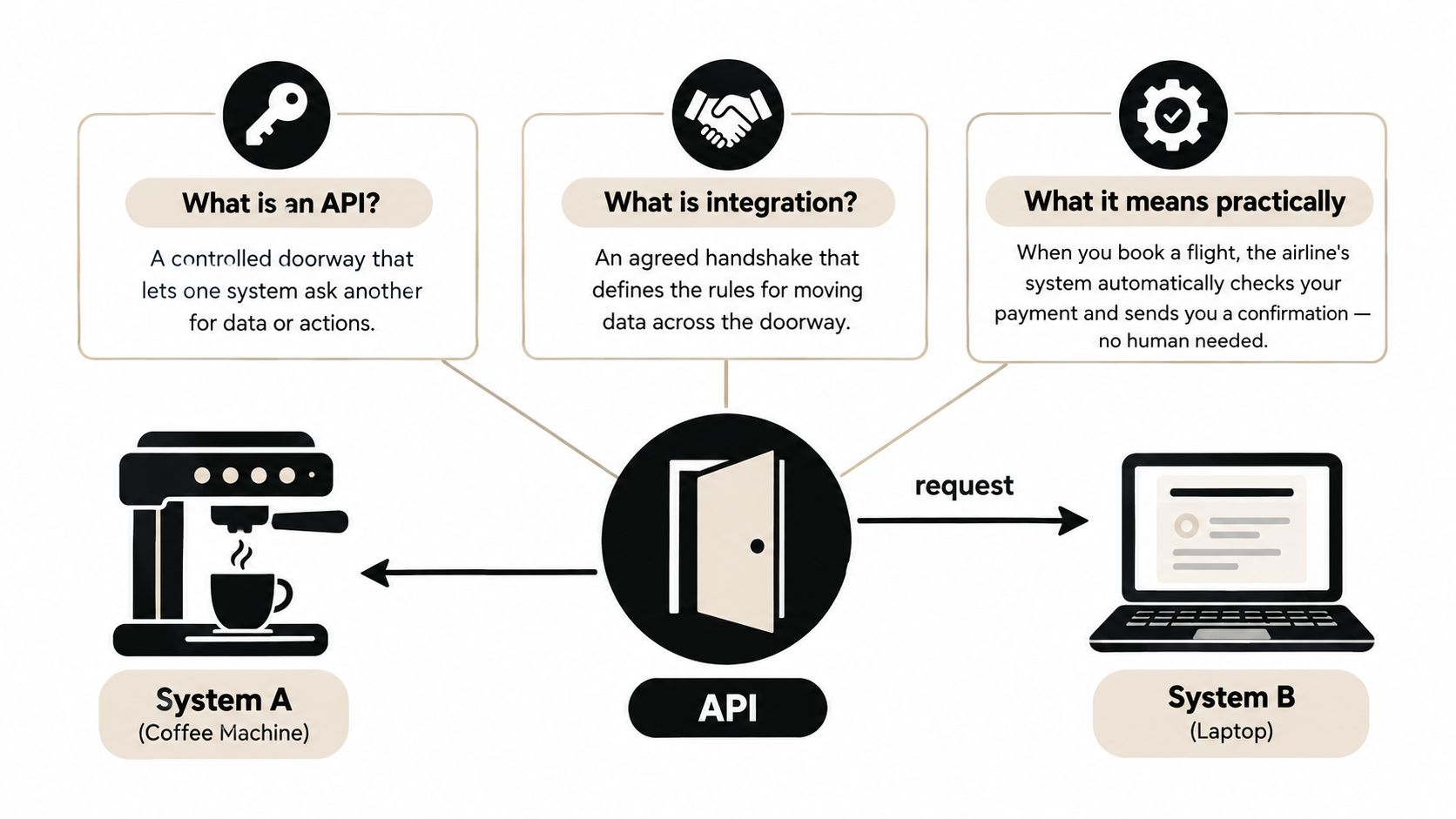
An API is a controlled doorway between systems. One system can ask for data or trigger an action, but only through the rules that doorway allows. Integration is the agreed handshake that lets the two systems exchange information predictably, instead of relying on someone to copy and paste it.
Managed access in a block. The door exists, but not everyone gets the same key. The point is not just that systems can talk, it's that they can do it in a way both sides understand.
API exists, integration follows
A platform can have an API and still not be integrated into your operation. If no workflow is built around it, it's just a doorway sitting there. Once the flow is designed, the data can move from one place to another without the same manual checking every time.
Standards matter because they remove ambiguity. The UK government's API guidance treats interoperability as a standards problem, with OpenAPI for machine-readable contracts, JSON for exchange, UTF-8 for text, ISO 8601 for dates and TLS 1.2 or above for transport security, because consistent schemas and date formats reduce integration defects and make automated validation and client generation possible UK government API technical and data standards.
Practical rule: if two systems can't agree on the shape of the data, the team ends up doing the agreement by hand.
That's why API integration is not a fancy synonym for “linked up”. It's a defined way of moving property data, maintenance updates, booking details or payment references between systems without the same repeated intervention. A non-technical colleague only needs that sentence, not a lecture.
How API Integration Works Across Your Existing Platforms
A property operation usually doesn't need one giant rebuild. It needs a few sensible connections between tools that already sit in the workflow. In practice, most setups fall into three patterns, and the right one depends on how much change you can tolerate without breaking the office rhythm.
The three patterns that actually show up
Point-to-point sync is the simplest. One platform sends data straight to another, like Alto pushing a maintenance record into Fixflo. It can be quick to set up, but it gets messy if every new connection is built separately.
A hub or middleware setup sits in the middle and routes the data. That suits a business that needs several systems to talk to each other, for example Qube feeding a service charge workflow, while other operational tools read the same record. It gives you one place to control the rules, but it still needs proper ownership.
Event-triggered automation is different again. Something happens in one system, then another system responds. That can work well where Arthur needs to trigger a channel manager update for serviced accommodation, or where a maintenance event should create a task only after a human has checked the right fields.
| Pattern | How It Works | Best For | Watch Out For |
|---|---|---|---|
| Point-to-point sync | One system sends data directly to another | A single clear handoff | Becomes brittle as more links are added |
| Hub or middleware | One central layer routes data between tools | Several systems sharing the same records | Needs governance, or it turns into another bottleneck |
| Event-triggered automation | A change in one tool triggers an action in another | Fast operational workflows | Can create noise if the trigger rules are loose |
The rule stays the same across all three. Integration connects to what you already run, it doesn't replace it. That matters in property because the operating system is usually a mix of software, emails, spreadsheets and human judgement, not a clean greenfield build.
If you want a plain-English view of the wider system-integration idea, this note on system integration software is the right place to start.
Don't start by asking which platform is cleverest. Start by asking which handoff causes the most copying, chasing or delay.
What Changes When Systems Are Properly Connected
The biggest shift is not dashboard speed. It is the order of work. A connected workflow removes the repeated checking that happens when one person has to read a message, open another system, confirm the record, then type the same thing again.
Maintenance triage before and after
Before integration, a tenant message lands in the inbox. Someone reads it, checks Reapit or Fixflo, opens the tenant record, looks at access notes, perhaps calls back, then logs the job and chases permissions. Each step creates delay, especially when the same person is also handling calls, renewals and arrears.
After integration, the message enters the right workflow once. The system can pull the relevant record, surface the access details, and create the next task. A human still approves what goes to the tenant, landlord or contractor, because that is where judgement belongs.
- Ticket arrives, then the right record is found automatically.
- A staff member checks the issue, before any message leaves the business.
- Certificate or access status is checked, so the team is not relying on memory.
- A task is created or updated, in the system you already use.
- A person approves the outward step, before anything reaches a tenant, landlord or regulator.
That is where the mechanical cost sits in a disconnected office. Double entry. Missed dates. Slow replies. Jobs reopened because the notes in one place never reached the other. Anyone who has run an inbox or a portfolio knows the pattern.
For property operators, the gain is practical. A block managed through Reapit, Alto, Fixflo and Arthur can stop acting like four separate jobs held together by staff memory. The workflow still needs ownership, but the handoffs become clear. One system records the trigger. Another carries the task. The person in the middle checks the decision.
The image below shows the shape of that change.
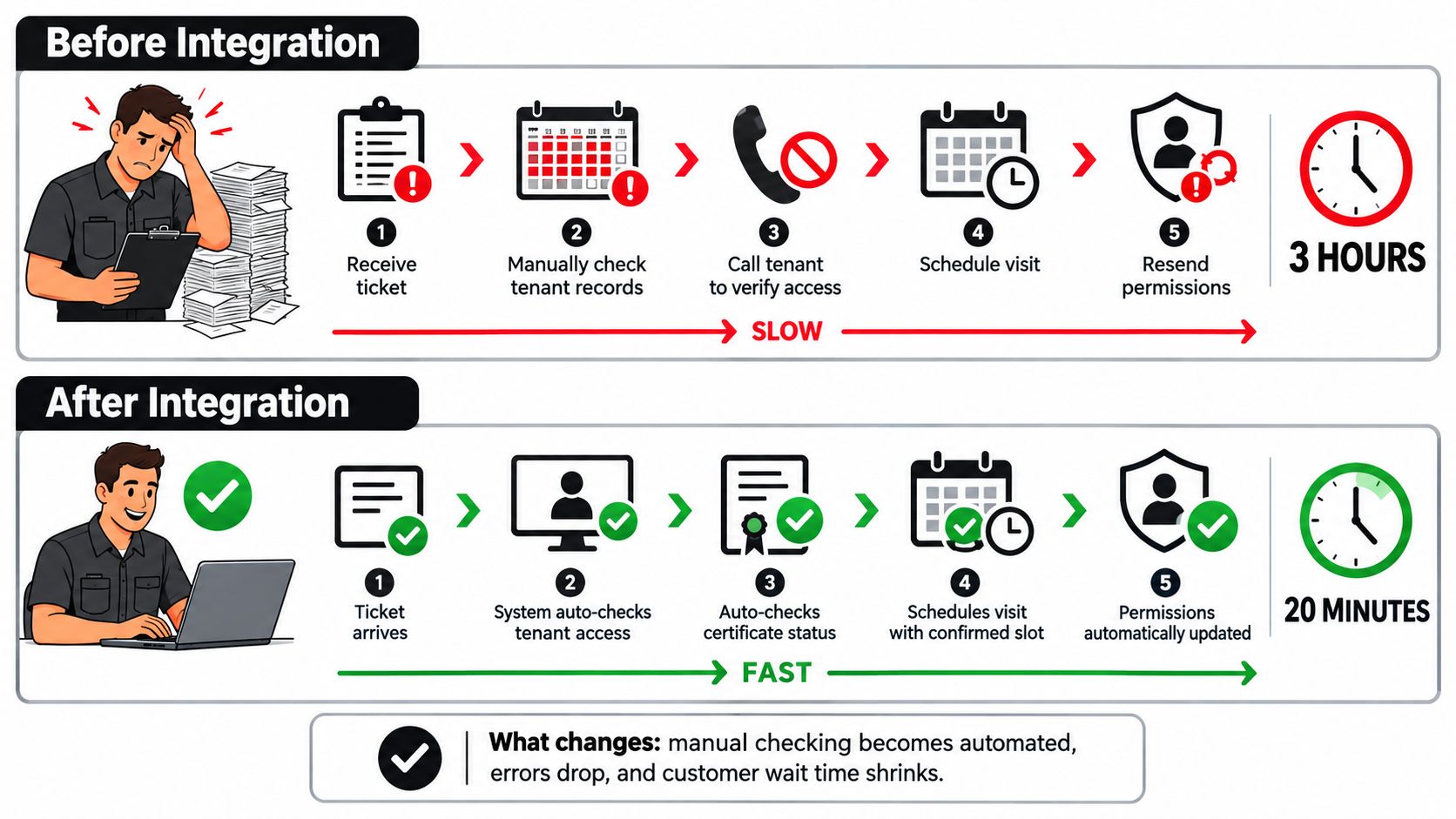
A connected workflow still needs a human in the loop. It just stops making that person type the same job into three places before they can do the work.
Security Governance and When Not to Integrate
API integration is also a security boundary. The UK National Cyber Security Centre says secure API integration should use JSON, OpenAPI, TLS, OAuth 2.0 and OpenID Connect, plus rate limiting, input validation and logging or monitoring, because those controls reduce brute-force, denial-of-service and credential-exposure risk NCSC guidance on securing HTTP-based APIs. That matters when the data includes client money, personal data or anything that might sit inside a UK GDPR data processing agreement.
Governance is part of the job
If you can't see what the integration is doing, you can't trust it. That means logging failures, watching for strange traffic, and knowing who can approve changes. It also means putting the right human approval step in front of anything that goes to a tenant, landlord or regulator.
For property operators, the risk isn't only technical. It's operational. An integration that saves admin time but creates unclear ownership around sensitive data is a bad trade.
If the business can't explain who owns the workflow, it doesn't own the workflow.
When not to integrate
There are times when doing nothing is cleaner. There are times when a hire is the better answer, because the issue is capacity, not connectivity. There are times when switching platform is cleaner than trying to bolt two awkward systems together. And there are times when using ChatGPT for a one-off draft or summary is enough, because a full workflow link would be overkill.
The 2025 DBT and Ipsos work on UK SME technology adoption points to behaviours, readiness and execution as the blockers, not just access to technology understanding technology adoption among UK SMEs. That lines up with what most operators feel in practice. If the process is unclear, the data is messy, or nobody owns the output, integration just automates confusion.
If you're looking at AI agents as part of the same conversation, the governance note on AI agents is worth reading alongside this. The rule is the same. Secure the boundary, define the owner, then decide whether the workflow is ready.
What to Look at First in Your Own Operation
Start with the points where people still bridge the gap by hand. That is usually the spreadsheet beside the main platform, the date living on a wall planner, and the message left waiting between 8pm and 9am. Pick one workflow, not five, and trace it from first contact to final update.
In a letting business, assess your operation with the AI readiness assessment and map where Reapit or Alto stops and the inbox starts. In block management, do the same around service charges, Section 20 admin, certificate renewals, or maintenance triage. The best first project is often the one where the same data gets typed more than once.
A phased rollout should keep the current platform in place. It should keep a person approving outward-facing steps. It should also give you a clear way to see whether the workflow is easier to run, not just easier to describe. If that is missing, the integration is doing too much or the process is not ready.
If you want to work out whether API integration is the right fit for your operation, book a free discovery call with InnovaAI Integration Ltd. If it is not a fit, I will say so on the call.