AI Adoption Roadmap for Property SMEs That Actually Works
ai adoption roadmapproperty management AISME AI strategyAI workflow automationAI readiness scorecard

At 8am on Tuesday, the shared inbox is already filling up. A gas certificate renewal is sitting unread, a tenant's 8pm message was answered at 9am, and somebody is checking a wall planner against a spreadsheet before opening Reapit, Alto, Arthur or Qube.
That isn't a lazy team. It's a process problem. The information needed to act is split across systems, inboxes and people's memory. An AI adoption roadmap for a property business should fix that flow, not add another dashboard nobody opens.
Table of Contents
- Your Tuesday Morning and Why the Backlog Never Shrinks
- Why Most SME AI Plans Stall After the ChatGPT Trial
- How to Map and Prioritise What to Automate First
- A Phased AI Adoption Roadmap You Can Run Without Replacing Systems
- What to Look at First and How to Decide If It Is Worth Building
Your Tuesday Morning and Why the Backlog Never Shrinks
Most property businesses already have a core platform. Reapit or Alto may hold tenancy and applicant information. Fixflo may hold maintenance tickets. Arthur or Qube may contain block records, service charges and unit details. The spreadsheet appears because the platform doesn't quite match the way the team works.
That creates small gaps between each action. A renewal date is recorded in one place, the supporting document is stored somewhere else, and the person responsible only knows about it because someone forwards an email. A maintenance request arrives through Fixflo, but the contractor update comes by phone and the landlord report is written manually.
The backlog grows through these hand-offs. Staff repeat checks, copy information between screens and make decisions without seeing the full record. Managers then hire another administrator, but the new person inherits the same fragmented process.
Practical rule: Automate the hand-off only after you know which record is authoritative.
A workable system can watch for defined events, gather the relevant information from the platforms you already use, prepare the next action and place it in front of a named person. It can flag a certificate approaching renewal, group maintenance requests by urgency, prepare a draft landlord update or identify a void where turnaround is slipping.
The human still approves anything sent to a tenant or landlord. A qualified person still makes compliance and legal decisions. The system doesn't replace Reapit, Alto, Fixflo, Arthur or Qube. It connects the work around them. The principles behind this approach are also set out in workflow automation for small business.
It won't repair poor service standards, unclear ownership or a broken approval process. It won't make a spreadsheet accurate because it has been connected. Those issues need a management decision before any build begins.
Why Most SME AI Plans Stall After the ChatGPT Trial
A property team can use ChatGPT to draft landlord emails while certificate renewals, service charges and maintenance triage remain manual. The UK market has moved beyond curiosity, but adoption is often shallow. The Office for National Statistics analysis of AI use in UK businesses reports that use of at least one AI technology among businesses with 10 or more employees rose from around 12% in September 2023 to around 35% by June 2026. The same release says adopting businesses used about 1.6 AI technologies on average, up from about 1.4 in late 2023.
For a property SME, the gap is not access to ChatGPT. It is whether certificate, void and maintenance data is structured enough to automate safely, with a person approving the result before it reaches a tenant or landlord.
The UK Business Data Survey 2026 found that 41% of businesses handling digitised data used AI-based technologies in 2025 to 2026 (Government survey coverage). Organised records provide a workable starting point. Duplicate addresses, inconsistent unit references and missing ownership fields create a data project before a reliable workflow can run across Reapit, Alto or Fixflo.
Business size affects capacity. ONS reporting found that 28% of firms with 0 to 9 employees used at least one AI technology, compared with 49% of firms with 250 or more employees (ONS data). A firm with 10 to 60 staff rarely has a dedicated data team. Embedding new workflows therefore requires deliberate change management strategies for SMEs, alongside a clear owner for each approval.
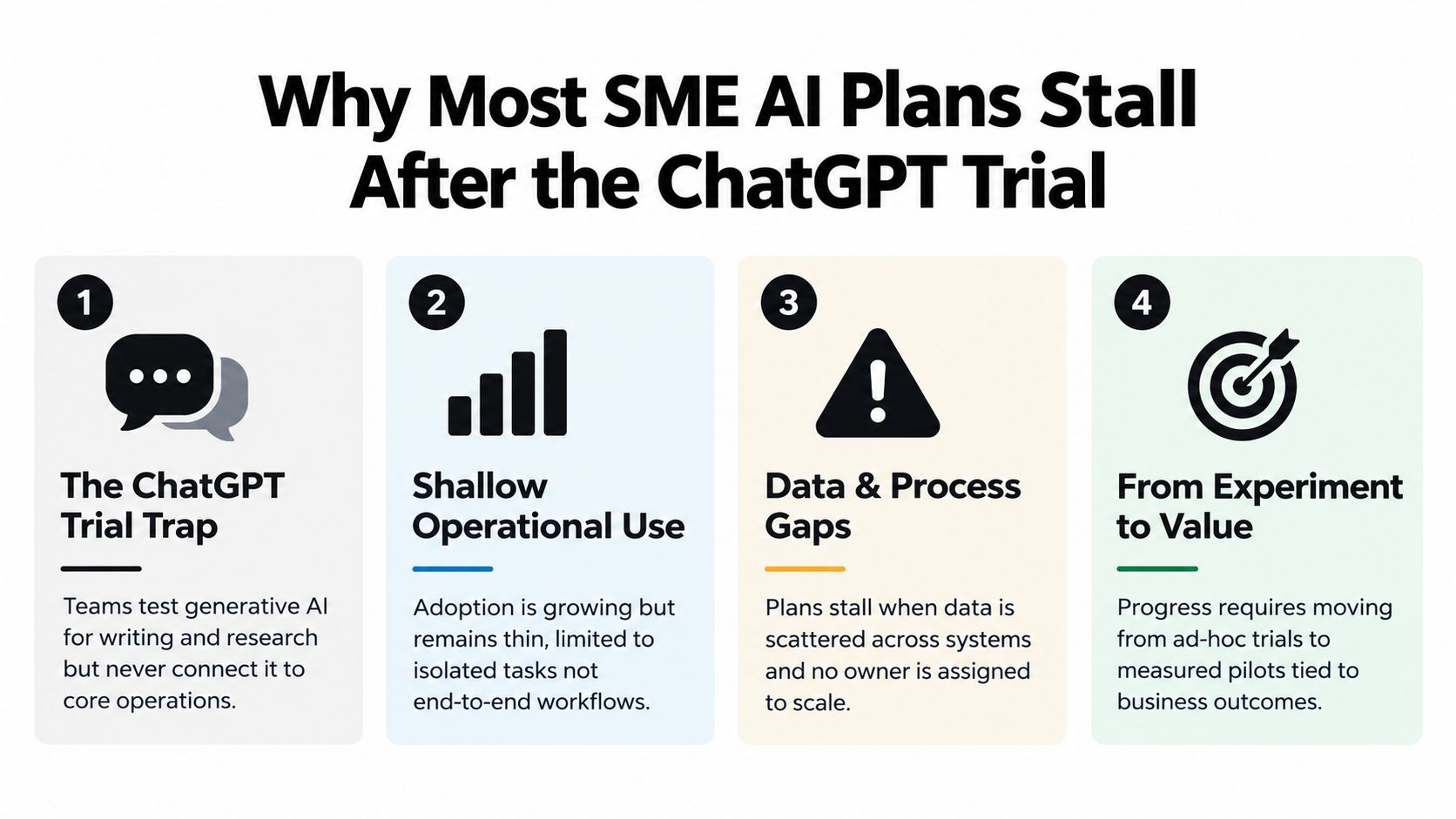
The recurring blockers are operational. Government research records ethical concerns as a significant barrier for 80% of respondents, high costs for 76%, and unclear regulation for 72% (GOV.UK AI Adoption Research). In property operations, trust depends on knowing which source supplied the information, who approved the output and what happens when a record is incomplete. That matters particularly for client money, compliance evidence and maintenance decisions.
Before selecting a model or buying another subscription, baseline the process. Use the AI readiness scorecard to record data ownership, process friction and safe starting points. The useful outcome is a defined pilot, not a technology recommendation.
How to Map and Prioritise What to Automate First
Start with the work that repeats and carries a visible operational consequence. List the workflows in the language your team uses, not in software categories.
Include tenancy progression, certificate renewals, maintenance triage, voids, Section 20 administration, service charges, client money checks and channel manager turnaround. For each one, write down the trigger, the data required, the person who acts and the point where a customer, landlord or regulator receives information.
Then record the current baseline. That might be the number of open maintenance tickets, the age of unresolved void actions, the number of certificates awaiting review, or the amount of rework in a landlord report. Don't invent a saving. Measure the queue and the handling steps you already have.
Rank each workflow against four practical tests:
- Value: How many doors, units, blocks or bookings does it touch, and does it protect recurring management-fee revenue?
- Risk: Could an error affect compliance, client money, a regulator, a tenant or a landlord?
- Resourcing: How much checking, copying and rework does the team perform?
- Quick win: Is the source data available, and can one person own the approval?
A certificate reminder may score highly for repeatability but still need a human review before any message is sent. Maintenance triage may be suitable for classification and routing, while the decision on habitability or emergency action stays with an experienced team member.
| Workflow | Value | Risk | Resourcing | Quick Win Score |
|---|---|---|---|---|
| Certificate renewals | High where many tenancies or units are involved | High | Repeated date and document checks | Medium |
| Maintenance triage | High across managed doors | Medium to high | Inbox review, routing and updates | High if Fixflo data is consistent |
| Void turnaround | High where empty periods affect income | Medium | Multiple teams and suppliers | Medium |
| Service charge queries | High in block portfolios | High | Record searching and response drafting | Low to medium |
| Channel manager turnaround | High for serviced accommodation bookings | Medium | Repeated listing and guest actions | High with clean booking data |
Doing nothing is still a choice, but it leaves the process cost in place. Hiring can add capacity, yet it often adds another person to the same hand-offs. Switching from Reapit, Alto, Arthur or Qube may create a long migration project without fixing the underlying ownership problem.
ChatGPT has a place for drafting and exploration. It doesn't know which tenancy record is current, whether a certificate is valid, or whether a proposed response is appropriate. A connected system can prepare the work from live records, but a person must approve the action.
A Phased AI Adoption Roadmap You Can Run Without Replacing Systems
The roadmap should move from one controlled workflow to wider use. Each phase has a stop point. If the process doesn't show value or staff don't use it, stop and change the process before adding another use case.
Phase 1 starts with readiness and a narrow pilot
Choose one workflow where the data already exists. For a letting agent, that might be certificate renewal tracking or tenancy progression. For block management, it may be maintenance triage or service charge query preparation. For serviced accommodation, it could be channel manager messages and turnaround coordination.
Connect to the platform already holding the record, such as Reapit, Alto, Fixflo, Arthur or Qube. Define the fields the system can read, the output it can prepare and the person who owns the decision.
The system may identify a due date, retrieve the relevant property record and draft an internal task. A property manager checks the information before a tenant, landlord or contractor receives anything.
Phase 2 integrates the workflow and adds controls
Once the pilot works in daily operations, measure the same baseline again. Check whether the queue is moving, whether staff are using the output and whether errors are being caught at approval.
Set data access rules. Limit the system to the records and fields it needs. Train the team on what it can do, what it cannot do and how to report a poor result. A workflow that saves preparation time but creates uncertainty won't be adopted.
UK GDPR requirements depend on the processing. ICO-related guidance identifies a Data Protection Impact Assessment trigger where AI involves systematic and extensive profiling leading to decisions with legal or similarly significant effects, large-scale processing of special category data, or systematic monitoring of publicly accessible areas on a large scale (workplace AI guidance). This is operational guidance, not legal advice. A solicitor or compliance adviser should confirm how the requirement applies to your process.
Phase 3 expands only after ownership is clear
Add an adjacent workflow when the first one is embedded. A maintenance triage pilot might lead to contractor update preparation, then landlord reporting. It shouldn't jump straight to every inbox and every block.
Assign a process owner, an approval owner and a fallback route. The system should make it obvious when a record is missing, a confidence threshold isn't met or a human needs to take over.
Phase 4 measures whether the work is staying useful
Review the original baseline, exception logs and user feedback. Remove prompts, fields or automations that create more checking than they remove. Build the next-use-case backlog from observed bottlenecks, not from a list of fashionable tools.
The API integration approach matters here because the system needs controlled connections to existing records, rather than asking staff to copy data into a new place.
The roadmap is relevant to letting agents, but the same gate applies in block management and serviced accommodation. Anything involving legal notices, Section 20 decisions, client money, safety or regulatory communication needs a defined human approval point.
A useful workforce signal comes from British Chambers of Commerce research summarised by the University of Essex. In its January 2026 wave, 95% of surveyed SMEs using AI said it had no impact on workforce size over the past year, while 86% said job roles stayed unchanged (University of Essex summary). For an owner, that supports a measured approach. The first result may be better control of existing work, not an immediate headcount reduction.
What to Look at First and How to Decide If It Is Worth Building
Pick one queue that everyone recognises. Check whether the records are complete, who owns the decision and where a human will approve the next action. Speak to the person doing the work daily, not just the manager who sees the monthly report.
AI may be the wrong tool if the issue is an unclear policy, a missing staff member or a platform field nobody maintains. Hiring or process redesign can be the better answer. A build is worth considering when the task repeats, the data is accessible, the approval rule is clear and the backlog has a measurable operational cost.
Cameron Atwal, founder of InnovaAI Integration Ltd in Wolverhampton, builds custom systems around the platforms property businesses already run. A free discovery call can test the workflow, the data and the alternatives. If it isn't a fit, I'll say so on the call.
I build connected AI systems for letting agents, block managers and serviced accommodation operators, covering discovery, bespoke automation, dashboards and team enablement. Visit InnovaAI Integration Ltd to arrange a free discovery call and work out whether your first workflow is suitable, with no urgency or hard sell.