Workflow Automation for Small Business: A 2026 Guide
workflow automationsmall businessproperty operationsAI integrationprocess automation
At 09:15 on a Tuesday, you open the shared inbox and the day has already gone sideways. A gas certificate reminder was missed, the maintenance triage spreadsheet wasn't updated, and a tenancy progression task is stuck because the referencing email landed in spam and nobody saw it. Then a tenant message sent at 8pm last night gets picked up after breakfast, by which point they're already irritated.
That usually gets framed as a people problem. It usually isn't. It's a process problem wearing a staffing costume.
I'm Cameron Atwal, founder of InnovaAI Integration Ltd in Wolverhampton. I build custom AI systems for letting agents, block and estate managing agents, and serviced accommodation operators across the West Midlands and wider UK. I also run a property portfolio myself, so I've done the admin, chased the certificates, and lived with the same bottlenecks I now wire out of the day.
Table of Contents
- What Your Tuesday Morning Is Actually Telling You
- Where the Hours and the Money Are Quietly Leaking
- What a Connected Workflow Actually Does Step by Step
- What Workflow Automation Will Not Fix
- Which Process to Automate First in Your Own Operation
- What to Look at First and How to Get Started
What Your Tuesday Morning Is Actually Telling You
That morning pile-up is rarely caused by one big failure. It's a chain of small frictions.
A team member updates Reapit or Alto, but the spreadsheet used for chasing renewals doesn't get changed. A contractor replies by email, but the latest status never makes it into Fixflo or Arthur. A certificate renewal date sits on a wall planner, in someone's diary, and half inside Qube. Nobody is wrong. The process just depends on memory too often.
The backlog is a design issue
When the same fact lives in three places, someone has to rekey it. When a status check depends on somebody remembering to look, it will get missed under load. When supplier updates arrive on channels nobody watches every day, work stalls.
Practical rule: if a process only works when your best person is in the office, you haven't got a process. You've got a workaround.
This is why hiring often doesn't solve it. You add another pair of hands into a process that already leaks information between inbox, CRM, accounts and spreadsheets. The extra person helps for a while, then the backlog returns.
What the wider market is telling us
Across smaller UK businesses, adoption is still uneven. Barclays found that only 21% of smaller UK businesses with annual turnover below £1 million had invested in automation, compared with 51% of medium-sized businesses and 71% of large businesses, while 65% of the smallest firms said they had not even considered automation in its SME automation report.
That gap matters because property businesses like yours don't need theory. You need the kind of visibility that shows where the handoffs are breaking. A simple operational KPI dashboard often makes the first problem obvious before any automation gets built.
Where the Hours and the Money Are Quietly Leaking
The leakage isn't dramatic. That's why it stays in place for years.
One UK small-business survey reported owners spend an average of 8 hours a week on repetitive admin, which works out at 384 hours a year, or ten full working weeks. The same reporting said 77% of trades businesses do admin in the evenings and nearly half do it at weekends, in this March 2026 write-up. Property operators know that pattern well. The work doesn't vanish. It just gets pushed into the edges of the day.
Common leakage points in small property operations
| Leakage Point | Typical Process Cause | Operational Consequence |
|---|---|---|
| Rekeying tenancy, contractor or rent data | The same update gets entered into CRM, accounts and a spreadsheet | Staff time goes into admin instead of chasing arrears, voids or progression |
| Missed certificate renewals | No single source of truth for gas, electrical or EPC dates | Reactive compliance work, rushed bookings, awkward landlord conversations |
| Duplicate tenant or landlord comms | Two people act from different inbox views or notes | Mixed messages, repeated chasing, lower trust |
| Approval bottlenecks | One sign-off sits with one person and no fallback route exists | Maintenance, deposit releases or Section 20 stages sit still |
Four places I see most often
Rekeying is the obvious one. New tenancy agreed. Somebody updates the lettings platform, copies details into a chasing sheet, sends a note to accounts, and forwards something to the team member handling progression. Every re-entry is a chance for mismatch.
Certificate dates are worse because they feel under control until they aren't. If gas, EICR or EPC dates aren't pulled from one auditable place, your team ends up doing reactive work close to expiry. Then the problem becomes operational and reputational at the same time.
Duplicate communication burns trust. One negotiator chases a tenant. Another replies from the main inbox. A landlord gets two different versions of the same update. That's not a service issue first. It's a routing issue.
Decision bottlenecks are often hidden. A maintenance triage sits waiting for approval. A deposit release stalls because one person has to check the notes. A Section 20 stage waits because supporting papers are scattered.
Most owners don't need a bigger team first. They need fewer places where work can go to sleep.
If you want to sense-check where your own operation is ready, this AI readiness assessment is useful because it forces the awkward question. Is the delay caused by lack of software, or by a process nobody has really defined?
What a Connected Workflow Actually Does Step by Step
The best example is maintenance triage, because nearly every property business has some version of the same mess. Tenant reports an issue. Team checks history. Somebody decides urgency. Somebody else finds the contractor. Then three people send updates from three different places.
A connected workflow doesn't replace your platform. It sits around what you already run, whether that's Reapit, Alto, Fixflo, Arthur or Qube, and moves the information properly.
Here's the shape of it:
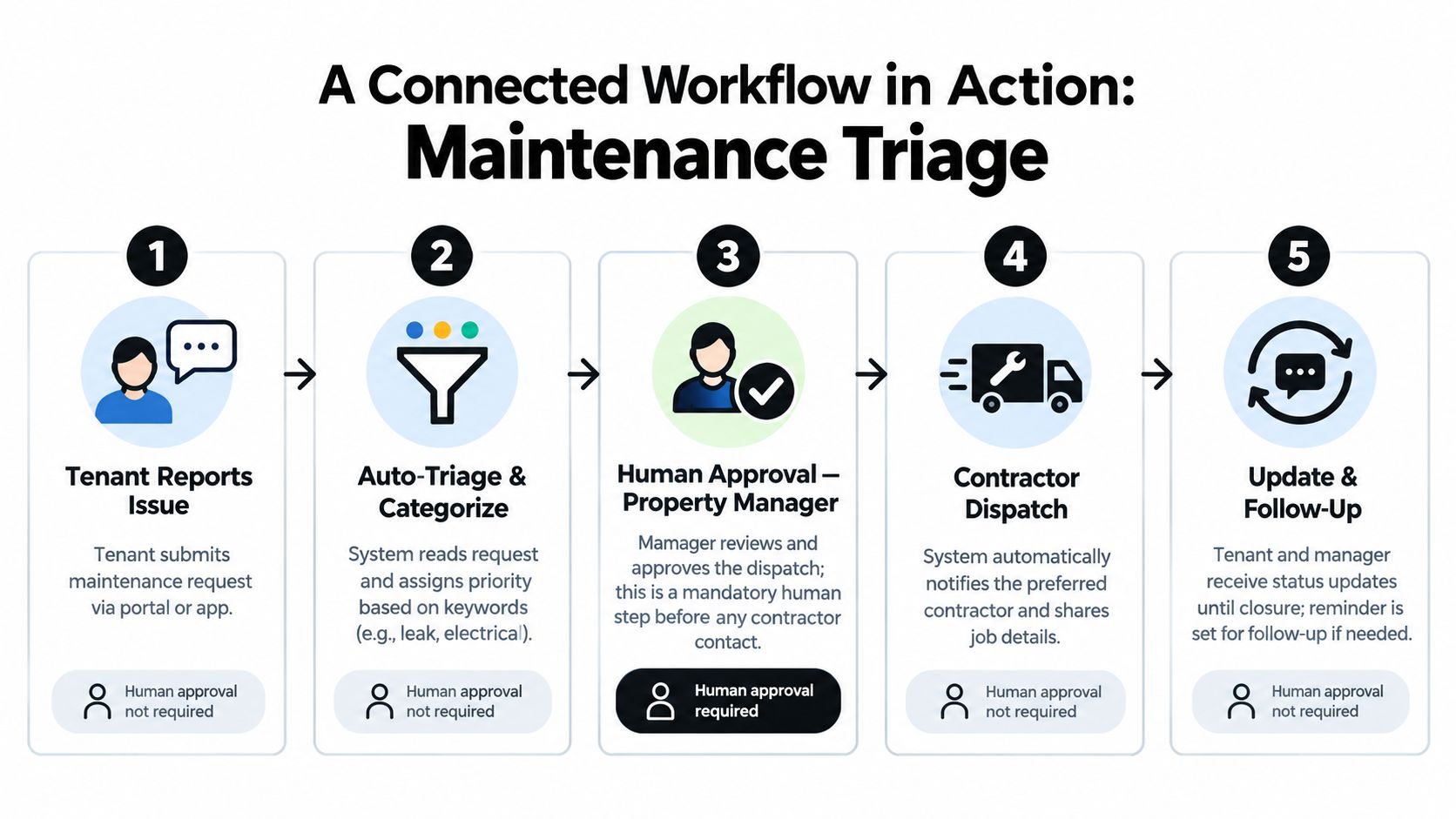
A maintenance workflow in plain steps
- Report comes in. The tenant sends the issue through the existing portal or by email. No need to retrain everyone onto a new front end.
- Rules sort the request. Basic business logic checks for known categories such as leak, heating, lockout or electrical issue. This part doesn't need AI judgment.
- The record gets structured. The system creates or updates a ticket in your operations platform and attaches unit history, prior jobs, and any relevant notes already on file.
- A property manager approves it. Before anything reaches the tenant or contractor, a human checks the categorisation, the proposed contractor and the message wording.
- Updates go out and the audit trail holds. After approval, the contractor gets the job, the tenant gets an acknowledgement with a realistic window, and the status pushes back into the main record.
Where AI helps and where it shouldn't
AI can help with unstructured text. A tenant writes three rushed paragraphs about a leak, mould, and access times. AI can summarise that into something the team can work from faster. It can draft a reply for approval. It can pull job history into one view.
It should not make the final call on anything sensitive.
If a message is going to a tenant, landlord or regulator, there needs to be a named human approval step. Same with deposit release decisions, Section 21 notices, and any Section 20 consultation. Automation should handle movement, reminders, formatting and drafting. People handle judgment and accountability. A solicitor or compliance adviser should confirm how any legal requirement applies in your case.
Why this approach works better in smaller firms
A UK SME productivity study found AIRA adoption at 5.9% of SMEs overall, while 57.2% adopted at least one digital technology. The same study found firms adopting production-enhancing technologies had higher labour productivity, and that BI and cloud tools were more common and associated with the strongest productivity premiums, which points to a practical sequence: start with cloud-enabled capture and reporting, then automate the repetitive admin on top, as set out in the Longitudinal Small Business Survey analysis.
That lines up with what works on the ground. You don't start by automating the whole agency. You start by wiring one repetitive process around the systems already in place. If you want an example of that kind of build, workflow automation for property operations is the area I work in most.
What Workflow Automation Will Not Fix
There's a lot of noise around workflow automation for small business. Most of it skips the awkward bit. Sometimes automation is the wrong answer.
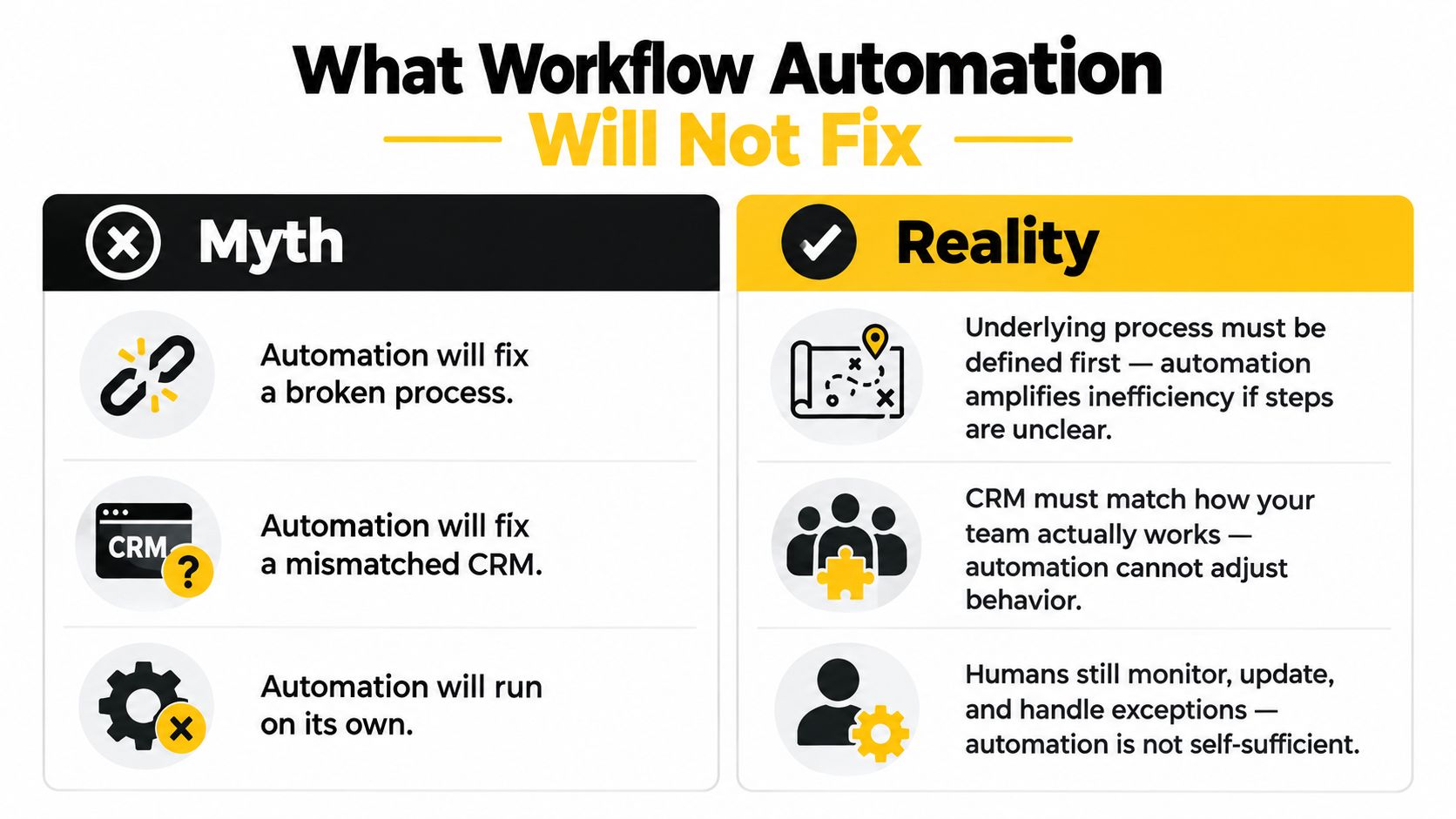
Four cases where I'd be cautious
Doing nothing is valid when the process is low-volume and low-risk. If something happens a few times a quarter and takes minutes, leave it alone. Not every admin task deserves wiring.
Hiring is right when the work needs judgment all day. A vulnerable tenant case, a difficult landlord relationship, or a messy block issue won't be fixed by routing rules. That needs a capable operator.
Switching platform is sometimes the answer. If your CRM or property system doesn't match how the team works, automation on top can become expensive glue around a bad fit. Better to sort the core operating system first.
Using ChatGPT is enough for one-off drafting or summarising. If a manager wants help rewriting a landlord update or condensing meeting notes, that doesn't need a connected build. Open the tool and use it.
Automation is a wiring change. It is not a culture change.
The confidence gap is real
Government-backed research on UK SME technology adoption highlights a familiar problem. 47% of small businesses report using AI, but only 19% feel very confident using it day to day, and 31% say they do not understand how to use it or are wary of embedding it into workflows, according to the UK SME technology adoption research.
That's why firms get stuck at isolated experiments. They try a tool, draft a few emails, maybe summarise a document, but they never turn it into an operating routine. Bolting automation onto a process nobody trusts just gives you faster mistakes.
Which Process to Automate First in Your Own Operation
The first process should be boring, frequent and expensive to get wrong. That's usually where the return sits.
A good candidate is tied to recurring revenue or compliance. Rent reminders. Certificate renewals. Maintenance triage. Deposit registration. Chasing tenancy progression. In my work with letting agents, those are usually the areas where the team feels friction every single day.
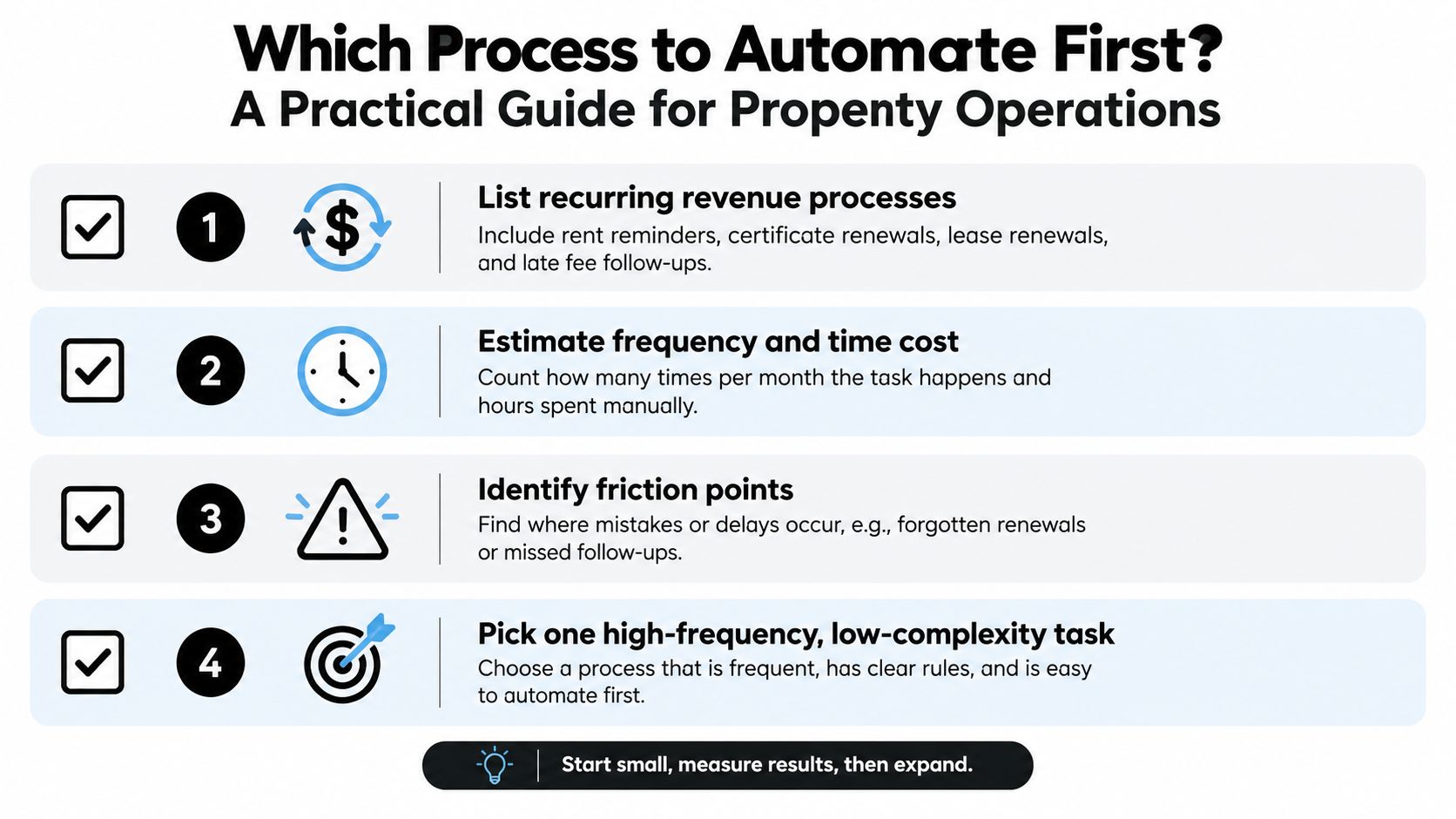
Use a simple shortlist
- List the recurring processes. Write down every repeatable process linked to money in, compliance dates, or resident communication.
- Score the pain. Look at volume, time taken, error cost and how clear the rules already are.
- Check ownership. If nobody owns the process, don't automate it yet.
- Check the record. Make sure there's one auditable source of truth in a platform you already pay for.
What to measure before touching the build
Don't start with software. Start with the current numbers you can observe in your own operation.
Measure:
- Minutes per cycle for the task from start to finish
- Response time from incoming request to first meaningful action
- Error rate such as missed dates, duplicate chases or incorrect status
- One money metric linked to the process, such as late rent chased late or compliance work handled reactively
A lightweight scorecard tool is useful here because it forces you to baseline the current mess before you try to improve it.
One market detail matters too. British Chambers of Commerce research reported 35% of SMEs were actively using AI in 2025, up from 25% in 2024, while only 11% were using technology to a great extent to automate or streamline operations. Another BCC wave in 2026 put active AI use at 54%, up from 23% in 2023, as covered in the BCC reporting on SME AI adoption. The practical read is simple. Plenty of firms are trying AI. Far fewer are embedding it into workflows.
This walkthrough is worth watching before you pick the first process:
What to Look at First and How to Get Started
Pick the one recurring process that eats the most minutes each week and sits nearest to a revenue or compliance event. Map it on paper first, including who approves what, where the record lives, and what happens when something falls outside the rule.
Then look for the handoffs, not the heroics. If the process only stays on track because one experienced person remembers to chase it, that's usually your first automation candidate.
I build connected AI and automation systems for property operators who want to grow doors, units or bookings without adding more admin drag. If you want a second pair of eyes on the process before building anything, visit InnovaAI Integration Ltd and book a free discovery call. If it isn't a fit, I'll say so on the call.