10 AI Agents Training Programmes Compared
ai agents trainingAI agent coursesagentic AIAI skillsAI workshops
Tuesday morning. The shared inbox is already filling. A gas certificate renewal is waiting for someone to check it, last night's tenant message at 8pm is still sitting there, and your team is bouncing between Reapit, Fixflo and a spreadsheet because nobody trusts one system to hold the full picture.
That usually isn't a people problem. It's a process problem. Work arrives in bits, gets triaged differently by different staff, and the handoff between admin, property management and compliance is where things go missing.
That's why AI agents training only makes sense when you start with the operational job. Some programmes help an owner or MD decide where agents belong and what controls need to sit around them. Some help a practitioner build internal capability. Some are proper technical routes for people who'll build and maintain the thing. They aren't interchangeable.
What matters in this comparison is simple. Who it suits. What learners will be able to do afterwards. How it's delivered. How much technical depth it has. How much governance it covers. And where it falls short.
I'm Cameron Atwal, founder of InnovaAI Integration Ltd in Wolverhampton. I build custom AI systems for property businesses across the West Midlands and UK, and I run property myself, so I know the admin I'm talking about because I've done it. If you're trying to add capacity without replacing the platforms you already pay for, this is written for that job. The examples here assume systems need to connect into tools like Reapit, Alto, Fixflo, Arthur or Qube, not rip them out. If your pressure point is lettings operations, the letting agents page gives the closest fit.
Table of Contents
- 1. InnovaAI Integration Ltd
- 2. LangChain Academy Deep Agents course
- 3. Hugging Face AI Agents Course
- 4. Cambridge Judge Business School Agentic AI Design Build Govern
- 5. JBI Training AI Agents Training
- 6. The TESS Group Build AI Agents workshop
- 7. University of Essex Agentic AI Workshop 2026
- 8. Weights and Biases The AI Agent Workshop London
- 9. Cambridge Spark Level 4 AI and Automation Practitioner apprenticeship
- 10. UCL Centre for Digital Innovation AWS Agentic AI Immersion Day
- Top 10 AI Agents Training Comparison
- Start With the Bottleneck You Already Know
1. InnovaAI Integration Ltd
This is the route for an owner who doesn't want a general AI course. They want one process fixed.
That might be maintenance triage. It might be certificate renewals. It might be tenancy progression where half the chasing sits in inboxes and the other half lives in somebody's head. The value here is that the training sits inside the build, so your team learns the exact workflow they'll use, connected to the systems already running the business.
What this route actually changes
Instead of teaching staff abstract prompting, the work starts with scoping the operational bottleneck. Then the build can combine custom AI agents, workflow automation, dashboards and internal web apps around it.
A practical example looks like this:
- Incoming work is sorted first: Maintenance emails or portal messages are classified, grouped and routed to the right queue.
- Risk points are flagged: Certificate dates, missing fields or unusual wording can be surfaced for a staff member to check.
- Draft actions are prepared: A tenancy progression task or internal note can be assembled for review before anyone sends anything.
- Approval stays with a person: Anything going to a tenant, landlord or regulator is checked and approved by staff before release.
That matters more than the model choice. A working sequence beats a clever demo.
Practical rule: If an agent touches compliance, client money, notices or tenant communication, it should prepare work, not make the final call.
Delivery, fit and trade-offs
The model is advise, build and enable. Discovery first. Fixed-price proposal after scoping. Build. Approval testing. Team training on the exact workflow. Then support as the process beds in. Delivery can be remote or in person, and there's a named practitioner rather than a handoff between sales, consultants and developers.
If you want a starting point before speaking to anyone, the AI Readiness Scorecard is useful for baselining where the opportunities and likely costs sit. If you want a more technical view of how bespoke systems are put together, see how to build AI agents.
The honest comparison is this. Doing nothing is cheaper, but the backlog usually just spreads. Hiring can work, but if the underlying process is broken you often pay another salary to carry the same mess. Switching platform is a much bigger operational risk and still won't fix weak handoffs on its own. Using ChatGPT might help one person draft faster, but it won't connect your process across Reapit, Alto, Fixflo, Arthur or Qube.
What this route doesn't do is replace legal or compliance advice. England and Wales rules still need checking by a solicitor or compliance adviser where the workflow touches notices, obligations or regulated communications.
Pros and cons are fairly clear. You get strategy, custom build and embedded training in one place. The trade-off is bespoke work takes real scoping time and costs more than an off-the-shelf course. Public pricing, testimonials and external awards or certifications aren't provided in the supplied material, so buyers should ask directly for references and relevant examples.
2. LangChain Academy Deep Agents course
For a developer, this is one of the clearest technical training routes. For a non-technical property owner, it probably isn't.
The course goes straight into engineering patterns for long-running agents. Tools, MCP, memory, delegation, sandboxes, interpreters, checkpointers, human-in-the-loop controls, local deployment and LangSmith evaluation are all part of the curriculum. There are Python and TypeScript tracks, plus a capstone around a sales assistant.
Where it fits best
This suits someone who'll build and maintain an agent, not someone who just wants the maintenance inbox handled better by next month.
In property operations terms, the learning is useful if you want an internal agent that gathers maintenance information, organises an internal queue, or assembles context across systems before a human reviews it. It does not remove the need for staff approval before a tenant-facing message goes out or before any compliance-related action is taken.
A chat window won't teach those patterns. A structured course will. That's the difference from using ChatGPT.
- Best for: Developers and technically confident operators.
- Strong point: Practical labs that map to production work.
- Main limit: It's framework-specific and assumes coding comfort.
A property business owner looking for immediate workflow change will usually get more value from either a leadership programme or a bespoke build. If you want examples of where agents fit operationally before picking a technical stack, the AI agents use cases guide is a better bridge.
The website is LangChain Academy Deep Agents.
3. Hugging Face AI Agents Course
If LangChain Academy is depth in one ecosystem, Hugging Face is breadth across several.
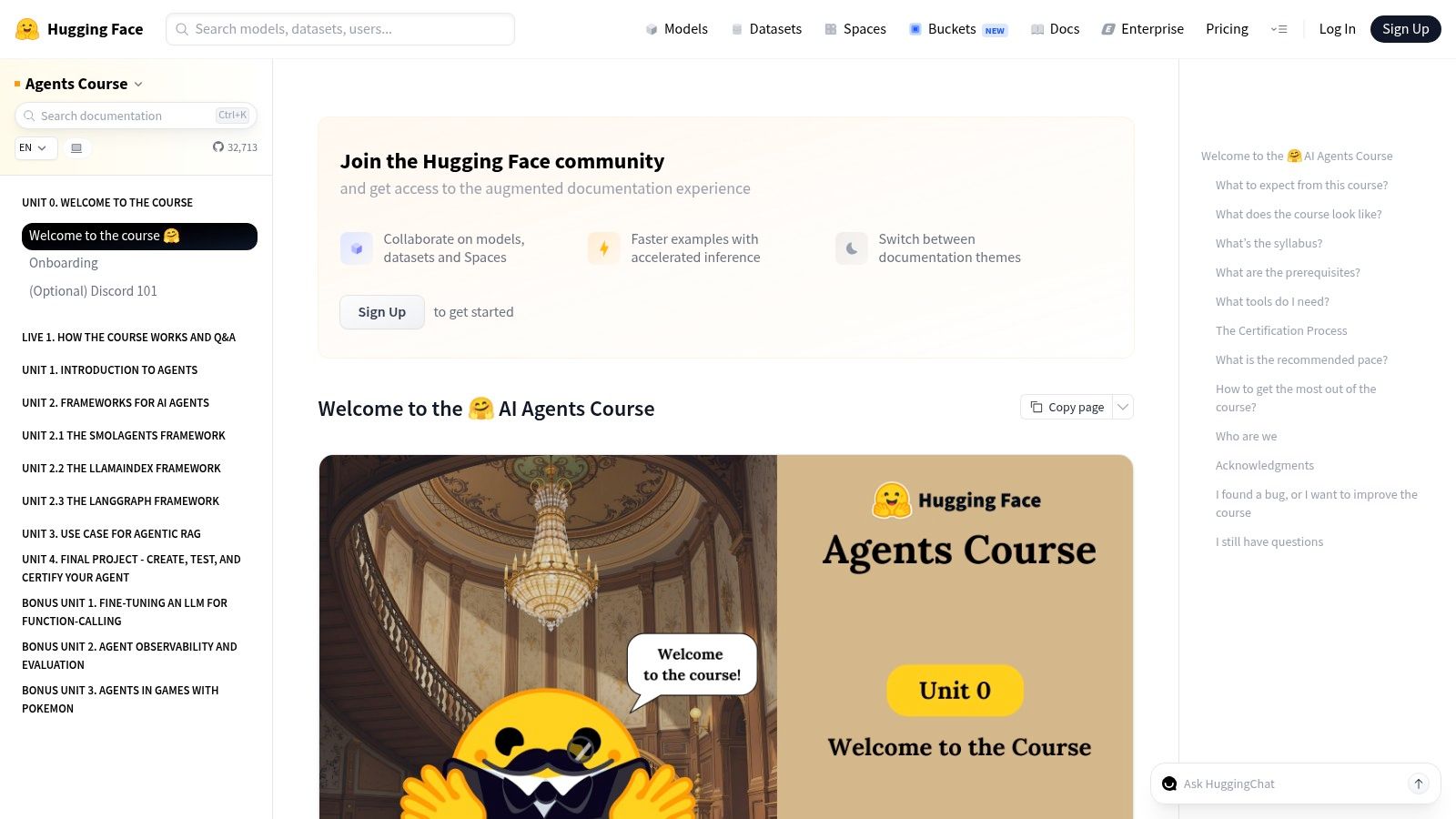
That makes it useful when your team hasn't yet decided whether an internal process should stay as a scripted workflow, become a lightweight agent, or justify a more complex stack. The course covers agent theory, smolagents, LlamaIndex, LangGraph, Spaces, assignments, a final project, a leaderboard, optional certification, and extra material on observability and evaluation.
Why breadth matters
A lot of businesses jump too quickly to “agent” when a narrower workflow would do the job better. A course like this helps a technical learner compare approaches before committing the business to one framework.
That's valuable if you're trying to test something against existing property software. A team could use the course to decide whether a maintenance triage flow should be a simple rules-led process with AI assistance, or whether it needs tool-calling and multi-step behaviour.
Broad framework knowledge is helpful at the decision stage. It isn't the same as operational rollout.
The limitation is discipline. It's self-guided, so you only get as much value as the learner puts in. It also won't give you UK-specific context for how a property business should handle approvals, risk or regulated communications. If a property use case touches tenants, landlords or regulators, human review still needs to sit before release, and compliance interpretation still needs a proper adviser.
The website is Hugging Face AI Agents Course.
4. Cambridge Judge Business School Agentic AI Design Build Govern

Some owners don't need to build anything yet. They need better judgement about where agents belong and where they don't.
The Cambridge Judge programme stands out. It's a three-day in-person course aimed at leadership-level decisions. The focus is no-code, with coverage across agent taxonomy, memory, RAG, MCP, A2A and ACP, practical break-to-build exercises, governance design and a faculty-reviewed 90-day roadmap.
Best use inside a property business
This is a good fit for an MD, head of operations or head of property management who wants to choose one bounded process and set the rules around it properly.
That might mean defining a maintenance triage pilot, setting escalation points, deciding what data the agent can access, and requiring human approval before any external communication. The roadmap format is useful because it forces a decision about ownership after the workshop ends.
- Best for: Leadership oversight and programme design.
- Strong point: Governance framing and a concrete action plan.
- Main limit: No-code delivery means technical depth is lighter.
This won't implement anything for you. It also won't replace your platform. It helps you make a better operational decision, which is different. For a smaller independent agency, the fixed-date Cambridge format and premium positioning may be more than the business needs.
Governance framing is helpful, but it isn't legal advice. If a workflow touches England and Wales compliance obligations, a solicitor or compliance adviser still needs to confirm how that requirement applies in practice.
The website is Cambridge Judge Business School Agentic AI programme.
5. JBI Training AI Agents Training
JBI sits in a practical middle ground. It's instructor-led, UK-delivered, and broad enough to suit teams working across different stacks.
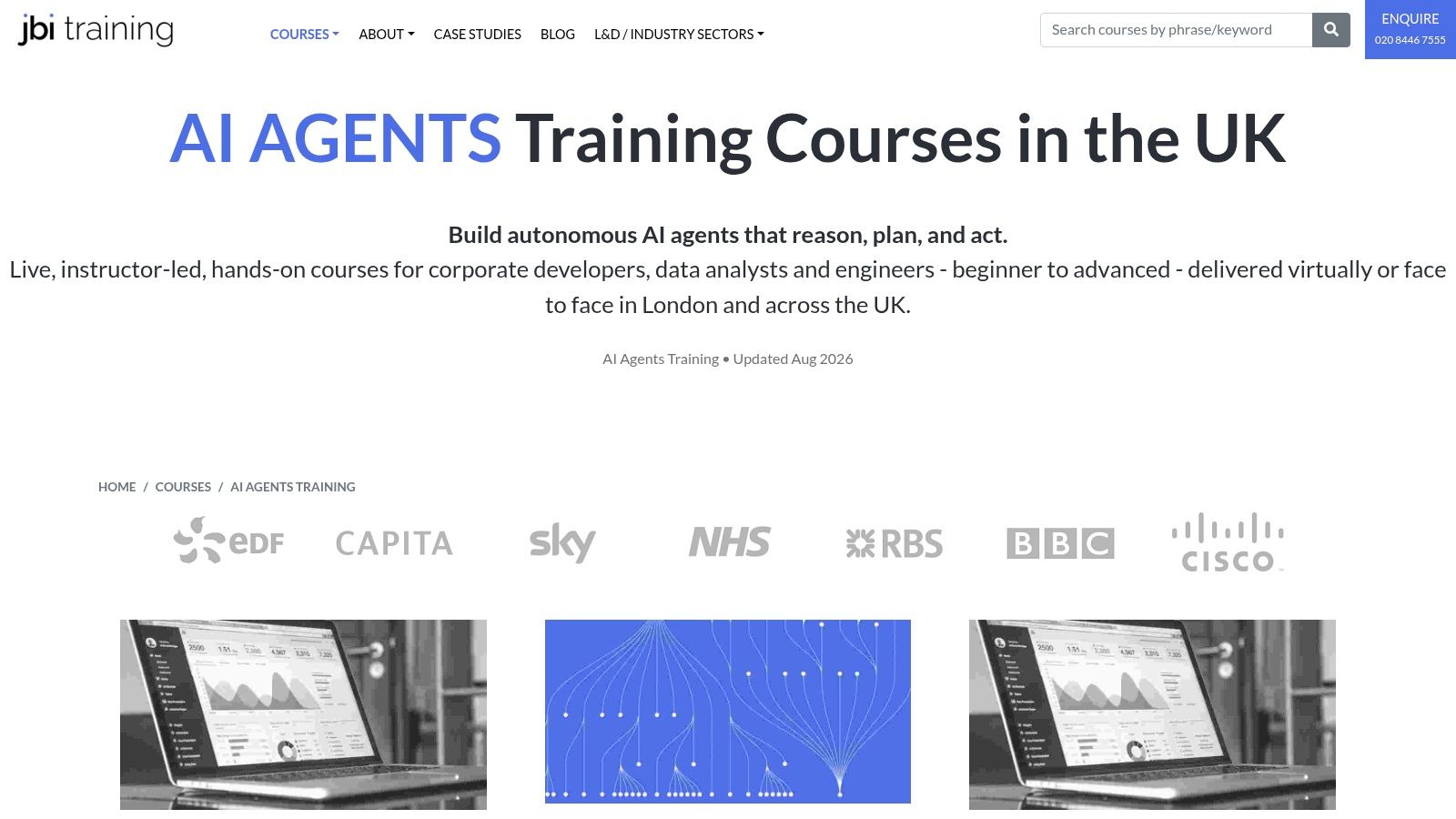
The course catalogue includes Build AI Agents with Python, RAG and MCP, LangChain for AI Agents, and Create AI Agents in Copilot Studio. Learning outcomes cover agent loops, multi-agent orchestration, evaluation harnesses and deployment. That mix matters when a business has a messy environment and not every internal tool sits in the same ecosystem.
Delivery options and likely fit
Public London classes, live online sessions and corporate on-site cohorts make this more flexible than many university or event-led options.
For a property business, a private cohort is where it becomes most useful. A team can work from a live process such as maintenance triage or tenancy progression, then learn how the technical pattern applies without pretending the whole agency needs to become a software company. A staff member still needs to check any draft response before it goes out.
The main trade-off is breadth versus depth. Covering several stacks is useful when your environment is mixed, but it can mean less depth in any one stack than a framework-specific course.
If your team needs a defined course and a UK delivery format, JBI is easier to operationalise than a purely self-paced option.
This also lines up with a wider UK training gap. The Department for Science, Innovation and Technology's evidence review reported that only 7% of UK employees received training in AI in 2023, while 11% of employers had staff undertake training in the previous 12 months, and there were 487 undergraduate and 183 postgraduate UK courses featuring AI for 2024–25. The supply of learning is growing faster than workplace depth.
If you're comparing short technical training with broader business enablement, the AI training for business guide is a useful cross-check.
The website is JBI Training AI Agents Training.
6. The TESS Group Build AI Agents workshop
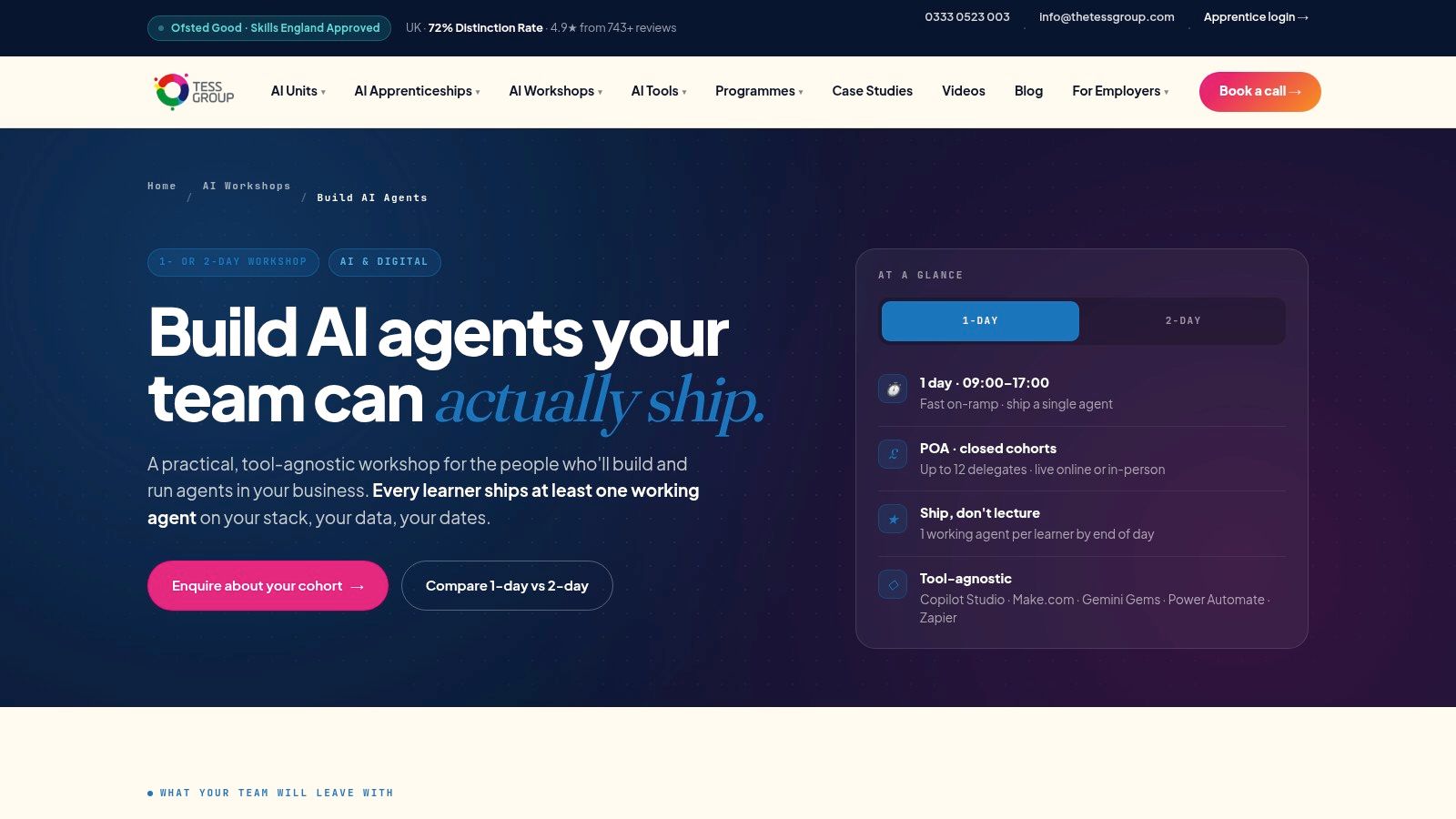
This one is for teams that want to leave with something working, not just a notebook full of concepts.
The one-day version covers single-agent fundamentals. The two-day route goes further into multi-agent orchestration, integrations and governance. The practical scope is strong: triggers, tool binding, evaluation, idempotency and rollback. It commonly uses Copilot Studio and Make.com, with demonstrations involving Gems, Power Automate and Zapier.
Why the workshop format works
For operational teams, short workshops can be more useful than a long curriculum if the process is already well understood.
A bounded property example would be sorting maintenance requests into categories, collecting the missing details, and preparing the next internal action. That's a good use of agent behaviour. Sending the final tenant response without staff review is not. Nor should an agent decide a legal or regulatory point on its own.
- Best for: Practitioner teams who want a working build quickly.
- Strong point: Outcome-led delivery and practical controls.
- Main limit: Low or no-code focus won't suit code-heavy teams.
Its tool-agnostic approach is sensible for agencies already paying for property software they're not replacing. The weak point is that pricing is by request and outcomes depend quite a lot on the private cohort and the quality of the process brought into the room.
The website is The TESS Group Build AI Agents workshop.
7. University of Essex Agentic AI Workshop 2026
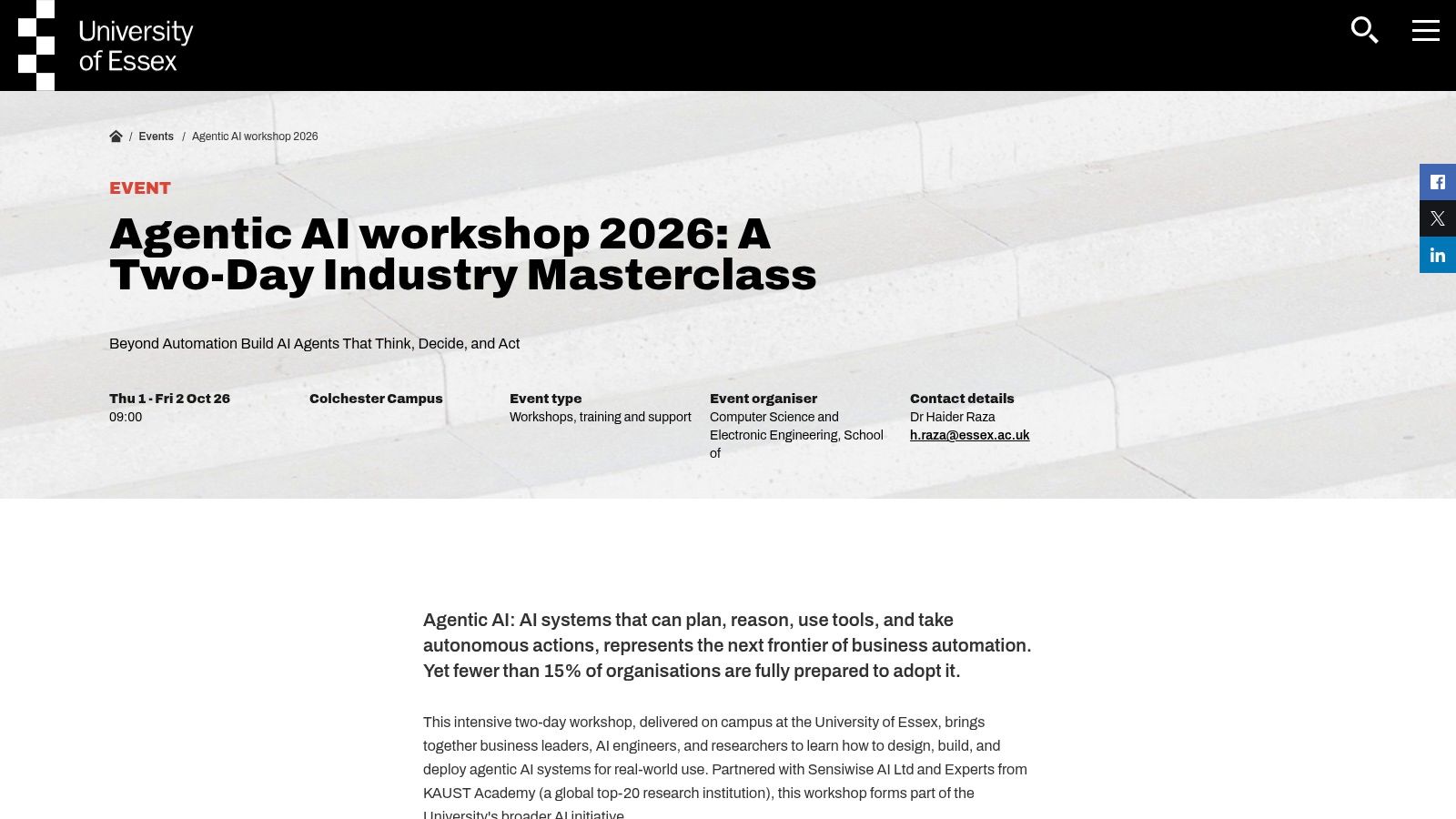
This is one of the better middle-ground options if your group includes both managers and technical staff.
The two-day campus format mixes code and no-code tracks. Labs cover research and data-analyst agents, meeting-summary pipelines, agentic RAG, model selection, tool integration and responsible AI. That combination makes it more mixed-team friendly than a pure developer course or a pure executive programme.
Mixed-team value
In an independent property business, the strongest use case is a small cross-functional group. Someone technical can test what's possible. A manager can define the escalation rules, approval points and practical limits.
That setup suits internal admin workflows. It might be meeting-summary pipelines after landlord or contractor calls. It might be a research-style assistant for pulling together block management context before a staff member acts. The certificate adds structure, but the value is getting different roles to look at the same process from different angles.
This is also where national skills policy is moving. The UK government's AI foundation benchmark defines six foundation skills for work, including writing clear instructions for AI tools, using AI tools to support routine processes and tasks, and understanding the risks and consequences of AI use. That's much closer to real operations than generic prompt training.
The limitation is time. Two days won't give deep coverage of everything. Fixed dates and a Colchester location also reduce flexibility.
The website is University of Essex Agentic AI Workshop 2026.
8. Weights and Biases The AI Agent Workshop London
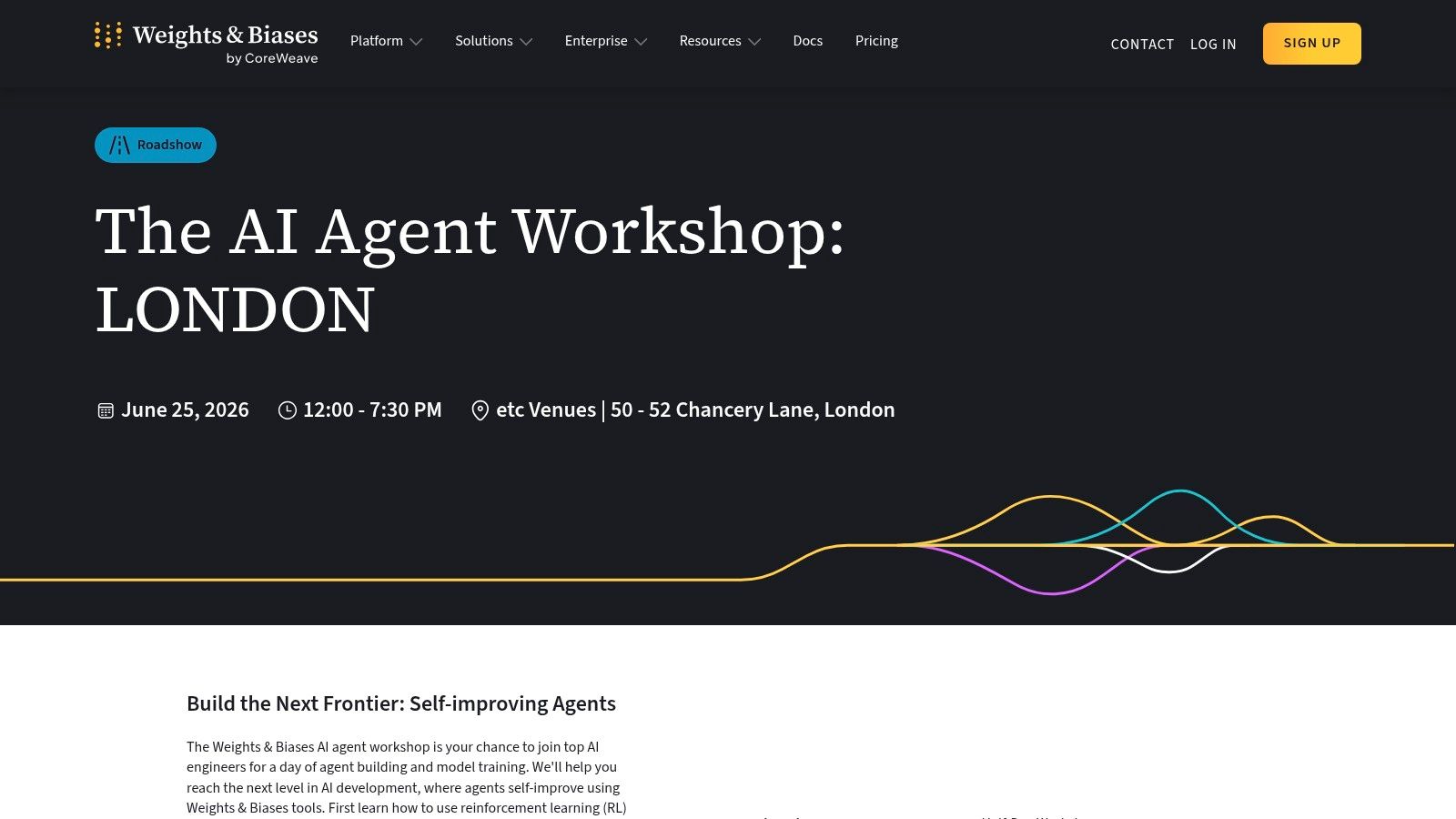
Skipping evaluation is usually a mistake.
The Weights and Biases workshop is narrow, but it goes after an important part of agent work that many general courses leave too vague. It focuses on real tasks, self-improving agents, serverless reinforcement learning, guardrails, MCP, agent skills and W&B Weave. That makes it more useful for teams already thinking about telemetry, repeatable testing and improvement loops.
Where it earns its place
If your technical team is building something that needs monitoring over time, this matters more than another intro course.
A property example would be testing maintenance-triage outputs against approved categories and expected actions before anything reaches a tenant. Evaluation can show drift, weak classifications or repeated failure patterns. It does not remove responsibility. A person still approves external communication, and compliance judgement still sits with the business.
Good monitoring doesn't make a weak process safe. It makes failure visible earlier.
This is a half-day event and that shows in the fit. It won't suit an owner looking for broad operational awareness. It suits a technical team that already knows why monitoring matters and wants sharper practice around it. The stack dependence is also real. If W&B tooling isn't relevant to your environment, the workshop narrows quickly.
The website is Weights and Biases AI Agent Workshop London.
9. Cambridge Spark Level 4 AI and Automation Practitioner apprenticeship
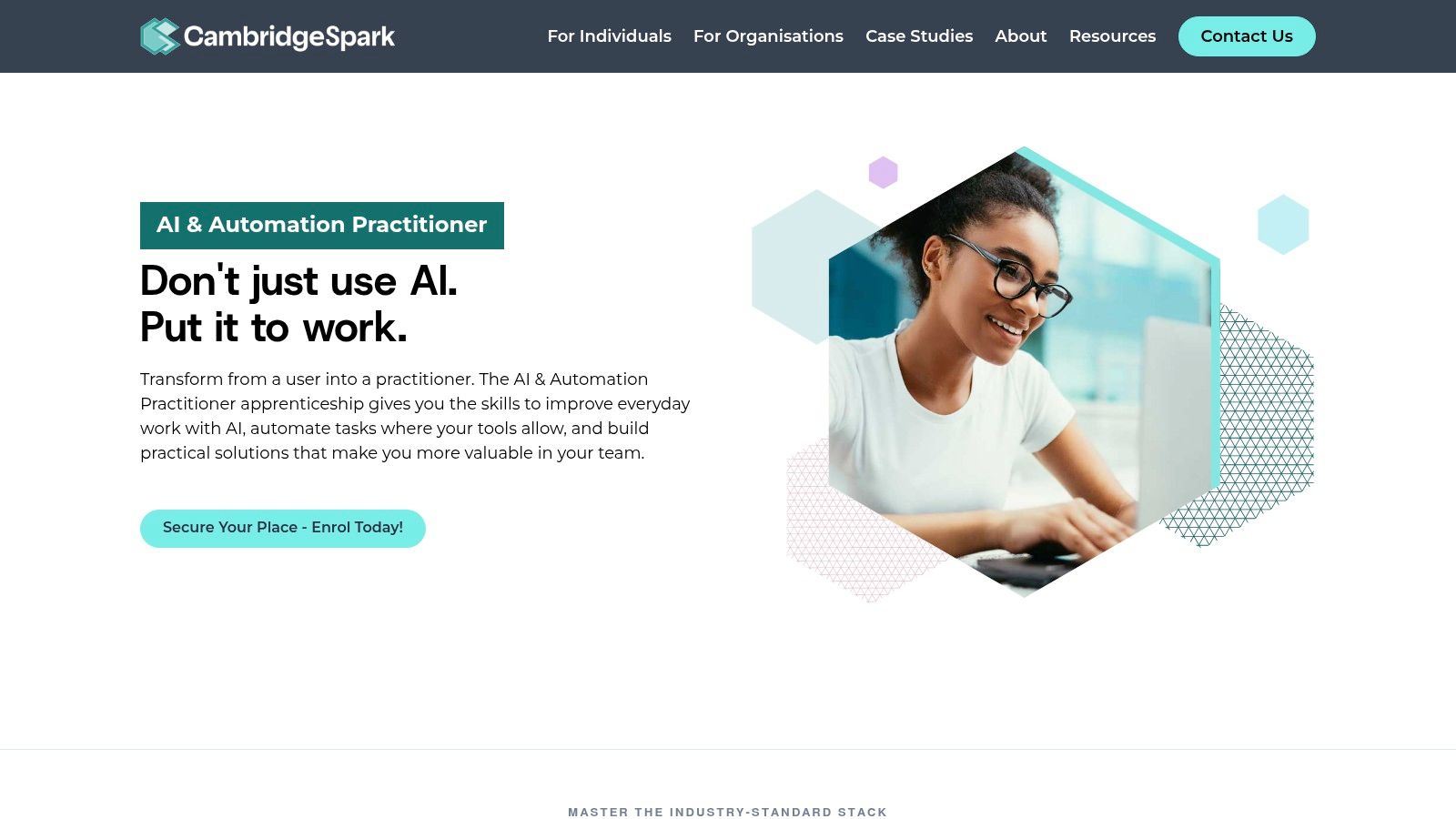
Short courses are useful. They don't always build internal ownership.
That's why the apprenticeship route deserves a place here. It's the slowest option on the list, but for the right employer it builds a proper internal workflow specialist rather than giving everyone a brief burst of exposure. The programme runs for 14 months and covers agentic patterns such as ReAct, tool use, memory, multi-agent orchestration, RAG, responsible AI, AI economics and LLMOps, delivered through live virtual workshops, self-paced learning, mentoring and coaching.
When the long route is the right route
This fits an employer that wants somebody inside the business to document recurring workflows, test agent behaviour against them, record approval rules and improve adoption steadily.
That can work well where the same operational pain keeps recurring across tenancies, maintenance, service-charge administration or booking operations. It doesn't replace Reapit, Alto, Fixflo, Arthur or Qube. It helps somebody in-house learn how to make those systems work better together.
The UK data backs the need for deeper capability. The ONS reported that 62% of UK businesses say they are training or retraining existing staff to integrate AI skills, while only 11% say more than half their workforce has received AI-related training, and 57% of AI-sector respondents plan to adopt Agentic AI within the next 3 years. Intent is ahead of operational depth.
This isn't a public short course. Eligibility matters, funding matters, and management support matters. Time-to-impact is slower than hiring a specialist or buying external delivery, but the capability lasts longer if the apprentice is given a real operational problem to own.
The website is Cambridge Spark Level 4 AI Workflow Specialist apprenticeship.
10. UCL Centre for Digital Innovation AWS Agentic AI Immersion Day
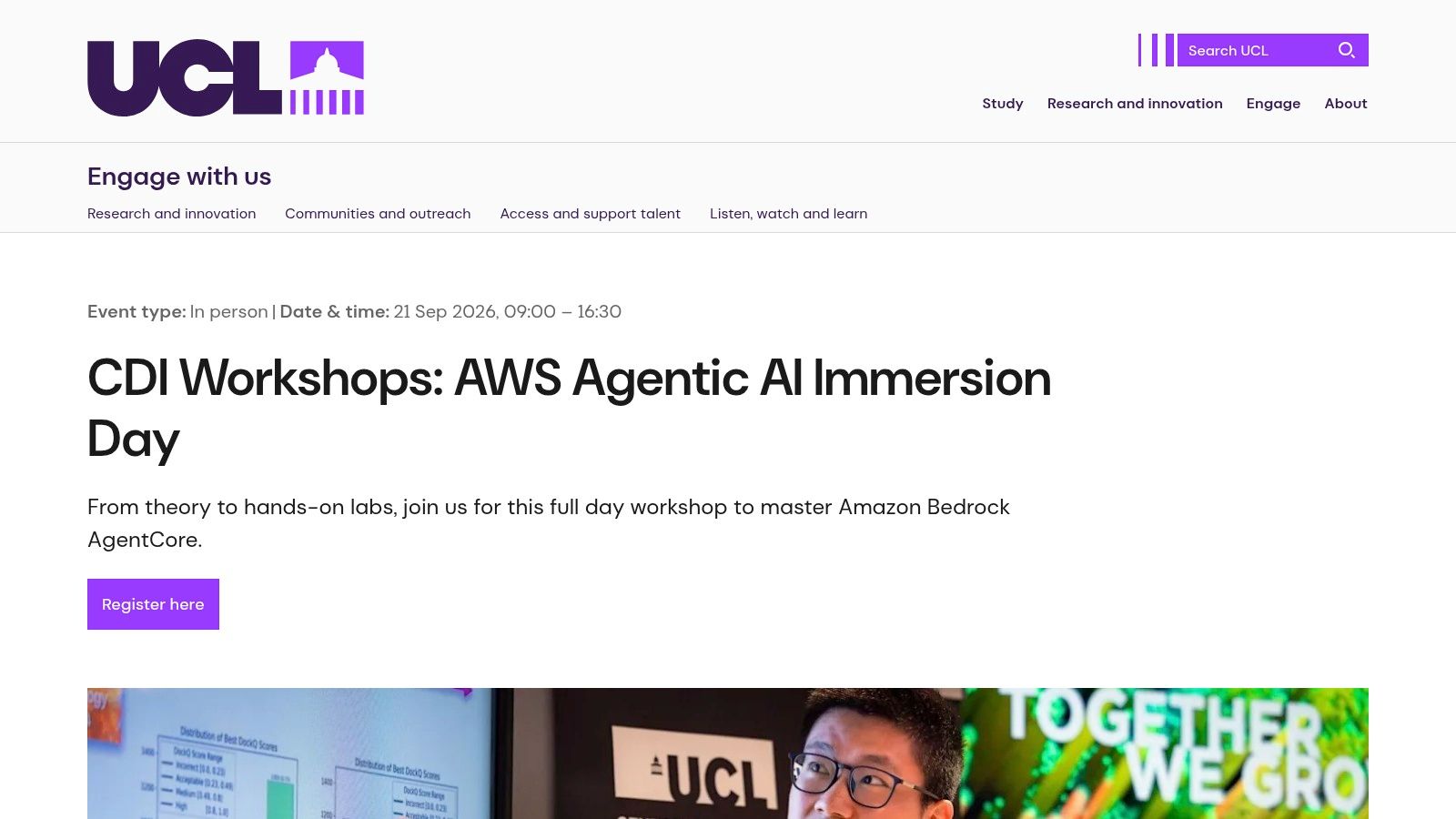
This is the cheapest way on the list to get a structured in-person look at platform-specific agent work, provided AWS is already on your radar.
The format is a one-day London immersion with guided theory and hands-on labs focused on Amazon Bedrock AgentCore. That makes it a sensible test bed for a technical team that wants to explore Bedrock Agents and AWS delivery patterns without committing to a larger programme upfront.
Good fit and obvious limits
This works when the business already has, or is considering, an AWS direction.
A technical team could use the day to explore a bounded internal information workflow, define what data an agent can access, and document where human approval must sit before any external output leaves the business. That's useful discipline. It still won't answer all your integration or compliance questions in one day.
A lot of UK businesses are still earlier than that. Government-backed reporting says only 21% of UK workers feel confident using AI at work, only 1 in 6 UK businesses were using AI by mid-2025, micro-businesses were 45% less likely to adopt AI than large firms, and a trial across 3,549 Department for Work and Pensions staff using Microsoft 365 Copilot found 65% reported increased job satisfaction. Structured rollout and support matter as much as the tool itself.
That's the main limitation here. It's a snapshot. If AWS isn't part of your likely stack, free self-paced learning may be enough. If AWS is relevant, the live lab environment is a better first test than reading documentation in isolation.
The website is UCL Centre for Digital Innovation AWS Agentic AI Immersion Day.
Top 10 AI Agents Training Comparison
| Service | Best for (👥) | Core offering / USP (✨/🏆) | Delivery & Quality (★) | Value & Price (💰) |
|---|---|---|---|---|
| 🏆 InnovaAI Integration Ltd | 👥 Property owners / SMEs needing workflow fixes | ✨ End‑to‑end advise→build→enable; custom agents, automation, dashboards; named practitioner | ★★★★★ In‑person & remote; 50+ builds, 500+ trained; approval checkpoints | 💰 Bespoke, fixed‑price after scoping; higher upfront, clear ROI |
| LangChain Academy, Deep Agents course | 👥 Developers / technical operators | ✨ Deep LangChain patterns (MCP, memory, delegation); hands‑on labs | ★★★★ Self‑paced, practical capstone; framework‑specific | 💰 Free access |
| Hugging Face, AI Agents Course | 👥 Engineers & advanced learners | ✨ Framework‑agnostic comparisons; Spaces examples & optional cert | ★★★★ Self‑guided, community examples, final project | 💰 Free (optional cert) |
| Cambridge Judge, Agentic AI: Design, Build, Govern | 👥 Leaders / execs deciding governance | ✨ Governance + 90‑day roadmap; faculty‑reviewed strategy | ★★★★ 3‑day in‑person, no‑code labs; premium cohort quality | 💰 Premium fixed‑date pricing |
| JBI Training, AI Agents Training | 👥 Mixed technical teams needing UK delivery | ✨ Multi‑stack courses, public dates & corporate cohorts | ★★★★ Instructor‑led; public/London, online & onsite options | 💰 Paid, transparent public pricing |
| The TESS Group, Build AI Agents (workshop) | 👥 Practitioners wanting a working agent quickly | ✨ Outcome‑led builds; tool‑agnostic demos; governance templates | ★★★★ 1–2 day hands‑on; ships agent per attendee | 💰 POA (cohort-dependent) |
| University of Essex, Agentic AI Workshop 2026 | 👥 Mixed teams (tech + managers) | ✨ Code & no‑code labs, certificate, practical projects | ★★★ Two‑day campus masterclass; balanced tracks | 💰 Affordable university fee |
| Weights & Biases, The AI Agent Workshop: London | 👥 Technical teams focused on evaluation/ops | ✨ Telemetry, RL, evaluation loops with W&B tooling | ★★★★ Half‑day specialist workshop; strong MLOps focus | 💰 Paid event (limited dates) |
| Cambridge Spark, Level 4 AI & Automation Practitioner | 👥 Employers wanting internal specialists (eligible UK hires) | ✨ 14‑month apprenticeship, L4 qual, levy funding option | ★★★★ Long‑form mentoring + workshops; embeds capability | 💰 Levy‑funded if eligible / paid otherwise |
| UCL CDI, AWS Agentic AI Immersion Day | 👥 Teams evaluating AWS/Bedrock Agents | ✨ Bedrock AgentCore labs; university‑hosted hands‑on day | ★★★ One‑day guided lab; good intro for AWS users | 💰 Free (Eventbrite registration) |
Start With the Bottleneck You Already Know
Don't pick an AI agents training programme by brand first. Pick it against one real process you already know is broken.
For most independent property businesses, that's something like maintenance triage, certificate renewals, tenancy progression, service-charge administration, client money checks, voids, or serviced-accommodation turnaround. The right programme depends on whether you need leadership judgement, internal capability, or somebody to build and train around a working system.
Start with the current workflow and inspect it properly.
- Check the handoffs: Where does work move from inbox to system to person to follow-up?
- Check the data access: What sits in Reapit, Alto, Fixflo, Arthur or Qube, and what still sits in email or spreadsheets?
- Check the exceptions: Which cases break the normal flow and need a person to step in?
- Check the approval point: Who signs off anything that goes to a tenant, landlord or regulator?
- Check the ownership: After training finishes, who owns the process?
That matters because adoption is moving faster than discipline. ONS reported that 25% of UK businesses were using AI in late December 2025, rising by 15 percentage points since late 2023, with 26% by April 2026 and 18% planning adoption in the next 3 months. The bottleneck now often isn't awareness. It's role-specific implementation, governance and outcome tracking.
The government direction points the same way. UK guidance now includes an AI Skills Framework, AI Skills Adoption Pathway Model and Employer AI Adoption Checklist, and the PRIMES framework sets out training principles that are Practical, Reachable, Integrated, Modular, Expandable and Sustainable. In plain terms, training works better when it sits inside the workflow and scales in small pieces.
There's also a capacity gap that isn't going away on its own. The government's AI Skills Boost programme is targeting 10 million workers by 2030, up from the earlier 7.5 million target, and industry partners had reported more than 1,001,147 course completions by January 2026. That tells you two things. Interest is real. Structured training at scale is becoming normal.
Still, doing nothing, hiring, switching platform or using ChatGPT may be the right call if the process is too variable, the data isn't ready, or the control requirements aren't clear enough yet. If you want a practical way to assess that before spending money, use the AI Readiness Scorecard tool to baseline where the opportunities and likely costs sit.
Look at the workflow first, not the demo. If you want to talk through whether a process in your business is suitable, book a free discovery call through the InnovaAI Integration homepage. If it isn't a fit, I'll say so on the call.
If you need more than a course, InnovaAI Integration Ltd builds and trains around working systems for property businesses, from maintenance triage and certificate workflows to internal dashboards and approvals connected to the software you already run. Have a look at InnovaAI Integration Ltd if you want to work out whether bespoke delivery, team training, or a smaller pilot makes sense for your operation.