AI Integration Services for UK Property Businesses
ai integration servicesai for letting agentsproperty automationai integration uksmes ai

Tuesday starts with the shared inbox already on fire. There's a deposit dispute draft that should've gone yesterday, a landlord pinging about a renewal on WhatsApp, three viewings to confirm, and a cluster of maintenance messages sitting in Fixflo, Reapit, Alto, Arthur, Qube, and a spreadsheet the team swears they'll kill off next month.
By 9am, someone has answered the 8pm tenant message, but only after copying half the detail from one system into another. That's the problem. Not effort. Not attitude. The work is split across too many places, and every extra hand just adds another person to the relay.
Table of Contents
- What Your Tuesday Morning Actually Looks Like
- Why the Backlog Will Not Shrink by Hiring Again
- What an AI Integration Service Actually Delivers
- AI Integration Versus Doing Nothing, Hiring, Switching or ChatGPT
- What AI Integration Will Not Fix in Your Business
- Where to Look in Your Own Operation First
What Your Tuesday Morning Actually Looks Like
The office doesn't fail because the team is lazy. It fails because the work enters in fragments and leaves in fragments. A repair lands in Fixflo, a tenant replies in email, a contractor confirms by text, and the diary lives somewhere else entirely.
A renewal in Reapit or Alto still needs someone to check dates, chase signatures, and update the landlord. A block team running Arthur or Qube still has to line up service charge queries, contractor responses, and the inevitable follow-up calls. PayProp handles one slice of money movement, but it doesn't remove the need to reconcile the rest of the admin around it.
The switchboard problem never went away
You already know the pattern. One person owns the inbox, another person owns the diary, and a third person owns the spreadsheet that keeps the whole thing honest. When one task crosses systems, the same facts get retyped, rechecked, and re-sent.
Practical rule: if a task needs three systems and two humans just to reach the next step, it's a workflow problem, not a staffing problem.
That's why the 8pm message sits until the morning. The tenant doesn't care which platform holds the record. They care that nobody has a clear route to answer them quickly and correctly.
If you want a simple internal benchmark for that sort of fragmentation, the operational KPI dashboard view is the right place to start, because it shows the joins instead of pretending the inbox is the business.
Why the Backlog Will Not Shrink by Hiring Again
Hiring another administrator feels like the obvious fix because the inbox is visibly full. It isn't the fix. It just adds more processing capacity to a broken flow, and the breakage stays exactly where it was.
The work in a property office is not one queue. It's multiple queues crossing at the same points. Maintenance triage needs a decision, tenant communication needs context, compliance chasing needs evidence, and scheduling needs a clean handoff. Those tasks are split across CRM fields, email threads, WhatsApp, paper notes, and whatever spreadsheet someone built in a hurry.
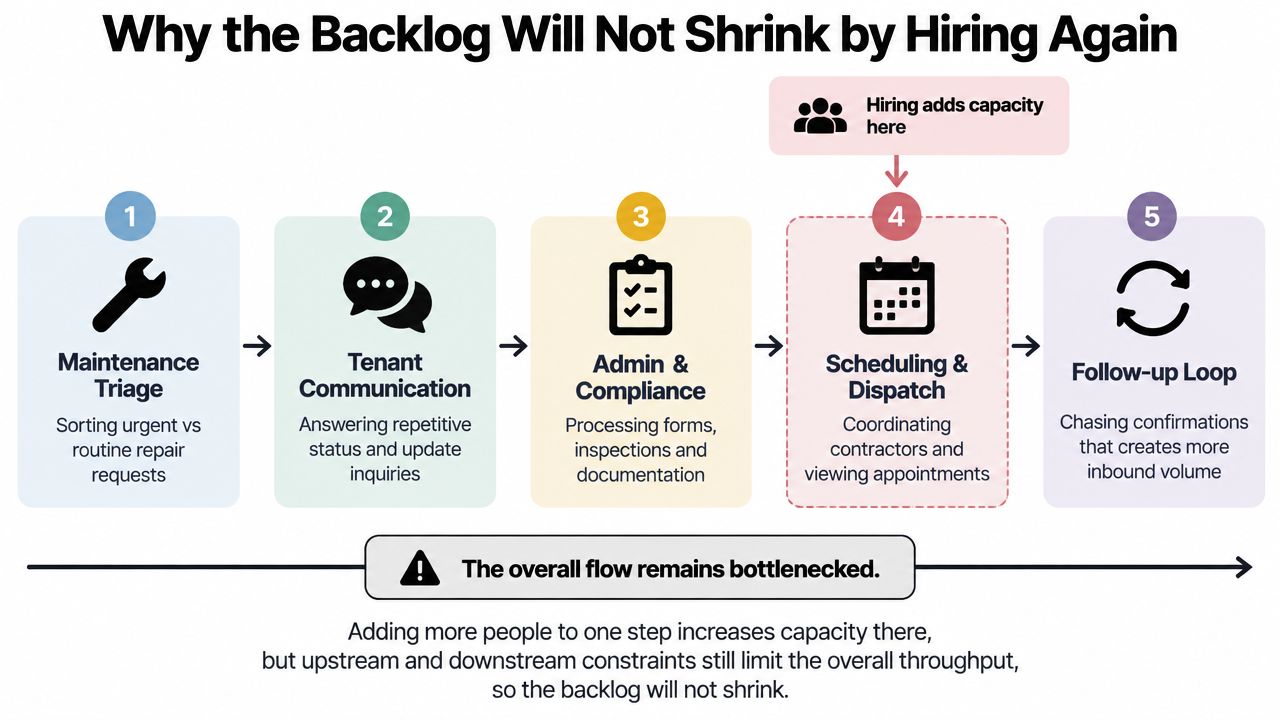
The bottleneck moves, the mess stays
A new hire can answer more messages. They can't magically know which ticket is urgent, which one is duplicated, which contractor is already booked, or which lease clause matters. Every extra person still needs training, handover time, and approval from the same overworked manager.
The result is coordination overhead. More people means more relaying, more checking, and more room for delay if there isn't a single workflow owner. The actual backlog sits in the joins between systems, not in the number of names on the payroll.
That's why the answer is structural. If the workflow doesn't know where a job is, who owns it, and what happens next, the team will keep chasing their own tail no matter how many times you recruit.
What an AI Integration Service Actually Delivers
A proper AI integration service doesn't replace Reapit, Alto, Fixflo, Arthur, Qube, or your inbox. It sits across them, maps the messy part of the process, and makes the handoffs behave like one working system instead of six disconnected ones.
The build starts with the workflow, not the model
First, the workflow audit. I'd map how a maintenance request, arrears chase, renewal, or landlord update moves through your business. Then I'd check where the data lives, which system is the source of truth, and where staff are re-keying the same thing twice.
From there, the integration layer gets built. That usually means APIs where they're clean, webhooks where events can fire properly, and RPA fallback where a platform's interface is awkward. Only then do the AI agents go in, for the jobs that are repetitive and rule-based, like maintenance classification, arrears drafting, compliance chasing, landlord reporting, and applicant-to-property matching.
Every outward step needs a person
Nothing should hit a tenant, landlord, lessor, or regulator without human review. That means a review queue before send, a sign-off step before anything leaves the system, and an exception route for anything unusual. You keep the judgement with the team, and the software handles the dragging admin.
The compliance side matters too. For anything involving personal data, the UK government's AI Playbook says organisations should complete a data protection impact assessment, identify the purpose and necessity of processing, map personal data flows and sources, establish the lawful basis under Article 6 of UK GDPR, and consider Article 9 conditions where special category data is involved. A solicitor or compliance adviser should still confirm how that applies in your operation.
Typical deliverables look like this.
| Deliverable | Owner | Approval Gate |
|---|---|---|
| Workflow map | Integration lead | Operations sign-off |
| Integration diagram | Technical lead | System owner review |
| Agent specifications | Build team | Manager approval |
| Review console | Operations team | Human send check |
| Runbook | Delivery lead | Internal training sign-off |
| Post-launch monitoring | Named owner | Weekly review |
The practical point is simple. You're buying working joins between systems, not a shiny chatbot sitting on top of the same backlog.
If you want to see how integration work sits against the rest of the stack, the system integration software discussion is the relevant one, because property ops lives or dies on the join points.
AI Integration Versus Doing Nothing, Hiring, Switching or ChatGPT
Most independent firms face four choices. They can do nothing, hire again, switch platform, or use ChatGPT directly. Only one of those keeps the current stack and attacks the actual bottleneck.
Doing nothing is the cheapest on paper and the most expensive in drift. The inbox stays full, responses slow down, and landlord confidence takes the hit when simple queries start stretching past sensible turnaround times.
Hiring another administrator helps volume, but it doesn't remove the training curve, holiday cover problem, or payroll exposure. A new person rarely knows your business well enough to carry judgment quickly, so the backlog just moves sideways while they learn.
Switching platform is the distraction people underestimate. Replacing Reapit, Alto, Qube, or Arthur means uprooting data, retraining the team, and living through a long period where nothing feels settled. That's the wrong move unless the core platform is broken.
Using ChatGPT directly sounds easy until someone pastes tenant data into a public tool and you lose the audit trail back into the system of record. It's fine for drafting ideas. It's not a workflow, and it's not accountable.
| Option | Typical Cost | Time to First Result | Main Risk |
|---|---|---|---|
| Do nothing | Low upfront, high in hidden admin drag | None | Backlog and response times worsen |
| Hire again | Payroll plus training overhead | Slow | Extra headcount without workflow fix |
| Switch platform | High project cost and disruption | Very slow | Data loss, retraining, downtime |
| ChatGPT directly | Low upfront, risky in practice | Fast but unmanaged | No audit trail, data handling issues |
| AI integration services | Targeted build cost | Faster than hiring or switching | Poor fit if the back office is messy |
The narrower route is to keep the platform, keep the team, and automate the repetitive joins around it. That's where InnovaAI Integration Ltd fits alongside other build partners in the market, because the job is to connect what you already run, not rip it out and start again.
What AI Integration Will Not Fix in Your Business
A good integration partner should be blunt about the dead ends. AI will not fix a maintenance culture where contractors ignore jobs and nobody closes the loop in Fixflo. It will not rescue arrears chasing if the whole process depends on one negotiator's memory.
It also won't magic missing data into existence. If landlord bank details, deposit records, or compliance certificates live in spreadsheets instead of Reapit, Alto, or Qube, the system can't reason properly over what it can't see. Garbage in still means garbage out, just faster.
Some problems are not technical
AI won't write your client money handling policy, your HMRC money laundering risk assessment, or your redress scheme complaints procedure. It should not be drafting Section 21 or Section 8 notices without solicitor review either. That's legal and compliance territory, not automation territory.
It won't fix underpriced block management fees, and it won't win back landlords you lost through poor communication last year. If the commercial model is wrong, or the service culture is weak, software only exposes it faster.
If the business doesn't know its own process, AI will just accelerate the confusion.
That's why a serious engagement starts with operational honesty. If the problem is staffing, legal structure, or pricing, deal with that first. If the problem is repetitive admin trapped between systems, then integration earns its keep.
Where to Look in Your Own Operation First
Start with the shared inbox and the maintenance log. Pull the last 30 days of messages and separate the routine questions from the exceptions. If half the work is status chasing, acknowledgements, or document requests, you've found the first candidate.
Then watch one repair from first contact to contractor confirmation. Mark every place where a human has to copy data from one place to another, or stop and ask someone else what to do next. Those joins are the cost centres.
Build your shortlist on evidence, not ambition
- Routine volume: Count how many times your team answers the same tenant, landlord, or contractor questions.
- Manual joins: Identify where a Fixflo ticket, a Reapit tenancy, or an Alto record fails to trigger the next step.
- Friday admin: Time the manual work that gets pushed into reports, arrears prep, or service charge chasing at week-end.
- Decision points: Note where a person still has to approve anything that leaves the business.
- Messy sources: List the spreadsheets, paper diaries, and WhatsApp threads that carry real operational weight.
For a practical way to frame that work, the workflow automation tools angle is useful, because it forces you to ask which tasks are repetitive, high volume, and low judgement.
Bring one number with you to any discovery call, even if it's rough. Hours spent, multiplied by your loaded hourly cost, is enough to tell you whether the project is worth looking at.
If you want to see whether your backlog is really an integration problem or just a resourcing one, start with the inbox, the repair flow, and the joins between systems. InnovaAI Integration Ltd builds connected workflows for letting, block, and serviced accommodation operations, and I'll tell you on a free discovery call if it's a fit or not.