10 Workflow Automation Tools for Property Firms
workflow automation toolsproperty automationletting agency softwareblock managementSME automation
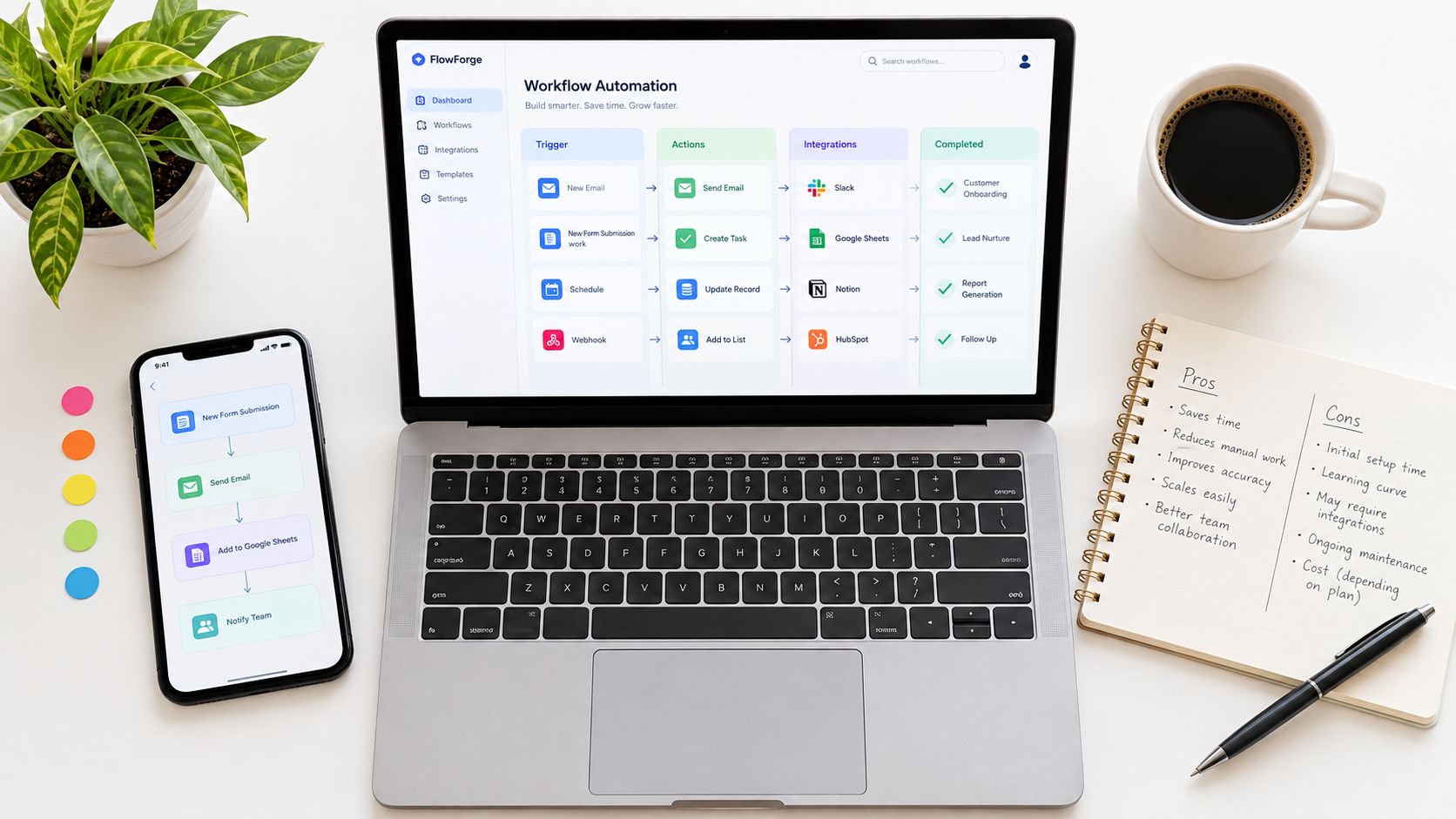
Tuesday morning starts with the shared inbox already full. A certificate renewal is sitting unchecked, the maintenance queue has three vague descriptions waiting for triage, and the tenant who messaged at 8pm is still waiting for a reply.
That usually isn't a staff-effort problem. It's a process problem. Information moves from inbox to spreadsheet, from spreadsheet to Reapit, Alto, Fixflo, Arthur or Qube, then back to a person who has to decide what happens next. Triggers are missing, hand-offs are unclear and nobody quite owns the approval.
The right workflow automation tools can connect those steps without replacing the property platform you already pay for. They can classify maintenance requests, flag certificate dates, move tenancy progression forward and prepare messages. A person should still approve anything sent to a tenant, landlord or regulator, and no system should make a legal or compliance decision without qualified review.
This comparison looks at ten tools through that practical lens, including process fit, limitations, implementation effort, data handling and the buying decisions that matter to an independent UK property firm.
Table of Contents
- 1. Can InnovaAI Integration build the workflow around my existing property systems?
- 2. Is Zapier enough for straightforward property admin?
- 3. Does Make give me better control over branching and exceptions?
- 4. Is n8n the right choice if I need data control?
- 5. Would Microsoft Power Automate fit a Microsoft-heavy office?
- 6. Is Workato too large for an independent property firm?
- 7. Does Tray.ai help with hybrid property systems?
- 8. When is UiPath justified for property operations?
- 9. Is Pipedream suitable for a technical property business?
- 10. Can Parabola replace the spreadsheets behind my operations?
- Top 10 Workflow Automation Tools: Feature Comparison
- Start With the Bottleneck You Can See
1. Can InnovaAI Integration build the workflow around my existing property systems?
InnovaAI Integration is the strongest fit when the problem isn't choosing another application, but connecting the systems and hand-offs you already have.
The West Midlands-based studio builds custom AI agents, workflow automations, dashboards and internal web apps for UK SMEs and mid-sized organisations. Its work can connect with Reapit, Alto, Fixflo, Arthur, Qube, inboxes, phones and existing channel managers, so the property system remains the system of record.
That matters in property operations. Replacing a platform means retraining staff, moving records and accepting disruption across doors, units, blocks or bookings. A connected workflow can sit around the existing setup instead.
What it can handle in a property operation
A typical build might receive a maintenance request, extract the address and issue, check whether the description contains enough information, classify urgency and send the case to the correct queue. A member of the team then approves the proposed response or escalation.
For certificate renewals, the system can read dates from existing records, create reminders, identify missing documents and prepare a task for the responsible person. It shouldn't decide whether a property is legally compliant. A solicitor, compliance adviser or suitably qualified property professional should confirm how any requirement applies.
The same approach works for tenancy progression, landlord updates, service-charge administration, voids and booking turnaround:
- Trigger: A new email, form submission, status change or approaching date starts the workflow.
- Data check: The system looks for the property, tenant, landlord, unit or booking record and flags missing information.
- Suggested action: It drafts a task, update or reply using the approved process.
- Human approval: A named team member checks anything that reaches a tenant, landlord, regulator or client-money process.
- Record update: The approved action is written back to the appropriate system and logged for review.
InnovaAI combines discovery, build, advisory and training, with Cameron Atwal providing named end-to-end accountability. The publisher states that it has shipped 50+ AI builds and trained 500+ professionals, with fixed-price proposals following scoping and training embedded in each build.
The trade-off is clear. Bespoke work needs proper discovery and normally requires more upfront time and cost than a simple off-the-shelf connection. It isn't the sensible choice for a low-volume process that a member of staff can handle without friction.
For an owner running a letting agency operation, the value is in fitting the workflow to the way the team works, rather than forcing the team into a template.
2. Is Zapier enough for straightforward property admin?
Zapier is often the quickest starting point when the workflow is simple and the applications already have supported connectors.
It connects SaaS applications through triggers, actions, filters and paths. A letting team might use it to send a new lead into a follow-up queue, create an internal task when a form arrives or notify the property manager when a landlord email is received.
Zapier also includes Tables and Interfaces, which can help a small team replace a basic spreadsheet used for intake or status tracking. That can be useful for a voids pipeline or a list of missing documents, provided the proper property platform remains authoritative.
Where it works and where it stops
The large integration library and approachable interface suit non-technical users. A team can test a narrow process without waiting for a developer, and templates reduce the amount of setup needed.
The weakness appears when the process has exceptions. Maintenance triage may involve access instructions, vulnerable occupants, contractor availability, insurance considerations and an approval before any tenant-facing message. A simple chain of actions can become difficult to audit once branches and workarounds accumulate.
Zapier is US-hosted, with data-transfer arrangements involving DPF or SCCs rather than UK or EU data residency. That doesn't automatically make it unsuitable, but the business should document what personal data enters the workflow, where it is processed, how long it is retained and whether the arrangement is acceptable under its own advice.
Task-based usage can also become difficult to control when every small action counts. Optimise the workflow before connecting high-volume inboxes or booking events.
Practical rule: Use Zapier for a clearly bounded hand-off. Don't use it as an informal replacement for your tenancy, maintenance or client-money system.
The workflow automation comparison from InnovaAI Integration is useful when you need to test whether a simple connector is enough or whether the process needs a more controlled build.
3. Does Make give me better control over branching and exceptions?
Make is better suited than Zapier when the workflow needs visible branching, data mapping and error handling.
Its scenario builder uses routers and iterators to split and repeat actions. The HTTP module can connect to systems that don't have a ready-made module, which is useful when a property platform, channel manager or internal database exposes an API but isn't listed in the standard catalogue.
Consider maintenance triage. One route might send a clear repair request to Fixflo, another might ask the tenant for missing information, and a third might create a priority review for a property manager. Make lets the logic remain visible rather than hiding every decision inside a chain of small connections.
The operational trade-off
The visual control is valuable, but it comes with a learning curve. Someone needs to understand data structures, failed runs, duplicate records and what happens when an API returns incomplete information.
Make uses credits, and individual steps can affect consumption. That makes the workflow design important for certificate reminders, booking updates and repeated inbox polling. A poorly designed scenario can run actions that add no operational value.
Its hosting options include EU and North America regions on AWS, with a GDPR-aligned programme. UK businesses still need to make their own data-handling assessment, especially where tenancy records, client details or financial information are involved.
Make is a practical middle ground:
- Choose it for: Multi-step workflows with branches, transformations and visible debugging.
- Avoid it for: A process nobody in the business can maintain after the initial build.
- Require: A failure notification, retry approach and named owner for changes.
Anything that drafts a tenant reply, landlord update or regulatory notification should stop at an approval task. The tool can prepare the information and route it. It shouldn't decide the final wording or legal position.
4. Is n8n the right choice if I need data control?
n8n appeals to firms that want deeper control over integrations and hosting.
It can be self-hosted in a UK or EU cloud environment, or on premises, and it also offers a managed cloud option. Its node-based design includes generic HTTP and webhook connections, code steps and credential management. That makes it useful when Reapit, Alto, Arthur, Qube or a specialist booking system needs a custom connection.
A technically capable team could use n8n to collect certificate dates, compare them against a controlled register, create internal tasks and send a review notification. It could also orchestrate a booking turnaround process across a channel manager, cleaning schedule, maintenance queue and owner update.
The cost of control
Self-hosting gives the business more control over location, access and operating configuration. It also makes the business responsible for uptime, backups, monitoring, security updates and recovery. That is a real operational commitment, not just a licence decision.
n8n's flexibility also means a poorly governed workflow can become difficult to understand. Code steps may solve a problem quickly, then leave the business dependent on one person who knows how the workflow works.
Use it when there is a technical owner, or when an integration specialist will maintain it. Keep the approval points explicit, log every automated action and separate test workflows from live ones.
n8n is particularly strong where the process needs custom logic but the owner doesn't want to surrender data control to a purely managed platform. It isn't the easiest first tool for a property team that wants to build everything themselves between viewings and inspections.
5. Would Microsoft Power Automate fit a Microsoft-heavy office?
Microsoft Power Automate makes sense when the business already lives in Microsoft 365, Teams, SharePoint, Outlook and Azure.
It combines cloud flows with desktop RPA. That gives it two ways to connect systems. An API-based flow can move information between supported services, while desktop automation can interact with an older application that lacks a usable integration.
For example, a block management team might receive a service-charge query through a shared mailbox, create a controlled review task in Teams, save supporting documents in SharePoint and update an internal register. A human approves the response before it reaches the leaseholder.
Strong governance, awkward licensing
Power Automate includes data-loss prevention policies, environment controls and audit features. UK and regulated organisations may value the fit with their existing Microsoft governance, but the licensing matrix needs careful scoping.
Non-Microsoft connectors can require premium licensing. Desktop RPA also brings questions about unattended operation, machine access and what happens when a screen layout changes. RPA can keep an old process moving, but it shouldn't become an excuse to avoid fixing a broken process or asking a platform supplier for an API.
The tool suits:
- Microsoft-led offices: Especially where staff already use Teams and SharePoint daily.
- Mixed estates: Where one older desktop application needs controlled interaction.
- Governed operations: Where roles, audit and environment separation matter.
A practical guide to workflow automation solutions can help frame whether the problem needs an API flow, desktop RPA or a connection built around the existing property software.
6. Is Workato too large for an independent property firm?
Workato is built for governed integrations across departments, not for a quick reminder when a certificate is approaching.
Its connector library, custom connector SDK, recipe lifecycle management and environment controls suit organisations that need development, testing and production separated. Roles, audit trails and monitoring matter when finance, operations, HR and customer communication all depend on shared integrations.
A larger property group could use it to connect CRM, finance, maintenance, HR and reporting workflows. The system might coordinate a new management instruction through onboarding, property setup, compliance collection, client-money checks and reporting, with approvals at each sensitive stage.
Why it may be the wrong buy
For a single independent agency, Workato may introduce more structure and cost than the business can use. Pricing beyond self-service tiers is sales-led, and the platform is likely to need someone who can own integration design and change management.
It becomes more credible when the firm has several departments, multiple systems and a serious requirement for auditability. It is less convincing when the problem is that a team hasn't agreed who owns a shared inbox.
Workato's AI and agent capabilities shouldn't alter that judgement. If the underlying records are incomplete, an intelligent layer will only move uncertainty around faster. Establish the source of truth, approval owner and failure route first.
7. Does Tray.ai help with hybrid property systems?
Tray.ai is a low-code integration platform with a developer-leaning canvas, regional hosting and hybrid connectivity.
Its on-premises agent can help connect data that can't be exposed directly to a cloud workflow. JDBC and GraphQL support add options where a property business has a database, internal application or specialist system sitting outside the normal SaaS stack.
That could matter to a serviced accommodation operator with a channel manager, cleaning data, owner reporting and an internal booking register. It could also suit a block manager with an older database that needs to feed a controlled dashboard without moving the underlying records.
A capable but sales-led option
Tray.ai includes a Connector Development Kit, role-based access controls, audit logs and SSO. Its EU hosting option supports businesses that need to consider UK and EU data-transfer requirements.
The drawbacks are practical. Public pricing isn't listed, so the buying process is sales-led. The template and community footprint is smaller than Zapier or Make, which means the team may need more technical input before a workflow is usable.
Tray.ai is worth considering when hybrid connectivity is central. It isn't the obvious choice for a property owner who wants a team member to build a basic lead notification without technical help.
As with every platform in this list, keep the property platform as the source of truth. The integration layer should carry validated information, not become another unofficial spreadsheet that staff trust more than Reapit, Alto, Arthur or Qube.
8. When is UiPath justified for property operations?
UiPath is the most natural fit when the process needs robotic process automation as well as API connections.
It supports attended and unattended RPA, API triggers, Orchestrator, process mining and developer or citizen-developer tooling. Its Automation Cloud has UK region availability on Azure and supports UK and EU data-residency options.
A property business might consider it where staff repeatedly copy information between a legacy desktop application and a newer platform, particularly when the old application has no usable API. It can also help expose where a team spends time in a process before deciding whether the better answer is integration, redesign or additional capacity.
Don't automate a legal judgement
UiPath is heavyweight for a simple API-only workflow. Licensing spans multiple modules, so scoping matters. The business also needs a clear owner for bot credentials, exception queues, machine access and changes to the screens the bot uses.
RPA follows the visible steps a person takes. If a button moves, a field changes or an unexpected document appears, the bot may stop or process the wrong information. That makes monitoring and human review essential.
Use UiPath when:
- The legacy application matters: The process can't be connected cleanly through an API.
- The steps are repeatable: The bot is following stable instructions rather than exercising judgement.
- Exceptions are owned: A person checks failed or unusual cases before anything consequential happens.
It's not a shortcut around reviewing Section 20, service-charge, client-money or tenancy decisions. Those require the appropriate human and professional oversight.
9. Is Pipedream suitable for a technical property business?
Pipedream is designed for people who want code inside their workflows rather than a purely visual builder.
It supports JavaScript, Python, Go and Bash steps, hosted OAuth clients and secure token storage. That makes it useful for niche APIs, especially where a property platform or channel manager has unusual endpoints that mainstream connectors don't cover.
A technical team could use it to receive a webhook when a booking changes, enrich the record with internal data, update a reporting service and notify the operations team. It can also prototype an integration without the business having to manage its own servers.
Speed for builders, friction for operators
Pipedream is less friendly for a non-technical property team than Zapier or Make. The workflow may be quick to build, but the business needs someone who can read the code, understand authentication and maintain it when an endpoint changes.
The platform is US-hosted in us-east-1, with DPF or SCC considerations for transfers. That makes data mapping and retention particularly important where tenant, landlord, guest or client information is involved.
Pipedream is a good engineering tool. It isn't a sensible choice because it can handle a difficult API. If nobody in the business can own the workflow after launch, a managed build with documentation and training may be safer than a clever script.
The approval stage should remain outside the code's assumptions. For instance, the workflow can prepare an owner update about a booking turnaround issue, but an authorised person should approve it before sending.
10. Can Parabola replace the spreadsheets behind my operations?
Parabola focuses on data workflows rather than broad integration governance.
It is built for visual transformations such as joins, pivots and lookups, with connectors for Google Sheets, CRMs, data warehouses and other systems. That makes it useful when the pain is a recurring export, manual reconciliation or spreadsheet cleanup.
A block management team could use it to combine unit data, contractor records and service-charge information for an internal report. A serviced accommodation operator could standardise booking exports before reviewing turnaround, occupancy or owner statements. A lettings team could prepare a controlled view of voids and outstanding tasks from several sources.
Strong for preparation, limited for decisions
Parabola helps operations staff repeat data preparation without rebuilding formulas each time. It doesn't replace Reapit, Alto, Arthur, Qube, Fixflo or a channel manager, and it isn't the right place to decide whether a compliance requirement has been met.
Credit-based execution needs planning for heavy flows. The platform is also narrower than a full integration platform, so it may become a staging area rather than the complete workflow.
That can be perfectly acceptable if the boundary is clear. Use Parabola to prepare and reconcile information, then put the approved result into the system of record. Don't let a report become the only place where a certificate, landlord instruction or client-money exception exists.
Top 10 Workflow Automation Tools: Feature Comparison
| Tool | Core features | 👥 Target | ✨ USP | ★ Quality | 💰 Price/value |
|---|---|---|---|---|---|
| InnovaAI Integration Homepage | Custom AI agents, automation, dashboards, advisory & training | SMEs & mid-sized UK organisations | End-to-end build+advise+train; named accountability; fixed‑price scoping ✨ | ★★★★☆ | 💰 Fixed-price proposals; premium bespoke ROI |
| Zapier | No-code multi-step automations; 6,000+ apps; Templates & Tables | Non-technical SMEs standardising workflows 👥 | Massive integration library; fast time-to-value ✨ | ★★★★☆ | 💰 Low entry; task-based costs can escalate |
| Make (Integromat) | Visual scenario builder; routers, iterators, error handling | Teams needing deeper logic without code 👥 | Granular control & debugging; EU hosting option ✨ | ★★★★ | 💰 Credit model; cost-effective at medium volume |
| n8n | Open-source node workflows; self-host or cloud; JS nodes | Technical teams craving data control & extensibility 👥 | Self-hosting for UK/EU residency; no per-connector fees ✨ | ★★★★ | 💰 Self-host free; n8n Cloud paid tiers |
| Microsoft Power Automate | Cloud flows + Desktop RPA; deep M365/Azure integration | Microsoft-centric orgs; public sector & regulated 👥 | Native MS ecosystem fit; strong compliance & RPA+API stack ✨ | ★★★★ | 💰 Complex licensing; aligns with M365 licensing |
| Workato | Enterprise iPaaS; connectors, lifecycle & env management | Mid-market & enterprise integration teams 👥 | Enterprise governance, observability & connector depth ✨ | ★★★★☆ | 💰 Sales-led pricing; premium for scale |
| Tray.ai (Tray.io) | Low-code canvas; SDK; on‑prem agent; regional hosting | Developer-led teams needing hybrid connectivity 👥 | Strong hybrid/on‑prem support; TypeScript SDK ✨ | ★★★★ | 💰 Sales-led; enterprise tier pricing |
| UiPath | RPA (attended/unattended), Studio, process mining | Enterprises needing RPA + strict governance 👥 | Market-leading RPA; UK/EU regions & enterprise security ✨ | ★★★★☆ | 💰 Module-based licensing; requires scoping |
| Pipedream | Code-first workflows (JS/Python/Go); serverless runtime | Developers & technical SMEs prototyping quickly 👥 | First-class code steps + serverless execution ✨ | ★★★★ | 💰 Credit/serverless billing; cost-effective for compute |
| Parabola | Visual data workflows for CSVs, Shopify, ops | Ops/ecommerce/RevOps teams automating data tasks 👥 | Spreadsheet replacement; ecommerce patterns & scheduling ✨ | ★★★★ | 💰 Credit-based; clear starter tiers |
Start With the Bottleneck You Can See
Don't begin by comparing licences. Begin with one recurring process that everyone recognises and nobody enjoys owning.
Map the process from its trigger to its final record. A maintenance request might start in an inbox, form or Fixflo, then pass through classification, tenant contact, contractor allocation, approval and closure. A certificate renewal might start with a date, require a document check, create an internal task and need a human decision before any landlord or regulator receives information.
Write down the system of record. It might be Reapit, Alto, Arthur, Qube, Fixflo, a channel manager or a controlled finance system. Every workflow should know where the authoritative record lives, what information it can read and where the approved result must be written.
Then record the hand-offs. Include the spreadsheet, wall planner, Teams message and personal inbox. The unofficial steps are often where the delay sits.
Define the approval point before building anything:
- Tenant communication: A person checks the response, tone and attachments before sending.
- Landlord communication: An authorised team member confirms the facts and instruction.
- Regulatory or compliance communication: A suitably qualified person confirms the position.
- Client money: The process routes information and exceptions, but doesn't make an unreviewed financial decision.
- Legal judgement: A solicitor or compliance adviser confirms how the requirement applies.
Check the failure path as carefully as the happy path. What happens when the property can't be matched, a certificate is missing, a contractor doesn't respond, an API fails or two team members edit the same record? A workflow without an exception queue hides the backlog.
The alternatives deserve an honest assessment. Leave the process alone when volume is low and the manual step is cheaper than building and maintaining automation. Hire when the work needs judgement, relationship management or capacity that a system can't provide. Switch platforms only when the current system blocks the process and the cost of working around it is greater than the disruption of change.
ChatGPT can help draft a reply, classify information or suggest a next step. It isn't a controlled workflow by itself. Without defined data handling, permissions, records, triggers, approvals and failure routes, it can create another place for staff to paste information and lose track of the final decision.
Use the AI Readiness Scorecard as a tool for baselining opportunities and costs, not as a substitute for mapping the process. The best first target is usually visible in a shared inbox, an ageing spreadsheet or a queue nobody has time to clear.
For a block management operation, letting team or serviced accommodation business, the practical test is the same. Can the workflow connect to what you already run, make ownership clear and stop before a human approval is needed?
If you want to work through that decision, book a free discovery call with InnovaAI Integration Ltd. We can map the process and work out whether a connected build is even a fit, and if it isn't, I'll say so on the call.
InnovaAI Integration Ltd builds custom workflow automations, dashboards and internal tools around the property platforms you already use, including Reapit, Alto, Fixflo, Arthur, Qube and channel managers. Visit InnovaAI Integration Ltd to discuss a practical process review, with human approval and UK data handling built into the design.