What an AI Strategy Consultant Does for SMEs
AI strategy consultantSME AI adoptionAI roadmapAI consulting UKAI implementation

Tuesday morning starts with the shared inbox. A tenant's message arrived at 8pm about a leak, a certificate renewal is still marked on the wall planner, and the person handling tenancy progression is copying details between email, a spreadsheet and Reapit. You hired twice already, but the backlog is the same size.
The problem isn't ambition, and it usually isn't a lack of software. It's that the process lives in too many places. AI experiments sit beside Alto, Fixflo, Arthur or Qube instead of connecting to the work your team already does.
An AI strategy consultant should help close that gap. In my case, that means building working systems for letting agents, block and estate managing agents, and serviced accommodation operators, not selling another licence or leaving you with a strategy document nobody uses.
Table of Contents
- The Tuesday Morning Problem Most SMEs Face
- Why UK SMEs Struggle with AI Adoption Despite the Hype
- What an AI Strategy Consultant Actually Delivers
- Engagement Models That Fit Different SME Situations
- Measuring ROI Beyond the Immediate Cost Savings
- Questions to Ask Before Hiring an AI Consultant
The Tuesday Morning Problem Most SMEs Face
The shared inbox is only the visible part.
A tenant sends a message outside office hours. Someone reads it the next morning, decides whether it's maintenance, passes it to a contractor, updates the property system and adds a note somewhere else. If the message includes a photograph, the image may sit in the inbox while the operative works from a short description.
The same pattern appears in block management. A compliance date is recorded on a planner, a supplier email contains the renewal evidence, and Qube or another property system holds a different version of the information. Nobody has deliberately designed the gaps. They've appeared as the business grew.

The process is fragmented, not the people
Your team may be capable and hardworking. They're still forced to remember which system contains the latest instruction, which spreadsheet has the useful workaround and who should approve the response.
That creates mechanical costs:
- Repeated entry: The same tenancy, unit or booking details are typed into several places.
- Delayed triage: A maintenance message waits for a person who knows how to interpret it.
- Unclear ownership: No one can see whether a certificate, repair or landlord update is waiting for approval.
- Inconsistent records: The property platform, inbox and spreadsheet drift apart.
- Interrupted work: Staff spend time searching for context instead of progressing a case.
AI doesn't fix a badly defined process by itself. A chatbot added to the front of a fragmented operation can create more messages, more exceptions and another screen for the team to ignore.
The useful work starts by mapping what happens from the first message to the completed action. That might mean classifying incoming maintenance requests, extracting dates from certificates, preparing a draft landlord update or assembling a serviced accommodation turnaround list. The system then connects to the platform you already run, while a person approves anything sent to a tenant, landlord, contractor or regulator.
Practical rule: If the proposed system doesn't have a named place to read from, write to and wait for approval, it isn't an operational design yet.
For a property business taking on more doors, this matters more than the model behind the tool. The aim is to reduce avoidable handling and make ownership visible, not to replace Reapit, Alto, Fixflo, Arthur or Qube.
Why UK SMEs Struggle with AI Adoption Despite the Hype
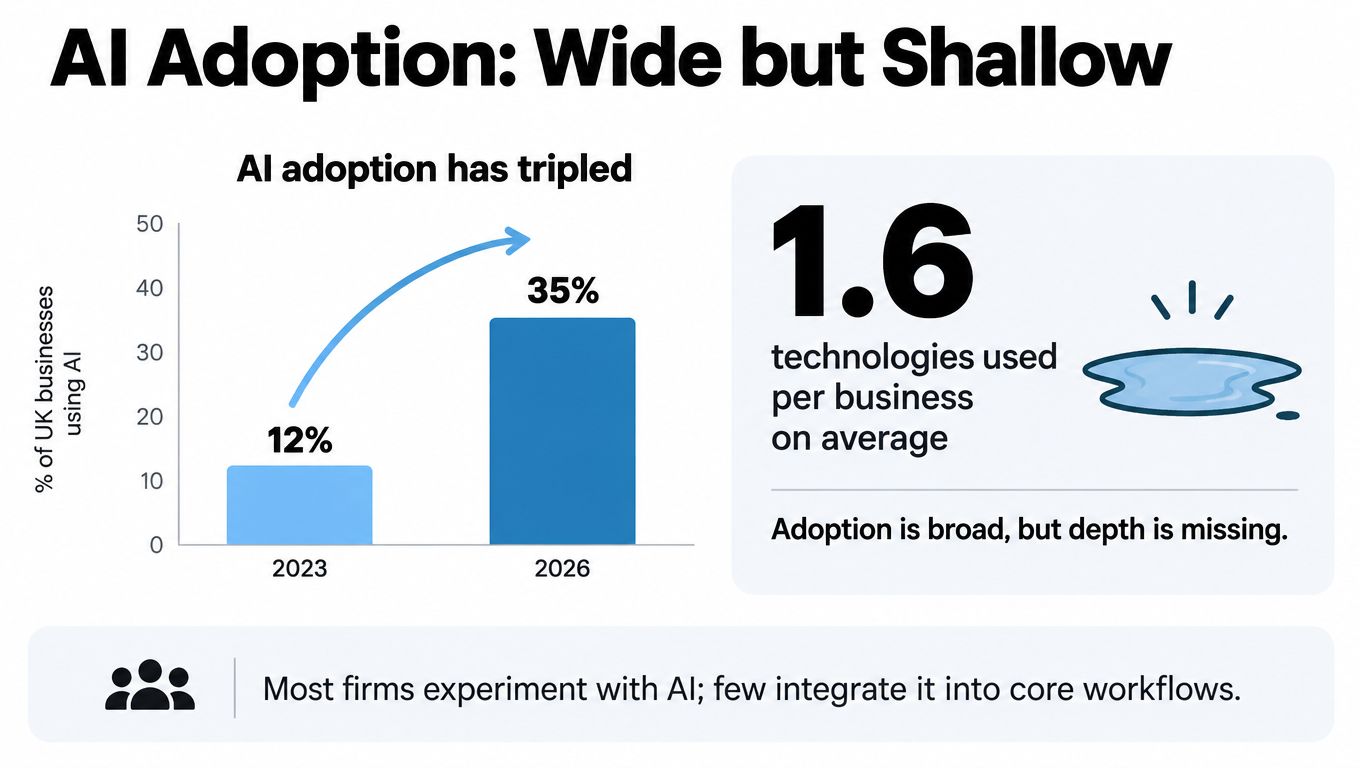
UK adoption is growing quickly, but the depth of adoption is the more useful fact for an owner deciding what to do next. The Office for National Statistics analysis of AI in UK businesses reports that use among businesses with 10 or more employees moved from roughly 12% in September 2023 to just under 35% by June 2026.
That is nearly a tripling in less than three years. Yet the average adopting business used only about 1.4 AI technologies in 2023, rising modestly to around 1.6 by 2026, according to the same ONS source.
Adoption isn't the same as integration
Those figures describe a market that is broadening without yet becoming firmly embedded. A business may have ChatGPT access, an AI email feature or a document tool, while the core process still depends on manual checking and a spreadsheet.
The UK Business Data Survey 2026 gives the operational detail. Of businesses that handled digitised data, 41% used AI-based technologies, but only 21% of those AI-using businesses had integrated AI into existing systems such as Microsoft 365, CRM, finance or workflow platforms, as reported in the UK Business Data Survey 2026.
That's the hidden gap. Experimentation happens at the edge, while the work remains unchanged in the centre.
The government has also made adoption a policy priority, with a support package of more than £200 million for businesses to test, adopt and scale AI. The package includes £100 million for Bridge AI, £53 million for new adoption and innovation initiatives, and £5 million for each AI Growth Zone, according to the government's AI adoption and skills announcement.
Support and tools won't remove the need for practical judgement. 83% of surveyed AI decision-makers said a deep learning skills shortage was hurting productivity and competitiveness. 49% said projects had been delayed, while 44% said the shortage was stopping further investment, according to the same government source.
For an independent agency owner, the implication is straightforward. The valuable question isn't “which AI tool should we buy?” It's “which workflow should change first, who owns it, what data does it need, and where must a person approve the result?”
That is why change management for AI adoption matters alongside system design. A tool that nobody trusts or understands will remain a trial, even if it performs well in a demonstration.
What an AI Strategy Consultant Actually Delivers
A useful engagement moves from diagnosis to a working change. It shouldn't start with a list of fashionable tools.
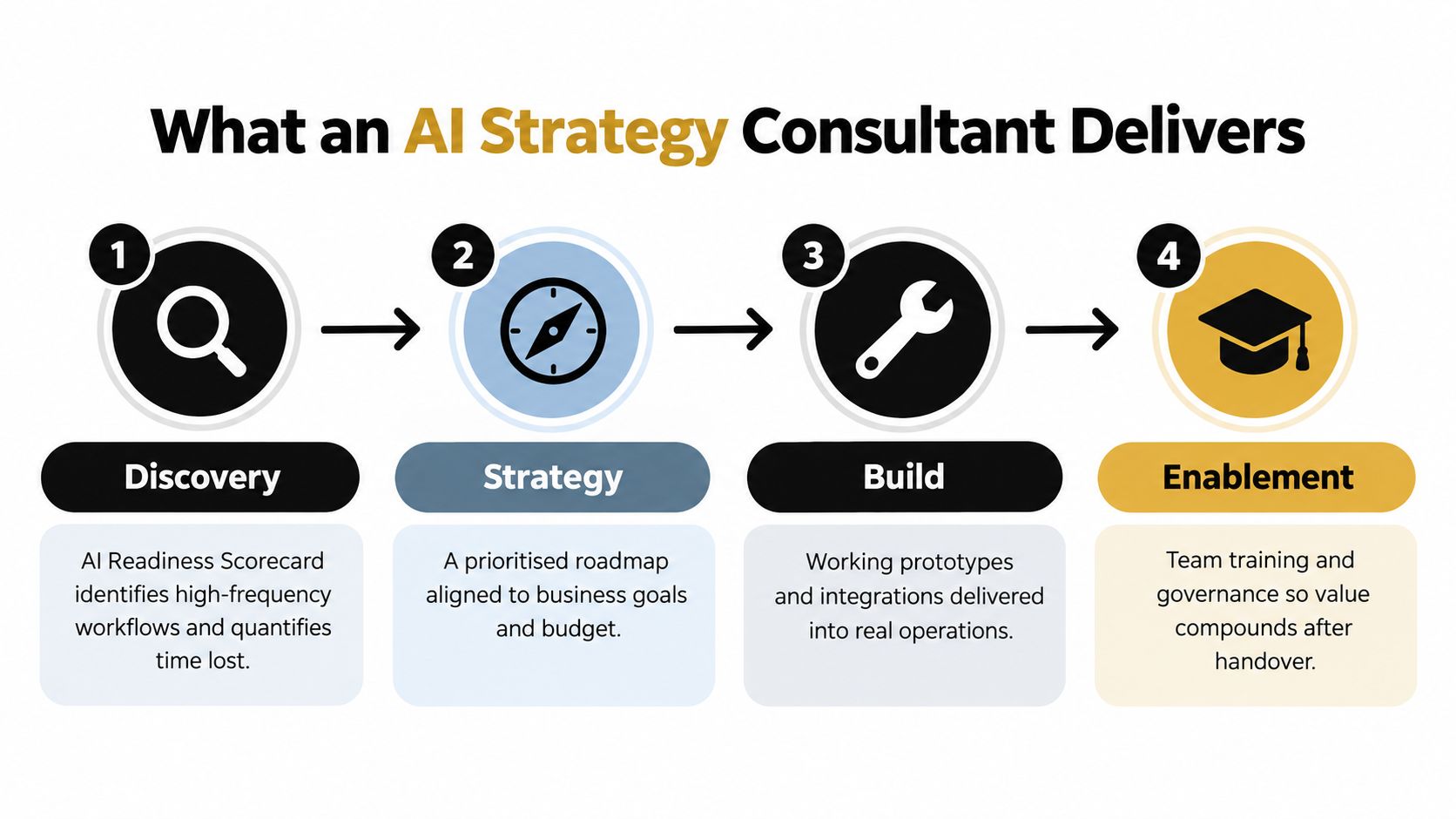
Discovery finds the work worth changing
The first step is an operational review. Look at the shared inbox, maintenance triage, tenancy progression, voids, certificate renewals, service charges, client money administration, landlord reporting and booking turnaround.
A readiness scorecard can help record where staff repeat the same handling, where information is trapped in email and where delays create follow-up work. It should also show what isn't suitable for AI. A legal decision, a regulatory judgement or a sensitive tenant outcome still needs the right human and professional oversight.
Strategy sets an order
The roadmap should rank workflows by practical value, data availability, risk and ease of adoption. A useful first project is often narrow but frequent, such as:
- Maintenance triage: Classify an incoming request, identify missing details and prepare a suggested priority for staff review.
- Certificate administration: Extract expiry dates and property references, then create a review queue rather than automatically marking anything compliant.
- Tenancy progression: Pull outstanding actions from messages and prepare a status view for an approved team member.
- Serviced accommodation turnaround: Combine booking, cleaning and maintenance information into a task list, with a human confirming exceptions.
The system must not make a legal or compliance decision without review. For requirements under England and Wales law, ask a solicitor or compliance adviser to confirm how they apply to your operation.
Build connects to the stack you have
The build stage should connect to Reapit, Alto, Fixflo, Arthur, Qube, Microsoft 365, your CRM, channel manager or finance workflow where appropriate. It shouldn't assume that replacing the platform is sensible.
The practical design is usually a controlled flow:
- Receive: Read the approved source, such as an inbox, form or existing record.
- Interpret: Extract relevant details or classify the request.
- Prepare: Draft a task, note, response or report.
- Check: Route it to a named person for approval.
- Write back: Store the approved result in the existing system.
- Monitor: Record exceptions, failed hand-offs and items needing manual handling.
The AI adoption roadmap guide is useful for thinking through sequencing before committing to a build.
Enablement keeps the change alive
Training isn't a presentation about prompts. Staff need to know what the system does, what it doesn't do, how to correct it and when to escalate.
InnovaAI Integration Ltd reports that it has shipped 50+ AI builds across business functions and trained 500+ professionals in applied AI practices. Those figures describe delivery experience, not a promise of a particular result for your business.
| Phase | Output | Duration |
|---|---|---|
| Discovery | Workflow map, readiness findings and opportunity shortlist | Agreed after scoping |
| Strategy | Prioritised roadmap and implementation decisions | Agreed after scoping |
| Build | Tested prototype or integration in the live operating context | Agreed after scoping |
| Enablement | Training, approval rules and ownership after handover | Agreed after scoping |
The important output is not a polished document. It's a working process with an owner, a review point and a sensible way to improve it.
Engagement Models That Fit Different SME Situations
Not every property business needs the same level of help. A company with scattered experiments needs diagnosis. A company with a clear maintenance workflow may be ready for a build.
Advisory only
This suits an owner who wants an independent view before spending on implementation. The work should identify the highest-frequency processes, the data required, risks, platform constraints and a practical order of attack.
The danger is stopping at the roadmap. An advisory engagement is worthwhile when it gives you decisions your team can act on, not when it produces broad statements about innovation.
Build and implement
This fits a business that has a defined problem and access to the people who own the process. The work includes mapping the workflow, connecting the existing systems, testing exceptions and putting approval controls in place.
For example, a maintenance triage system might prepare a suggested category and draft response, but the property manager still confirms the priority and wording before anything reaches the tenant or contractor.
Training focused
Some teams have chosen tools but aren't using them consistently. Training should then follow real cases from the inbox, property system or booking operation. It should cover boundaries as well as capabilities, especially where client money, tenant information, service charges or compliance records are involved.
Training alone isn't enough if the underlying workflow remains fragmented. People can't reliably adopt a process that has no clear owner.
A combined model can reduce hand-offs between a strategy adviser, software developer and trainer. That can be useful for a smaller business, but only if the person leading the work can explain what they personally own.
Fixed-price proposals are usually easier to assess after proper scoping. Hourly billing can be appropriate for open-ended advice, but it can also reward activity rather than a defined result. Ask for payment terms, exclusions, approval responsibilities and the exact output at each stage.
The alternatives deserve an honest comparison. Doing nothing preserves cost and avoids implementation risk, but leaves the same backlog in place. Hiring another administrator adds capacity, but may reproduce the same fragmented process. Switching platform can solve a platform-specific limitation, but it's disruptive and won't automatically redesign the work. ChatGPT can help an individual draft or summarise, but it doesn't by itself connect the approved result to Fixflo, Qube, a CRM or your client records.
Measuring ROI Beyond the Immediate Cost Savings
The most obvious measure is headcount. It's also often the wrong starting point for a property business.
A system may create value by compressing the time between a tenant message and a properly prepared response, reducing duplicate entry, finding missing information earlier or giving a manager a clearer view of overdue actions. That can support more doors without immediately changing the team structure.
British Chambers of Commerce research with Intuit reports that 35% of SMEs actively use AI, up from 25% in 2024, and 24% plan to adopt it in future, according to the BCC research on SME AI adoption. Around 60% of respondents use AI for content creation and knowledge work, but only 11% report using technology to a great extent to automate or streamline operations.
Measure the workflow, not the novelty
For a maintenance process, track the flow of work rather than how clever the tool appears:
- Queue age: How long cases wait before someone reviews them.
- Rework: How often staff need to ask for information already available elsewhere.
- Exception rate: Which cases still need manual handling.
- Approval quality: Whether the reviewer can confirm or correct the suggested action.
- Record completeness: Whether the approved result reaches the existing property system.
A dashboard can help bring these measures together. A business intelligence dashboard example is more useful when it reflects your operating decisions, not when it only displays activity.
The skills issue also affects return. 97% of organisations surveyed identified at least one AI labour-market skills gap, with 57% reporting technical gaps and 30% reporting non-technical gaps, according to the AI Labour Market Survey 2025 executive summary.
That means training can have a compounding role. A property manager who understands how to review an AI-prepared maintenance summary can improve the workflow, identify bad inputs and set better rules. A team that only receives a login won't necessarily build that judgement.
A sensible business case uses your own volumes and handling steps. Count the cases, messages, renewals or booking changes that pass through the process. Then estimate where manual handling, delay and rework occur. Don't promise a saving before the workflow and approval rules have been tested.
Questions to Ask Before Hiring an AI Consultant
The first test is whether the person understands property operations. Ask them to discuss a real workflow, not a generic vision.
Questions about delivery
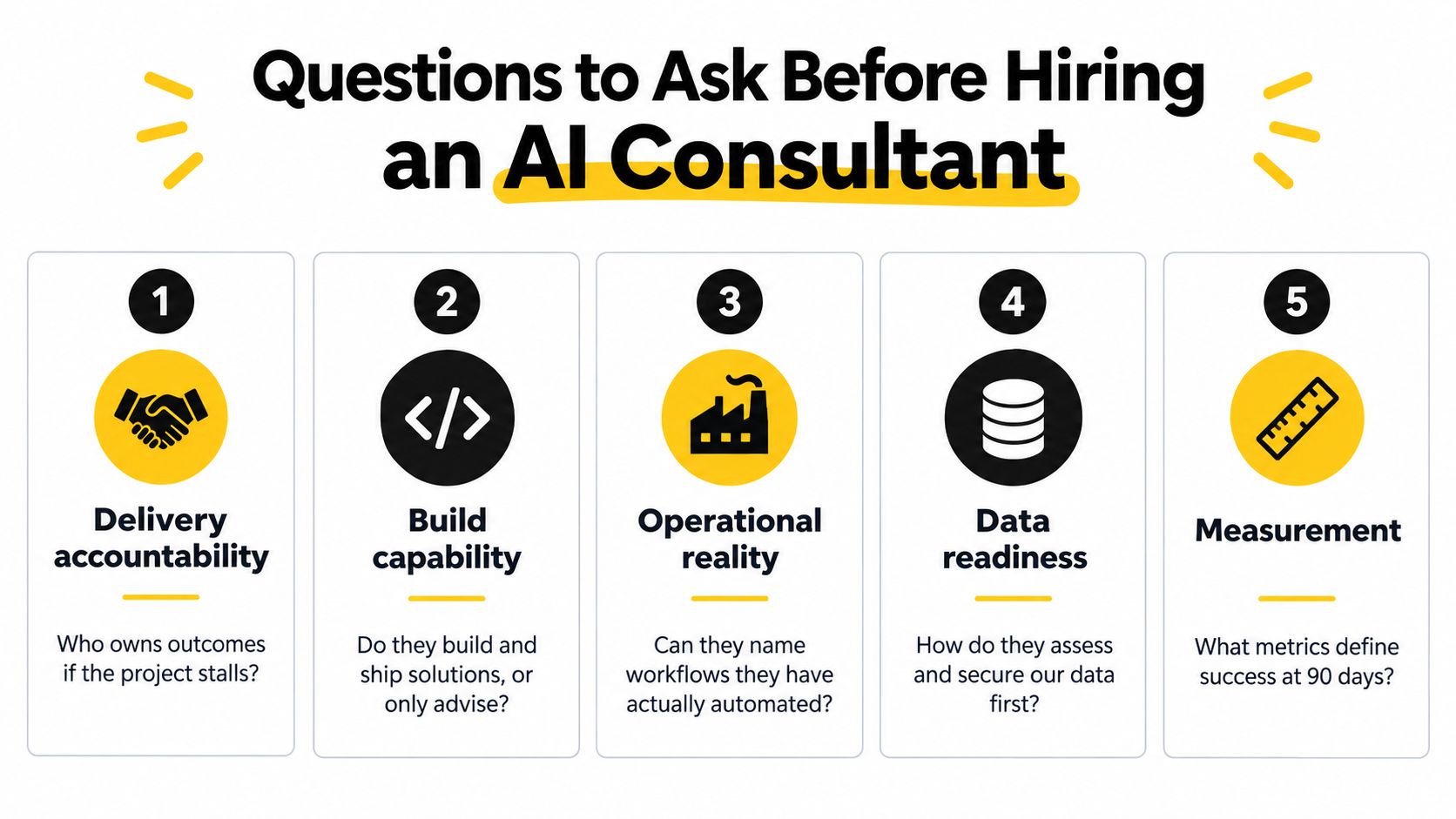
- Delivery accountability: Who owns the result if the project stalls, and who will do the work each week?
- Build capability: Do they build and ship integrations, or will you need another supplier after the advice?
- Platform fit: How will the proposed system connect to Reapit, Alto, Fixflo, Arthur, Qube or the tools you already use?
- Approval controls: Where does a human review an output before it reaches a tenant, landlord, contractor or regulator?
- Exceptions: What happens when the message is ambiguous, the record is incomplete or the system is uncertain?
Questions about evidence and fit
A credible practitioner should be able to explain which workflows they have built or improved. Ask for examples involving maintenance triage, tenancy progression, block administration, service charges, client money, certificate renewals, voids or serviced accommodation turnaround.
You don't need a consultant who claims every process is suitable for AI. Ask for an example of a project they rejected, delayed or narrowed because the data, risk or expected value didn't justify it.
The best first answer may be, “That isn't the right tool for this process.”
Ask how they measure adoption after handover. A useful answer should include named users, a baseline, an approval process and a review point. “The team will use it” isn't a measurement plan.
Questions about commercial terms
Request a fixed-price proposal only after a proper discovery conversation. It should state what you're getting, what you need to provide, which systems are included, what counts as a change and how payment is staged.
Check who trains the team and whether training uses your own cases. Ask what documentation remains with you, who supports the system after launch and how access to your data is controlled.
The AI Readiness Scorecard can help you organise those questions before a conversation. Use it as a diagnostic tool, not as a substitute for speaking to the people who handle the work every day.
Finally, ask whether the consultant understands England and Wales requirements relevant to your operation. They shouldn't give legal advice. They should identify where a solicitor, Propertymark or ARLA guidance, an IRPM professional or RICS-qualified adviser may need to confirm the operational approach.
Start with one process where the backlog is visible, the owner is known and the approval point can be agreed. InnovaAI Integration Ltd builds and connects custom systems for property operators across the West Midlands and UK, and you can visit InnovaAI Integration Ltd to arrange a free discovery call about whether that process is suitable. If it isn't a fit, I'll say so on the call.