Workflow Automation Services for Property Businesses
workflow automation servicesproperty automation UKSME efficiencyAI for letting agentsautomation engagement model

Tuesday starts with the shared inbox already deep in messages. An expired gas certificate is sitting in a sub-folder nobody opened, while the tenant who reported a leaking boiler at 8pm last night is still waiting for a reply.
I'm Cameron Atwal, founder of InnovaAI Integration Ltd in Wolverhampton. I run a property portfolio myself, so I've done the admin I now automate for letting agents, block and estate managing agents, and serviced accommodation operators across the West Midlands and the UK.
The issue usually isn't that your team is careless. It's that information sits across Reapit, Alto, Fixflo, Arthur, Qube, inboxes, spreadsheets and phones, with people manually moving it from one place to another. Workflow automation services are useful when they remove those hand-offs without removing the judgement that property operations still need.
Table of Contents
- Tuesday Morning in a Growing Agency
- What the Backlog Actually Costs You
- What a Workflow Automation Service Actually Does
- Engagement Models and What to Ask Before You Sign
- What Automation Does Not Fix
- Where to Look in Your Own Operation First
Tuesday Morning in a Growing Agency
The shared inbox is 40 messages deep before 9am. The expired gas certificate is buried in a folder marked “compliance”, and the tenant's message about a leaking boiler is waiting for someone to decide whether it's an emergency, a contractor callout or a landlord approval.
That morning rarely improves because somebody needs another generic reminder to “stay on top of things”. The team already knows what matters. They're working around a process that makes them search, copy, check and chase the same information repeatedly.

I build custom systems for letting agents and property managers, but I don't replace the platform they've paid for. Reapit, Alto, Fixflo, Arthur and Qube remain the system of record. The job is to connect the parts around them, add sensible rules, and put a person in control before anything important reaches a tenant, landlord or regulator.
What the Backlog Actually Costs You
The backlog starts with fragmented data. A tenancy progression coordinator checks referencing in one system, searches email for missing documents, updates a spreadsheet, then calls a negotiator who has a different version of the position.
Certificate renewals create a similar problem. A wall planner, calendar reminder or spreadsheet may flag a date, but nobody has designed the complete process from approaching expiry through to document receipt, review and escalation.
Arrears chasing depends on who notices the issue and who happens to pick up the phone. Maintenance triage relies on gut feel when a structured intake could collect the property, issue, urgency, photographs and access details before a human decides what happens next.
| Bottleneck | Frequency | Time per week | Silent risk |
|---|---|---|---|
| Tenancy progression and referencing | Repeated throughout every active let | Varies by pipeline | Delayed move-ins and poor applicant communication |
| Certificate renewals | Recurs against every relevant property or unit | Varies by portfolio | Missed follow-up and incomplete records |
| Arrears chasing | Recurs whenever balances remain unpaid | Varies by rent cycle | Inconsistent contact and avoidable escalation |
| Maintenance triage | Arrives throughout the working day and evening | Varies by repair volume | Wrong priority, delayed response or unnecessary callout |
| Spreadsheet alongside the platform | Used whenever the core system doesn't show the required view | Varies by team | Duplicate records and unclear ownership |
The cost isn't only the hours spent typing. It's the delay between an event and the person who needs to act, plus the rework when the record is incomplete.
A useful operational KPI dashboard can expose those hand-offs. It won't repair the process by itself, but it can show where work waits, where tasks return to the queue and where the platform stops being trusted.
UK evidence shows why this matters beyond a single agency. The Turing Institute estimated that UK central government handles about 1 billion citizen-facing transactions each year across roughly 377 services, including 143 million complex repetitive transactions. It estimated that 84% of those complex transactions are highly automatable, and that saving one minute per transaction would equal about 1,200 person-years of work annually. The Turing Institute's analysis isn't property-sector research, but it demonstrates the scale hidden inside repetitive administration.
What a Workflow Automation Service Actually Does
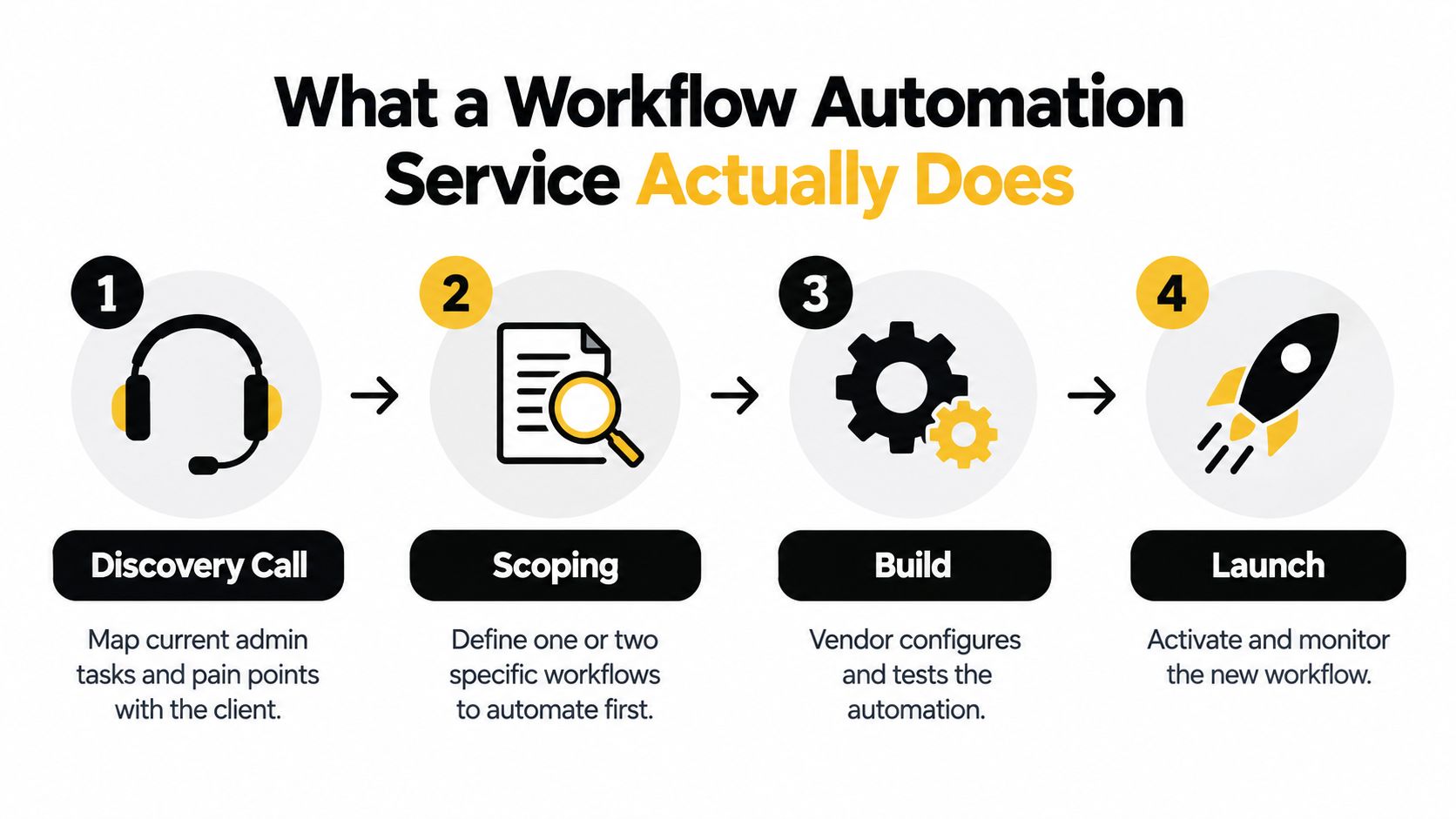
A proper engagement starts with your current admin, not a demonstration of somebody else's software. We map what happens when a tenant reports a repair, when a certificate approaches expiry or when referencing stalls.
The first useful output is often a simple process map showing the trigger, the systems touched, the decision points, the owner and the exceptions. If nobody can explain where a workflow begins and ends, it isn't ready to automate.
The work happens in a controlled sequence
- Discovery: We review the current process, including the spreadsheets and inbox rules people use because Reapit, Alto, Fixflo, Arthur or Qube doesn't quite cover the operational need.
- Scoping: We choose one or two workflows with clear rules and recurring friction. A renewal reminder process is usually easier to govern than an open-ended chatbot.
- Build: The system is configured around your existing stack. That may involve an API, middleware, inbox connection or a controlled data exchange, rather than forcing a platform switch.
- Testing: Sample records are used to test missing fields, duplicate properties, unusual messages and failed connections. The exception path matters as much as the happy path.
- Launch: The workflow goes live with monitoring, named ownership and a clear route for anything it can't classify safely.
An off-the-shelf SaaS trigger might copy a form submission into a spreadsheet or send a fixed email. That can be useful for a narrow task. A custom workflow automation service goes further by handling the sequence across systems, recording what happened, flagging exceptions and keeping a human approval point before tenant-facing communication.
Practical rule: If the vendor can't show you the exact trigger, rule, destination, exception route and approval step, the workflow isn't properly scoped.
For example, a maintenance intake could identify that a message concerns a boiler, extract the address and ask for missing access details. It shouldn't decide a legal liability, approve an expensive repair or promise a response time without your team's review.
You can compare different approaches in this property workflow automation tools guide, but the platform choice comes after the first workflows. A well-designed process connected to existing systems is more useful than an impressive platform nobody adopts.
InnovaAI Integration Ltd builds bespoke AI agents, dashboards and internal tools around the systems property teams already use. The point isn't to sell you another property platform. It's to make the current operation easier to run and easier to check.
Engagement Models and What to Ask Before You Sign
Most projects fit one of three shapes. The right choice depends on whether you have one defined blockage or an ongoing queue of operational work.
| Engagement Model | Best For | Typical Pricing Cue | Watch Out For |
|---|---|---|---|
| Fixed-scope project | One defined workflow, such as certificate renewals | Per workflow or integration | Licence fees, training and later changes may sit outside scope |
| Rolling retainer | Several workflows that need iteration | Per month | Unclear ownership or an open-ended backlog |
| Embedded consultant | A team that needs process mapping and build support | Agreed delivery period | You may still need platform fees and internal staff time |
Ask where the data lives and which systems hold the master record. You need to know whether tenant messages, certificates, maintenance details and approval logs are stored in a way your business can access and govern.
Ask who owns the automations if the supplier relationship ends. A workflow that only one technical person can edit creates a different form of dependency.
Check the integration properly. Has the supplier built against your specific version of Reapit, Alto, Fixflo, Arthur or Qube? Will it use an API or rely on screen-clicking? What happens when Zapier, Make or another middleware service is unavailable?
Questions worth putting in writing
- Approval controls: Can staff review and amend a message before it reaches a tenant or landlord?
- Edge cases: Where does an incomplete or ambiguous record go?
- Audit trail: Can you see who approved an action and when?
- Training: Is end-user training included, or is the build handed over?
- Support: Who investigates a failed connection or duplicated record?
- Change requests: What counts as included work after launch?
A workflow automation solutions overview can help you compare delivery shapes, but the cheapest quote is rarely the cheapest project once integration, testing, training and support are added.
What Automation Does Not Fix
Automation won't make a team communicate if nobody owns the next action. It won't create a process where the business has never agreed what should happen. It also can't replace a qualified human making a compliance judgement.
That matters in England and Wales, where property operations may involve tenancy obligations, safety documentation, client money controls, Section 20 processes and professional standards. A system can track dates, request documents, route information and show an audit trail. A solicitor or compliance adviser should confirm how a legal or regulatory requirement applies to your circumstances.
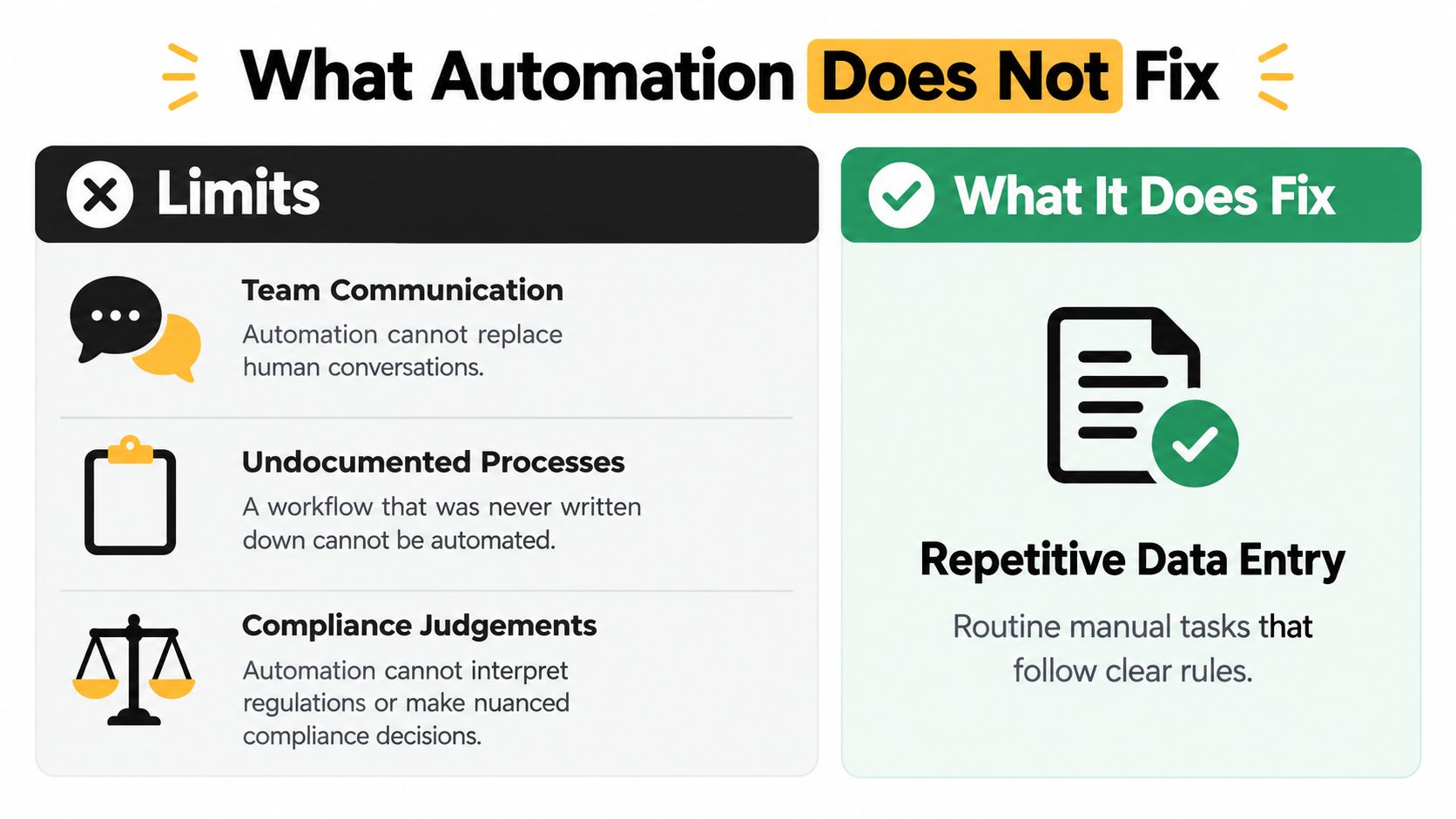
Bad automation makes a weak process faster. An arrears chase with the wrong wording can be repeated at scale. A tenancy progression sequence can fire before referencing is complete. A maintenance triage rule can send the wrong issue to a contractor and damage a landlord relationship.
The alternatives deserve an honest assessment:
- Do nothing: This avoids build cost, but keeps the current backlog, spreadsheet dependency and missed hand-offs.
- Hire another administrator: More capacity may be right when the work requires judgement or relationship management. It won't solve duplicated entry or unclear ownership on its own.
- Switch platform: Replacing Reapit, Alto, Arthur or Qube may be justified if the core system blocks the operation. It's a substantial operational decision, not a shortcut.
- Use ChatGPT informally: Staff may draft replies or summarise messages, but personal use without controls can create inconsistent records and shadow processes.
UK policy increasingly focuses on adoption support, process redesign and capability building, not just buying tools. The professional and business services adoption plan describes AI being used mainly to improve legacy processes, client-facing services and day-to-day productivity, while also recognising the need for structured adoption. The UK Government's professional and business services plan supports the practical point: control and training belong in the design.
Where to Look in Your Own Operation First
Start with the workflow that causes the most repeated friction, not the one that sounds most impressive. Score each candidate against volume, error rate, time taken, system fit and tenant impact.
A useful candidate has a clear trigger, repeatable rules and a sensible human approval point. It should also leave a record in the system your team already trusts.
Use a workflow automation scorecard to rank the candidates rather than choosing the one that attracts the most attention in a software demo.
A renewal reminder process may outscore a website chatbot because it fires every week, touches landlords and tenants, depends on dates and documents, and has a clear escalation route. A chatbot can be useful later, but it often creates a new channel to monitor before the underlying records and hand-offs are organised.
For block management, look at certificate renewals, maintenance intake, contractor updates, service charge queries and Section 20 administration. For serviced accommodation, inspect booking exceptions, channel manager discrepancies, guest messages, cleaning allocation and turnaround checks.
Start small, but make the first workflow real. It should run against live operational conditions, with a person checking every external message until the team trusts the result.
I build and connect these systems for property businesses across the West Midlands and the UK. A free discovery call can establish whether your first problem is suitable for workflow automation at all. If it isn't a fit, I'll say so on the call.
If your operation has recurring admin across tenancy progression, compliance dates, maintenance triage, block management or serviced accommodation turnaround, visit InnovaAI Integration Ltd to arrange a free discovery call. I'll help you identify what to examine first and whether connecting your existing systems is sensible, and if it isn't a fit, I'll say so on the call.