AI Adoption Consulting for UK SMEs: A Practical Guide
ai adoption consultingai consulting uksme ai strategyai readinessai implementation
At 8:45 on Tuesday, the shared inbox has 43 unread messages. Two tenants have reported repairs, a gas certificate has expired, and a landlord wants an update on a void. By 10am, the property manager has switched between Reapit, Fixflo, a spreadsheet and email, copied the same answer twice, and still isn't sure which item has been properly logged.
That isn't a dramatic failure. It's a normal morning in a letting or block management business. The small frictions are where any AI adoption decision will be tested, not in a polished demonstration. I'm Cameron Atwal, founder of InnovaAI Integration Ltd in Wolverhampton. I run a property portfolio myself, and I've personally done the admin I now build systems to handle.
Table of Contents
- What Your Tuesday Morning Actually Looks Like
- Why the Backlog Keeps Growing After You Hire
- What an AI Adoption Engagement Delivers
- How Engagements Are Priced and Structured
- How to Evaluate an AI Adoption Consultant
- The Alternatives Worth Taking Seriously
- What to Look at First in Your Own Operation
What Your Tuesday Morning Actually Looks Like
The expired certificate is easy to describe but harder to deal with. Someone needs to find the correct property record, check whether a renewal is already booked, identify the responsible contractor, update the compliance record and decide whether a landlord or tenant needs contacting.
The 8pm tenant message creates a different problem. It may be a genuine emergency, a routine repair or a request that needs information from the tenancy file. The message sits in the inbox overnight because nobody has defined what can be routed, what can be drafted and what must be reviewed immediately.
Practical rule: If the process depends on one experienced person remembering what to do next, it isn't controlled yet.
A useful operational KPI dashboard can show where work accumulates, but a dashboard won't decide the next action by itself. The system needs to connect the incoming message to the right property, tenancy, landlord, contractor or block record in the platform you already use.

For a block management operation, that might mean sorting service-charge correspondence, identifying Section 20 queries and sending only approved drafts to the right manager. For a letting agent, it could mean separating tenancy progression from maintenance triage. For serviced accommodation, the pressure may sit in the channel manager, guest messages and turnaround coordination.
The point is simple. AI adoption consulting starts with the queue, not the tool. If the queue isn't understood, adding another application just gives the team another screen to ignore.
Why the Backlog Keeps Growing After You Hire
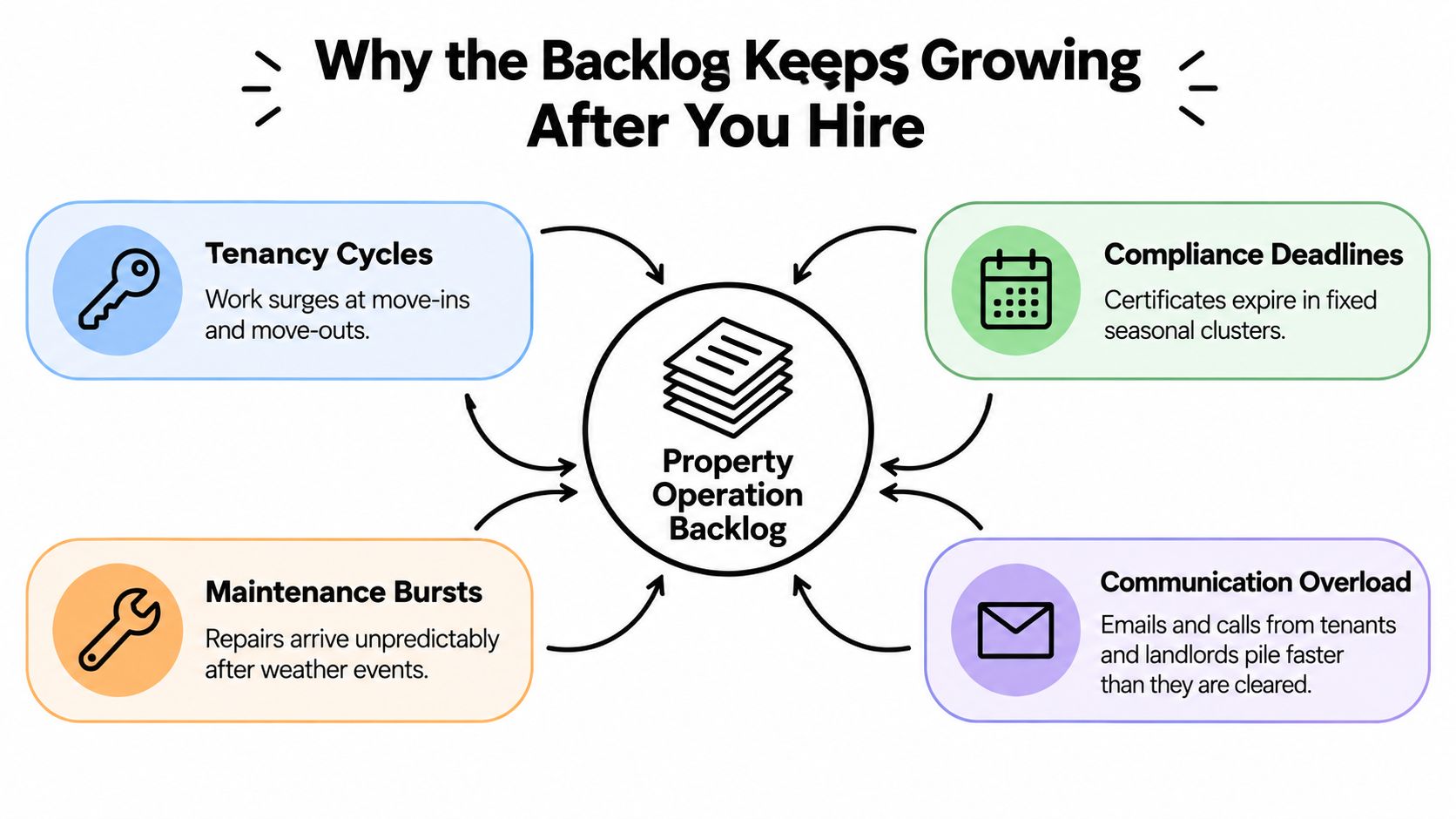
Hiring another administrator can help for a while. It doesn't remove the conditions that create the backlog.
Property work arrives unevenly. Move-ins and move-outs create bursts of tenancy progression. Certificate renewals collect around fixed dates. Maintenance arrives unpredictably, while landlord and tenant messages keep coming regardless of whether the team has cleared yesterday's work.
The second problem is fragmentation. Reapit, Alto, Fixflo, Arthur and Qube each hold part of the context, while a spreadsheet often carries the exceptions. Staff reconstruct the full story manually every time a case moves from inbox to system, contractor or client.
The UK evidence supports this process-first diagnosis. Government research found that 15% of small businesses had adopted at least one AI technology, compared with 34% of medium-sized companies and 68% of large companies. The gap reflects more than access to tools. Smaller firms often lack the skills, capital and implementation capacity to connect a new system to daily work. UK government research on AI activity in businesses makes that distinction clear.
The decision rules are usually invisible
A senior property manager knows which repair can be acknowledged immediately, which one needs a contractor, and which one must be escalated. A block manager knows when a service-charge query needs a formal response. A director knows which landlord complaints should reach them personally.
Those rules often live in conversation, not in the PMS. New staff ask questions, experienced staff interrupt their own work to answer them, and nobody can easily audit why a message was routed one way rather than another.
The ONS analysis of AI adoption barriers found that difficulty identifying suitable activities or business use cases was the leading barrier, reported by 39% of firms. Cost followed at 21%, with insufficient expertise and skills at 16%.
That is why another licence or another hire often disappoints. The operation hasn't defined the workflow, the baseline, the approval rights or the record that must be updated.
What an AI Adoption Engagement Delivers
A useful engagement leaves an independent letting or block operation with decisions, tested workflows and documents staff can run. It should produce working changes, not a maturity score in a slide deck. I would expect four stages.
Readiness assessment
The consultant traces one process from receipt to resolution. In England and Wales, that might be a shared inbox, maintenance triage, certificate renewals, deposit release or guest communication.
The assessment records:
- Incoming work: where messages, documents and requests arrive.
- Systems involved: which records sit in Reapit, Alto, Fixflo, Arthur, Qube, the channel manager or a spreadsheet.
- Decision rules: what staff can approve, route, draft or escalate.
- Failure points: where information is copied, delayed, lost or entered twice.
- Baseline measures: handling time, rework, errors, overdue actions and unresolved items.
The output is a process map with named owners and integration points. The consultant must show where the proposed system reads information, where it writes updates and what happens if a record is missing. See how AI integration services connect to existing PMS and data sources before approving a build that leaves those connections undefined.
Pilot design
Keep the pilot narrow enough to control. A single shared inbox gives clearer evidence than an attempt to automate every tenant interaction. A certificate workflow gives a safer test than a promise to automate compliance.
The system might classify an incoming message, retrieve the relevant record, suggest a priority and prepare a draft. A named member of staff approves anything sent to a tenant, landlord, guest, regulator or contractor. Legal and compliance decisions stay with the responsible person.
Agree success criteria before build work starts. Check whether the workflow routes the right work, produces usable drafts, reduces duplicate entry and leaves an audit trail. Prompt volume and the number of connected tools are poor measures of operational value.
Controlled rollout and handover
After the pilot, extend the same queue or process gradually. Add users and exception types in stages. Staff need role-specific training, not a generic workshop about ChatGPT.
Training must cover permitted data, output checks, correction of poor classifications and ownership of exceptions. The ICO guidance on AI and data protection applies when systems process names, addresses, tenancy details, repair histories, identity documents or correspondence. Ask a solicitor or compliance adviser to confirm how the requirements apply to your operation.
The final deliverable is a runbook the team can maintain. It should set out the workflow, approval points, access controls, escalation route, monitoring checks and the response when a connected platform changes. If those controls cannot be operated by the team, the AI tool is not ready for live property work.
How Engagements Are Priced and Structured
There are three sensible shapes for ai adoption consulting. The right one depends on how clearly you understand the problem and how many parts of the operation must change.
| Model | Typical Cost Range | Duration | Best For | Key Risk |
|---|---|---|---|---|
| Fixed-fee discovery sprint | Quoted after scoping | Short, defined engagement | One painful process with unclear requirements | A report that isn't followed by implementation |
| Phased build and implementation | Quoted by phase and integration scope | Staged delivery | Multi-site, multi-team or multi-system rollout | Scope expands before the pilot proves value |
| Ongoing advisory retainer | Agreed recurring fee | Continuing support | Portfolio operators improving several workflows | Paying for advice without named delivery work |
A discovery sprint suits a letting agent that knows maintenance triage is painful but hasn't mapped the queue. The deliverable should be a process map, opportunity ranking, integration view, pilot specification and implementation recommendation.
A block manager preparing a rollout across several blocks normally needs phased work. The first phase might cover inbox classification and document handling. Later phases could address service-charge correspondence, contractor updates and management reporting, with approval rules defined for each.
A portfolio owner with continuous change may prefer a retainer, but only if the agreement names the work. “Access to an AI expert” is not a deliverable. Ask whether the fee covers system changes, training, monitoring, troubleshooting and documented improvements.
Pricing signal: Be cautious when the quote is based on the number of AI features rather than the number of workflows, integrations, users and approval points.
The variables that change the price are straightforward. More integration points mean more testing. More staff means more training and feedback. More sensitive records mean more governance work. A fixed proposal after proper scoping is easier to assess than a vague day rate attached to an undefined transformation programme.
How to Evaluate an AI Adoption Consultant
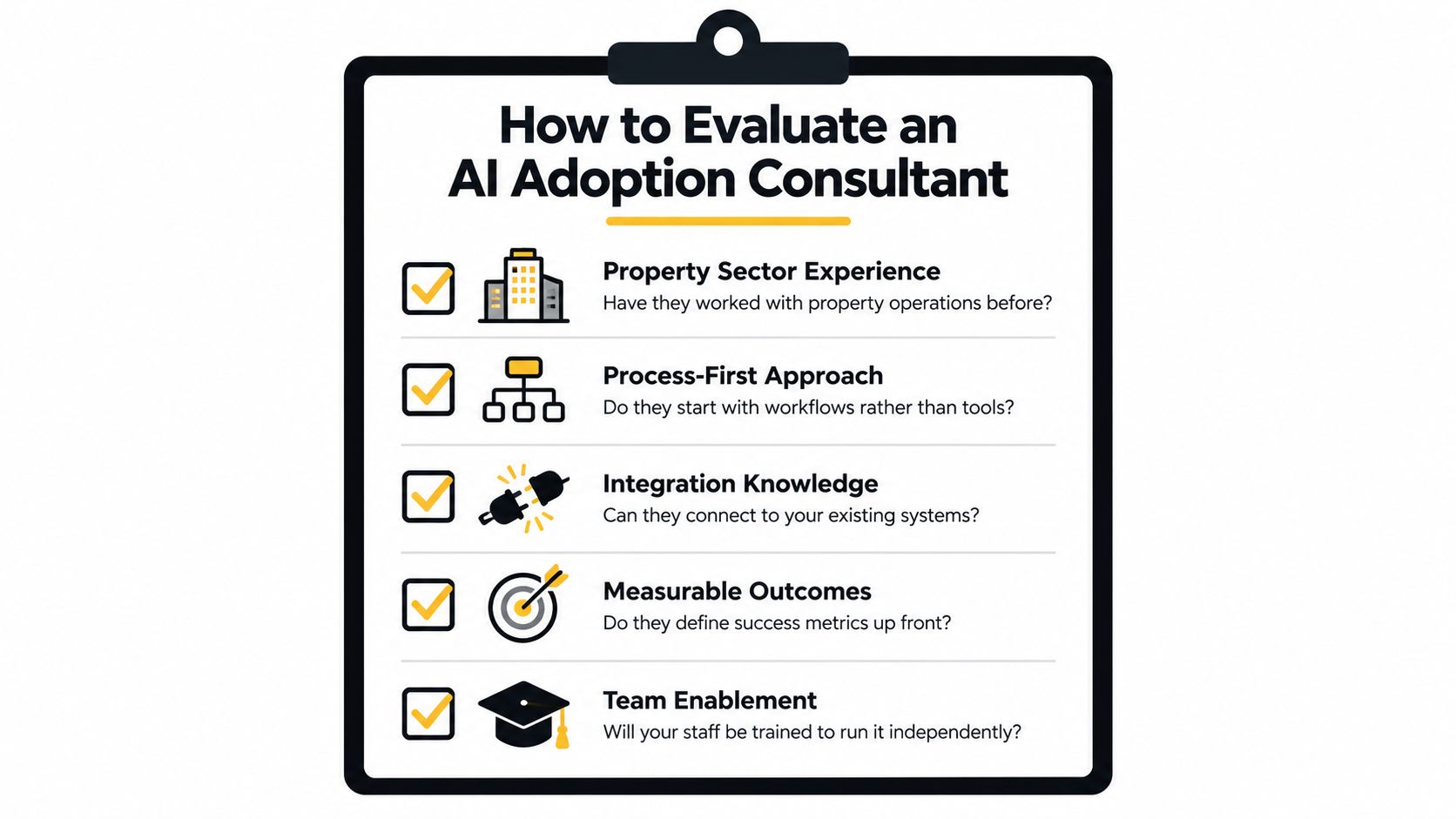
You don't need a vendor list. You need answers that expose whether the person understands property operations.
Ask these questions before signing:
- Property experience: Have you worked inside a letting agency, block management firm or serviced accommodation operation?
- Process detail: Which workflow would you examine first, and what would you need to see in Reapit, Alto, Fixflo, Arthur or Qube?
- Approval design: Where does a person review the output before it reaches a tenant, landlord, guest, contractor or regulator?
- Integration reality: How will the system connect to what we already run, and what happens when a record is incomplete?
- Success measures: What will we measure before launch, and what would make you recommend stopping the pilot?
- Handover: What will my team be able to operate without you after the engagement?
- References: Can you provide a named reference from a similarly sized UK SME?
- Wrong-tool test: Tell me when AI is the wrong tool for this problem.
The approval question matters most. Many pilots look impressive until a manager has to check every result manually, correct missing context and decide whether a draft is safe to send. That isn't necessarily a reason to abandon the work, but it may show that the process needs better data or narrower scope.
Use a practical AI strategy consultant guide to frame the conversation, but don't let a generic strategy replace a walk through your actual inbox or maintenance log.
A consultant who refuses to talk you out of a project is treating your budget as the objective. A good practitioner will say that a standard rule, a cleaner PMS setup, a staff hire or a simple report is the better answer when it is.
The Alternatives Worth Taking Seriously
Doing nothing is a valid decision when the process is stable, the backlog is controlled and the cost of change would exceed the likely benefit. It isn't neutral when experienced staff are carrying undocumented knowledge and overdue work is becoming normal.
Hiring another administrator is also reasonable when there is genuine demand for judgement, relationships and case ownership. It isn't the answer when the new person will spend the day copying information between systems, chasing the same documents and asking the same approval questions as everyone else.
Switching platform can make sense if your current system cannot support the operation, has poor data access or no longer fits your management model. But a newer wrapper won't fix a broken workflow. If the decision rules and ownership remain unclear, the backlog just moves into a different interface.
ChatGPT is useful for drafting, summarising and thinking through an awkward message. Used alone, it won't connect reliably to your PMS, enforce an approval chain or update the authoritative property record. It also creates data-protection questions when staff paste tenant, landlord, guest or employee information into a public tool.
The BCC research on technology use among UK SMEs identified fragmented technology stacks and underused existing tools as barriers to operational automation. That matches what I see in property businesses. The issue is often not a shortage of applications. It's that the applications aren't joined at the point where work changes hands.
The sensible answer may be a hire, a platform change or no AI at all. Choose ai adoption consulting when the operation has a repeatable queue, existing systems worth keeping and a clear need to connect work without removing human judgement.
What to Look at First in Your Own Operation
Start with one queue this week. Pick the shared inbox, maintenance ticket log or deposit release queue. Don't begin with the most politically important process. Begin with the one where work arrives repeatedly and staff can describe the current steps.
Spend forty minutes with the person who clears it. Count the incoming items, then separate them into three groups:
- Pure routing: the information is complete and the next team or person is obvious.
- Assisted judgement: a staff member needs to check context before choosing the next action.
- Human decision: the item affects a legal, financial, compliance or relationship outcome.
Then mark where approval already sits. Is it with the property manager, branch owner, block manager, accounts team or director? Write down the record that must be updated after each action.
You're looking for the true bottleneck. High volume points towards routing and prioritisation. Repeated rework points towards poor process design or fragmented records. Delays around one senior person point towards undocumented approval rights.
Self-led adoption is realistic when the process is bounded, the data is accessible, one owner can approve the output and the team has time to test it. Get a short diagnostic when the workflow crosses several platforms, handles sensitive records or has competing approval rules. A tool such as the AI Readiness Scorecard can help you baseline the opportunity before spending on a build.
Look first at one queue, one owner, one approval point and the record that must be updated. InnovaAI Integration Ltd builds and connects practical AI systems for property operators using the platforms they already run, then trains the team to operate the workflow. Visit InnovaAI Integration Ltd for a free discovery call to work out whether it's a fit, and if it isn't, I'll say so on the call.