AI Agent Development Services for Property Businesses
AI agent development servicesproperty automationletting agent softwareblock management adminAI agents UK

The 8pm tenant message is still sitting in the shared inbox at 8am. Beside it, a gas safety certificate has passed its expiry date on the wall planner, next to two Section 20 consultations that somebody meant to check yesterday.
I know that desk because I ran a property portfolio before I started building these systems. The problem isn't that your team doesn't care. The problem is that the work depends on somebody noticing every trigger, opening the right platform, copying the detail, chasing the next person and logging what happened.
Table of Contents
- Your Tuesday Morning at 8am
- Why the Backlog Never Shrinks No Matter Who You Hire
- What the Manual Admin Actually Costs You
- What AI Agent Development Services Actually Do Differently
- How an Engagement Runs From Discovery to Handover
- When AI Is the Wrong Tool and What It Won't Fix
- How to Choose a Builder and Where to Start
Your Tuesday Morning at 8am
By eight o'clock, the inbox has filled with maintenance requests, tenancy progression queries, landlord updates and messages from applicants who expect a reply before lunch. Your property manager is already deciding which issue looks urgent, while somebody else checks a spreadsheet against Reapit, Alto, Fixflo, Arthur or Qube.
The tenant with the leaking ceiling doesn't care which system holds the job. They care that someone has read the message and taken the right next step.
The same applies to a certificate renewal, a void, a service charge query or a booking that needs turning around before the next guest arrives. The work is known. The movement between steps is where the backlog starts.
Why the Backlog Never Shrinks No Matter Who You Hire
Your main platform holds the records. It doesn't necessarily move the work.
A tenancy progression still needs someone to notice that a reference is missing, copy the detail into an email, chase the applicant, update the landlord and record the result. A Fixflo ticket still needs someone to read the description, work out whether it is urgent, check the property history and decide who should receive it.
The spreadsheet exists because the team needs a working queue the platform doesn't provide. That isn't poor discipline. It's a sign that the process crosses too many systems without a trigger connecting them.
The manual trigger is the real bottleneck
Most recurring property work follows the same pattern:
- A date arrives: A certificate, inspection, renewal, consultation or tenancy milestone becomes due.
- A person notices: Someone checks a wall planner, inbox, report or spreadsheet.
- A person interprets: They read the message or document and decide what it means.
- A person acts: They draft a reply, create a task, make a call or update another system.
- A person checks the result: They chase the missing response and close the loop.
Hiring adds another person to that chain. It doesn't remove the chain. The backlog grows back because the trigger points remain manual, and the new member of staff inherits the same fragmented process.
That is why changing from Reapit to Alto, or from one block management platform to another, rarely fixes the underlying issue on its own. The data may move. The work still waits for someone to open a screen.
What the Manual Admin Actually Costs You
Every management-fee door carries a recurring administrative load. More doors bring more certificate renewals, tenant messages, maintenance triage, landlord questions, arrears follow-up and tenancy progression steps.
Those tasks arrive in proportion to the portfolio. Your team can absorb them for a while, then the margin on each additional door gets eaten by another salary line, extra overtime or slower service. The result is a ceiling on growth that has nothing to do with demand.
The cost isn't only the task. It's the decision to refuse another hundred doors because the next hire would take the margin.
There is also an opportunity cost. A delayed reply can lead to another call. A missed renewal can create a compliance escalation. An unclassified maintenance message can send the wrong contractor, delay access or leave a genuine emergency in the general queue.
The Office for National Statistics reported that around 25% of UK businesses were using some form of AI in late December 2025, rising to 44% among firms with 250 or more employees, while 15% were planning to adopt AI within three months. The ONS business insights release puts this firmly beyond early-adopter territory.
That doesn't mean every property process needs AI. It means the question has moved from whether the technology exists to whether a specific repetitive workflow is worth connecting.
What AI Agent Development Services Actually Do Differently
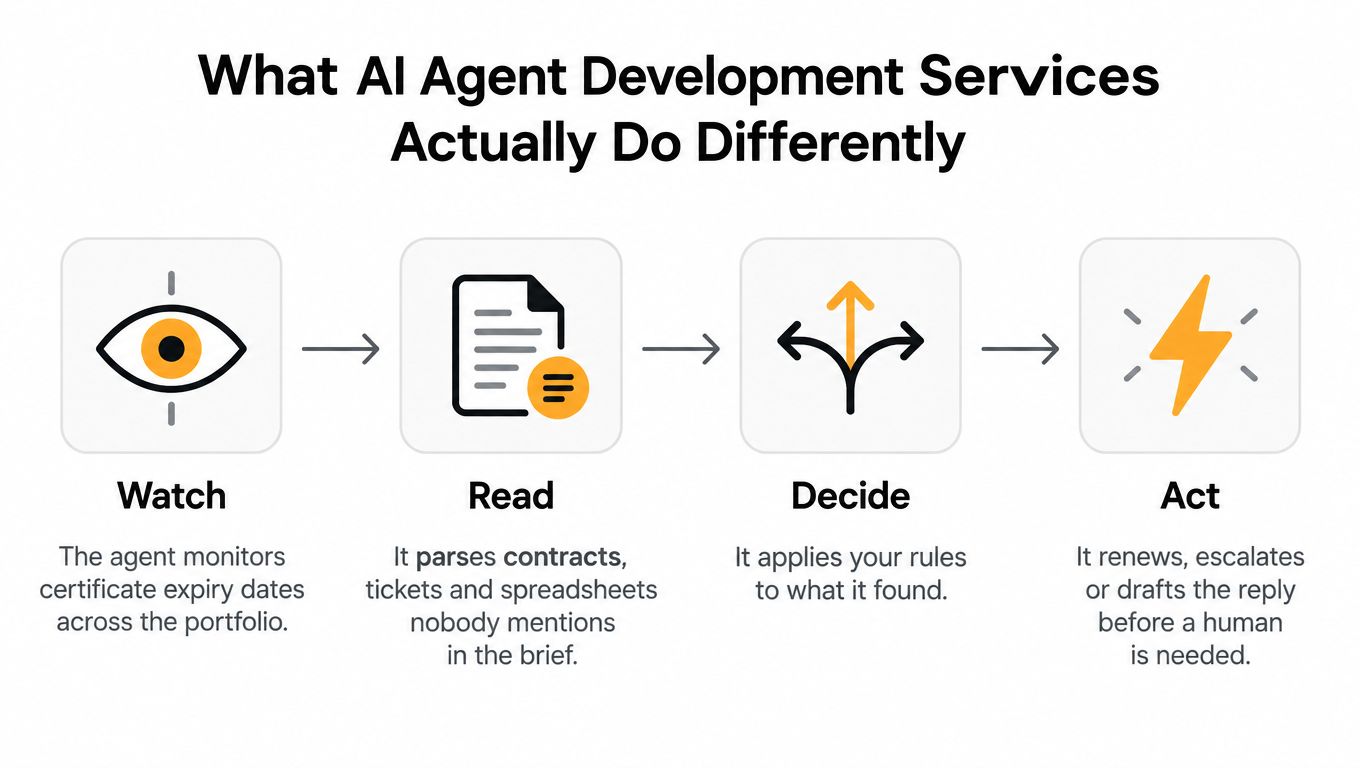
A useful agent watches for a trigger, reads the relevant information, applies your rules and prepares the next action. It doesn't replace Reapit, Alto, Fixflo, Arthur or Qube. It works alongside the systems your team already uses.
For a letting agency, that might mean connecting the letting-agents workflow to the existing property platform, inbox and document store. For block management, the same principle applies to units, service charges, Section 20 activity and contractor records.
Certificate renewals
The agent monitors expiry dates across the portfolio. It identifies the properties that need attention, checks the relevant record and drafts a renewal chase using your preferred wording.
A property manager approves the message before it reaches the landlord, tenant, contractor or regulator. A solicitor or compliance adviser should confirm how the relevant requirement applies to your properties. The agent manages the operational sequence. It doesn't make a legal decision.
Maintenance triage
The agent reads an incoming tenant message, identifies the property, checks available context and sorts the request against rules you define. It can flag a possible emergency, identify missing information and prepare a route for the maintenance team.
A named member of staff approves the urgency classification and any response before it reaches the tenant. The agent shouldn't diagnose a dangerous condition, promise an outcome or instruct a contractor without the approval point your process requires.
Tenancy progression
The agent checks which step is complete, spots what is missing and prepares the next task. It might assemble a summary for the property manager, draft a chase for a referencing document or highlight a landlord decision that is holding up the move.
The human confirms the information and approves every external message. This keeps judgement with the person who understands the tenancy, the client relationship and the consequences of getting it wrong.
The safe rule is simple. Nothing reaches a tenant, landlord, contractor or regulator without a named human approval step.
How an Engagement Runs From Discovery to Handover
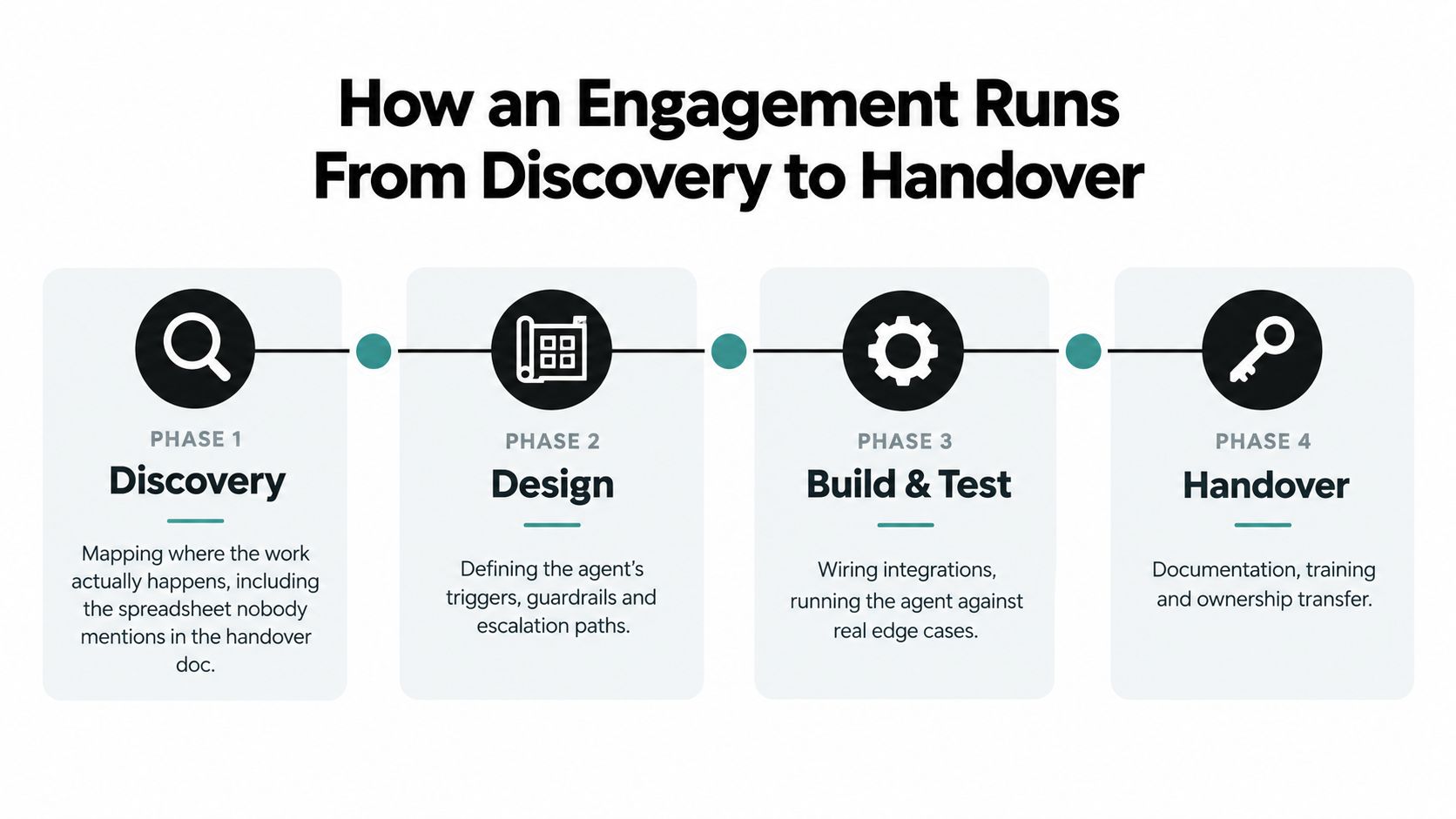
You shouldn't buy a property agent from a feature list. The work starts with the process as it runs in practice, including the spreadsheet, inbox rule or wall planner nobody mentioned in the first meeting.
Discovery
The first job is to map where a task begins, which systems it touches, who makes decisions and where it stops. That includes exceptions, duplicate records and informal workarounds. A discovery that only documents the official process will miss the reason the team created the unofficial one.
Build
The system starts with one process. Certificate renewals, maintenance triage or tenancy progression is enough to test the approach properly. The build should use real examples and edge cases, not a polished demonstration that avoids incomplete information.
Integrate
The agent reads and writes alongside Reapit, Alto, Fixflo, Arthur or Qube. It doesn't require a rip-and-replace project. The connection should respect access permissions, preserve an audit trail and make it clear which action was prepared by the system and which was approved by a person.
Enable
Training sits inside the build, not at the end as an optional extra. The team needs to know what the agent watches, what it can prepare, what it cannot decide and where an approval is required.
A self-serve scorecard can help you baseline the manual touchpoints and identify which process deserves attention before you book a conversation.
A sensible proposal follows proper scoping. It should be fixed-price where the scope is clear, with one named practitioner accountable from discovery through handover.
The technical detail matters less than whether the system works inside your existing operation. This guide to building AI agents sets out the practical build considerations without assuming you want to replace your current software.
When AI Is the Wrong Tool and What It Won't Fix
Doing nothing is a valid choice. It also leaves the ceiling on doors, units and bookings where it is. If the same admin already defeated two rounds of hiring, hiring again without changing the process is likely to repeat the pattern.
Switching platforms can make sense when the current one cannot support the operation. It can also become a two-year disruption that leaves the manual triggers untouched. A new system doesn't automatically read the inbox, understand the certificate schedule or decide who should act next.
ChatGPT in a browser tab has a narrower problem. It can draft text when someone supplies the context, but it doesn't see your portfolio data, monitor your dates or update your workflow by itself.
Where judgement must stay with people
An agent can't negotiate with a freeholder, decide a Section 20 consultation strategy or sign an agreement. It shouldn't decide how client money is handled or whether prescribed information has been served correctly.
For England and Wales, your operational process still needs clear ownership of compliance dates, records, approvals and escalation. A solicitor or compliance adviser should confirm how the relevant legal requirement applies to your business. Good governance for AI agents is about controlling access, documenting actions and keeping review points in the workflow.
The best use is narrower and more practical. Let the system find the work, prepare it and make the next step visible. Keep accountability with your team.
How to Choose a Builder and Where to Start
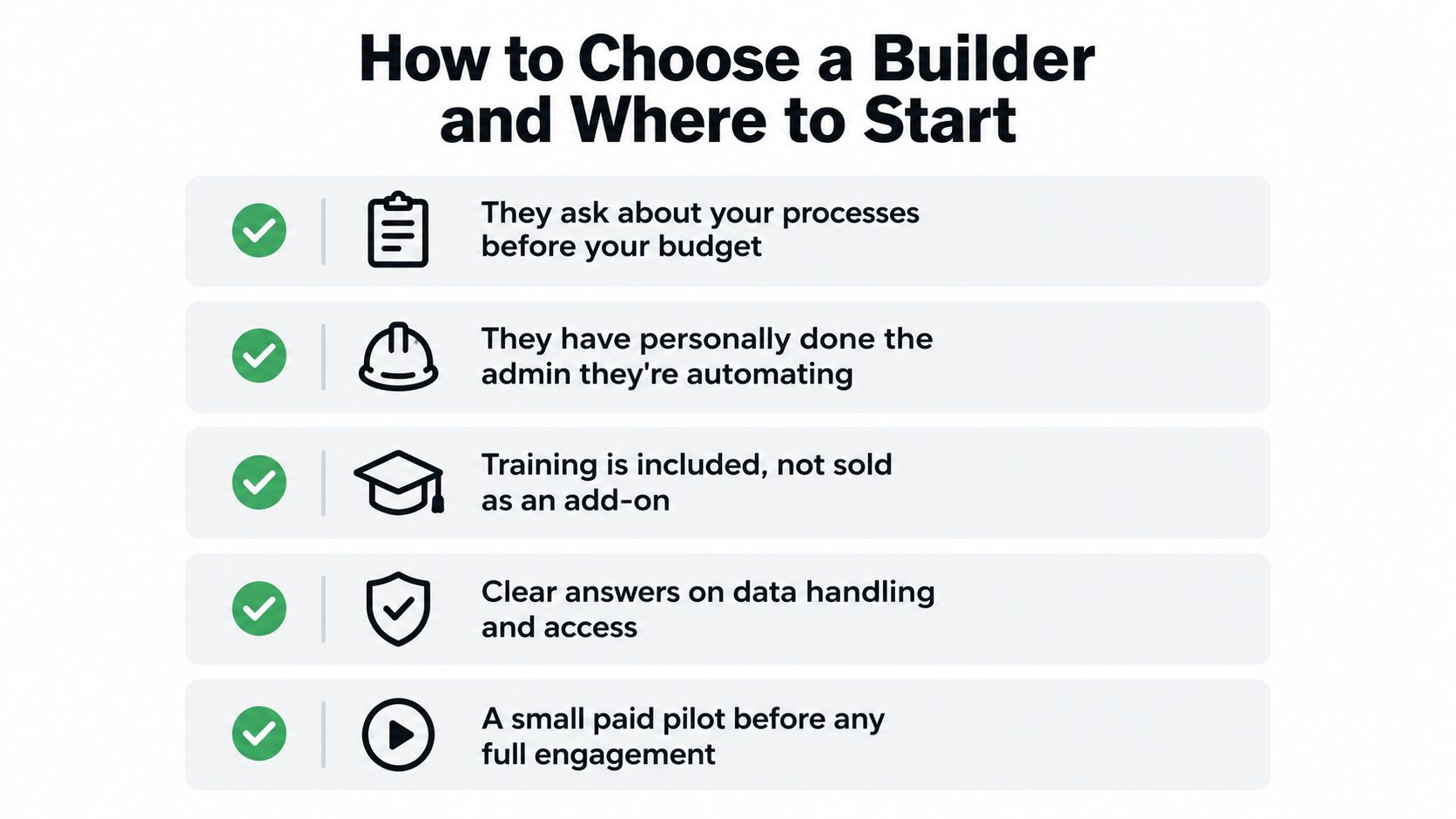
A builder should ask about your process before asking about your budget. They should want to see the spreadsheet, the shared inbox and the way a maintenance request is handled.
Look for these answers:
- Process first: They map the work before choosing a platform or model.
- Operational experience: They have personally done, or closely studied, the admin they propose to automate.
- Training included: The team receives practical training as part of the build, not as a later upsell.
- One accountable person: You know who owns the engagement from first meeting to handover.
- Existing systems respected: They connect to what you run instead of pushing a rip-and-replace project.
- Clear scope: The proposal explains triggers, approvals, integrations, testing and ongoing ownership.
InnovaAI Integration Ltd builds custom agents and bespoke software for property and other SME workflows, connecting systems rather than replacing them. The right provider may be a specialist studio, an internal developer or nobody at all. Judge them by the quality of the questions they ask and the boundaries they put around the system, not by broad claims about AI.
Start with the process that consumes the most hours and carries the clearest consequence when it slips. Count every manual touchpoint from the first message or date to the final update, then use an AI readiness assessment to decide whether the work is suitable.
If you want to test the fit, book a free discovery call with InnovaAI Integration Ltd and we'll look at the workflow, the systems you already run and the approval points required, and if it isn't a fit, I'll say so on the call.