AI Automation UK for Property Businesses: A Practical Guide
AI automation UKproperty automationletting agentsSME automationUK AI adoption

It's 8.45 on Tuesday. The shared inbox has forty unread threads, a gas safety certificate expired last week and nobody flagged it, and a tenant who reported no heating at 8pm is still waiting for a reply.
You've hired twice and the backlog hasn't moved. That's a process problem, not a people problem, and it's exactly where AI automation in the UK either earns its keep or wastes your money.
Table of Contents
- Why Your Tuesday Morning Looks Like This
- What the UK Adoption Data Actually Shows
- Where Automation Genuinely Helps in Property Operations
- How a Working System Changes the Process
- The Regulatory Lines You Cannot Cross
- The Alternatives and Why They Fall Short
- Where to Look First in Your Own Operation
Why Your Tuesday Morning Looks Like This
Your team isn't slow. The work is split across too many places.
You pay for Reapit, Alto, Fixflo, Arthur or Qube. Half the office still runs a spreadsheet alongside it. Compliance dates sit on a wall planner, tenancy progression lives in email, and the certificate renewal depends on someone remembering to check.
Where the handoffs break
A repair comes in by phone, email or portal. Someone reads it, works out which property it relates to, checks the record, re-keys the details, chases photos, then raises the job. Each handoff is manual, so each one can stall.
For letting agents, the same pattern repeats with arrears letters, applicant enquiries, viewing bookings and document chasing. For block managers it's service charges, Section 20 notices and contractor updates. For serviced accommodation it's the channel manager, cleaning rotas and turnaround.
Practical rule: If the same fact is typed twice, in two places, by two people, you've found a process fault. Hiring another person just gives you a third pair of hands doing it.
What it costs you mechanically
Forget percentages for a minute. Look at the mechanism. Every re-keyed detail is paid admin time that produces no fee. Every missed certificate is a compliance risk you've already paid someone to prevent. Every 8pm message answered at 9am is a tenant who feels ignored, then phones twice in the morning and takes up more time anyway.
The cost isn't dramatic in any single hour. It's steady. Tenancy progression slows because documents arrive in dribs and drabs. Voids last longer because nobody chased the reference. Landlords ask for updates because they haven't had one, so your team stops doing the work to report on the work.
I've run a property portfolio myself and done this admin. The work doesn't feel broken day to day. It just never gets smaller, even when you add doors or add staff. That tells you the constraint is how information moves, not how hard anyone works.
What the UK Adoption Data Actually Shows
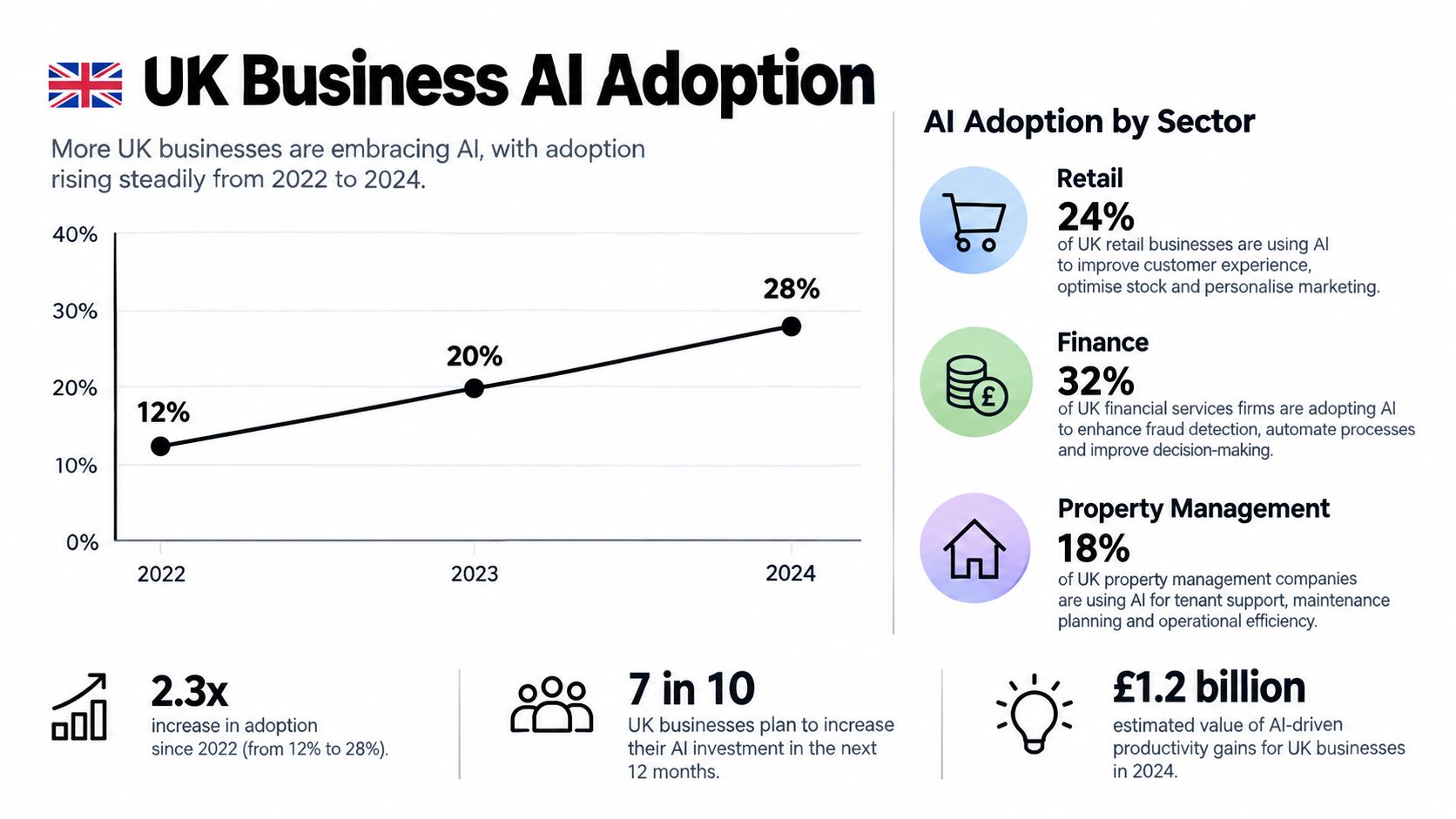
UK businesses aren't short of AI tools. They're short of finished implementation.
The chart below summarises the direction of travel in adoption among UK businesses.
According to the UK Business Data Survey 2026 published on GOV.UK, the share of UK businesses with 10 or more employees using at least one AI technology rose from approximately 12% in September 2023 to approximately 35% by June 2026, nearly three times the starting level. Adoption reached 49% among businesses with more than 250 employees, compared with 35% overall.
That size gap matters for an independent with 10 to 60 staff. Larger firms have IT resource, cleaner data and someone whose job is process. You have a senior negotiator who also fixes the printer.
Broad use, shallow use
Sector gaps are just as wide. The same survey shows AI use reported by 58% of information and communications businesses, 46% of professional, scientific and technical businesses, and only 13% of construction businesses. Property sits closer to the construction end of that spread than most agents would like to admit.
The most common tools are text generation at 17% and visual content generation at 14%. That's drafting and images, not a workflow connected to your tenancy file. Uptake is broadening, but most firms use very few technologies and keep them at arm's length from operations.
Readiness beats access
Earlier official analysis found only 9% of UK firms had adopted AI in 2023, compared with 69% using cloud-based systems, and that the main barriers were difficulty identifying viable use cases at 39%, cost at 21% and insufficient expertise at 16%, as set out in the ONS analysis of management practices and technology adoption in UK firms.
That matches what I see in property. The barrier isn't finding a tool. It's deciding which process to fix first, who owns it, what data it needs and how you'll know it worked. Access to a tool is not automation.
Where Automation Genuinely Helps in Property Operations
Start with capacity, not novelty. The image below shows the kind of dashboard view your team should be working from, one place for jobs, dates and exceptions.
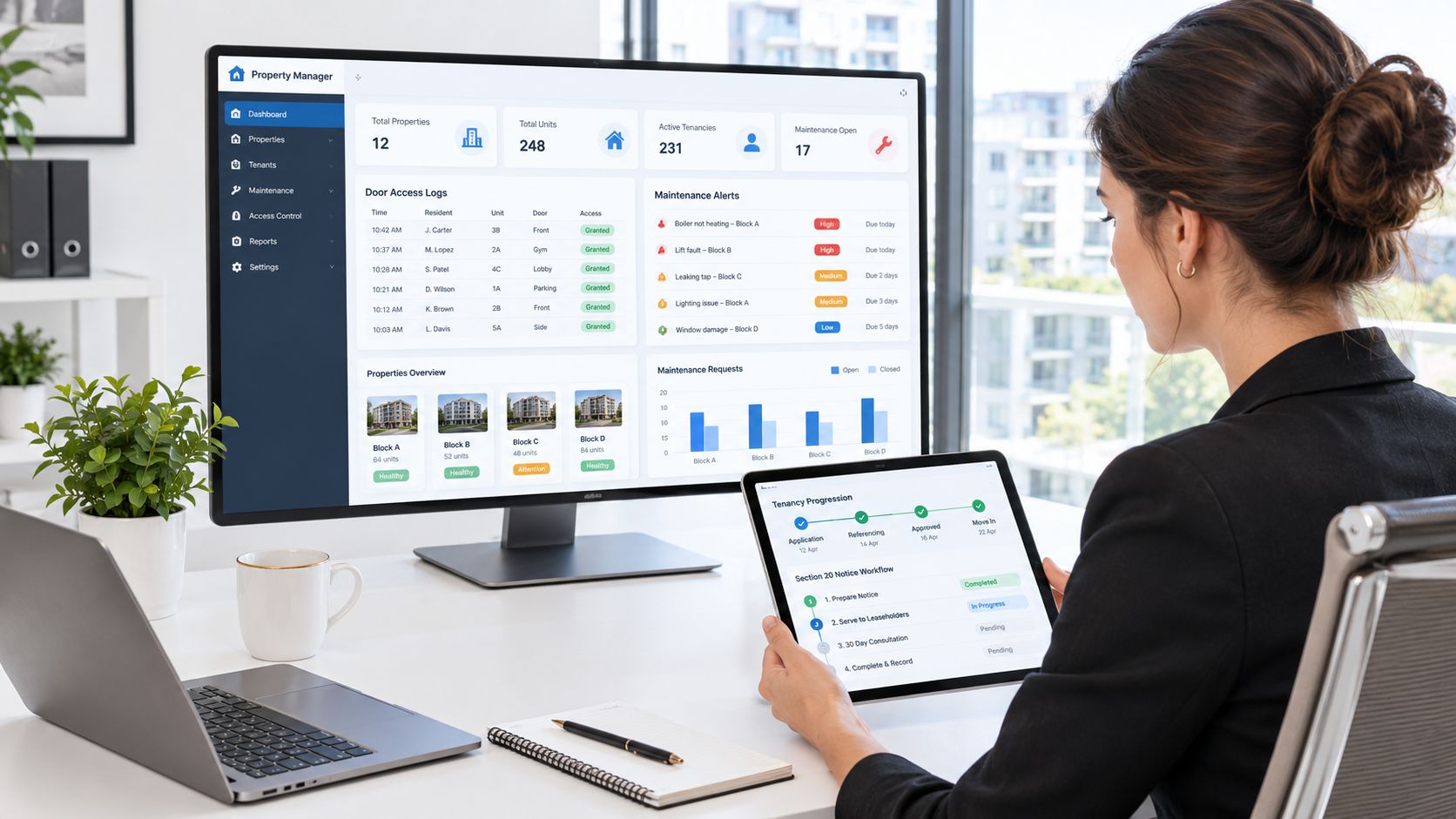
A 2025 UK lettings industry report on agency size and staffing found the average agency managed 340 properties with 14 employees, 44% of agencies were focused on reducing administrative time, much of it linked to compliance, and only 19% planned to grow their team in the following year. You want more doors without another salary. So does everyone else.
Work worth automating
These tasks are repetitive, rule based and high volume. They're the credible targets, and the wider pattern is covered in these workflow automation examples for property teams.
- Certificate renewals: Gas, electrical, EPC, fire and licensing dates flagged early, contractor booked, landlord told, with a named person signing off.
- Maintenance triage: Report acknowledged, property identified, urgency sorted, missing facts requested, then routed for approval.
- Tenancy progression: Missing documents chased in order, references tracked, applicants updated without a negotiator re-typing the same email.
- Arrears follow up: Reminder sequence drafted from the ledger, scheduled repayment records filed, anything contentious passed to a person.
- Status updates: Landlords, leaseholders and vendors told what's happened before they phone to ask.
The video below walks through how this kind of intake and routing works in practice.
Work you shouldn't automate
Don't automate judgement. A difficult leaseholder meeting, a Section 20 consultation where residents are angry, a deposit dispute, a decision on a borderline applicant. The time saved is small and the cost of getting it wrong is large.
Don't automate client money decisions either. A system can flag a discrepancy and prepare the reconciliation. It shouldn't move money or approve payments. Same with legal notices. Draft and diarise, yes. Serve without a person checking, no.
If a mistake would land you in front of Propertymark, the IRPM, RICS or a tribunal, a person approves it before it goes out. No exceptions.
Government research also backs a narrow start. UK government AI adoption research found 56% of AI adopters reported increased employee productivity, while 35% reported no change and 1% reported a decrease, and most adopters said fewer than half their staff used it. Tight scope first, then widen.
How a Working System Changes the Process
A working system connects to what you already run. It doesn't ask you to replace Reapit, Alto, Fixflo, Arthur or Qube, and it doesn't ask your team to learn a new platform for its own sake.
The diagram below sets out the five stages from intake to audit trail.
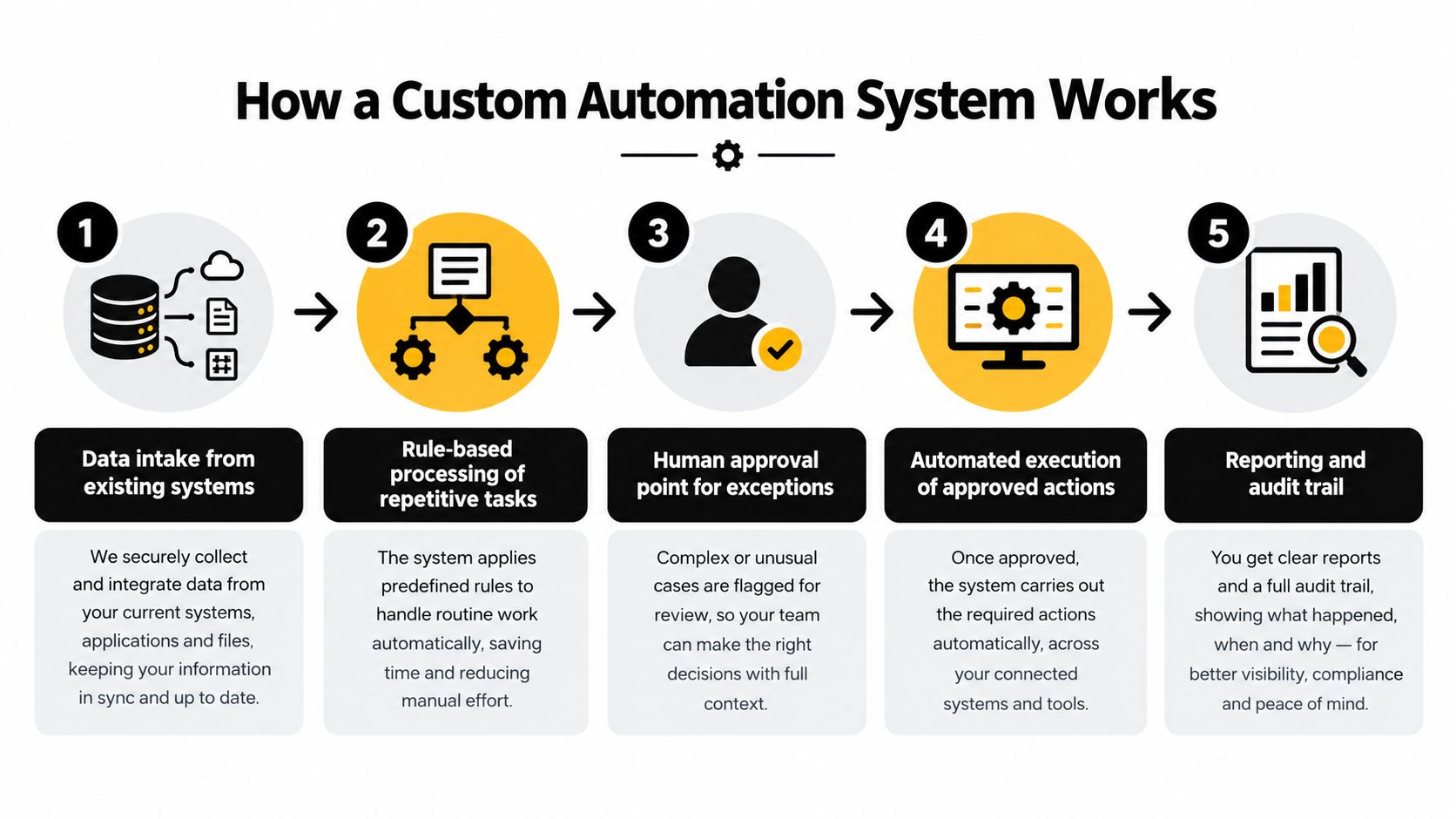
A repair, step by step
A tenant reports a leak at 8pm through your usual channel. The system reads the message, matches it to the property and tenancy in your existing record, and asks for the facts you'd ask for. Is the water stopped, where is it coming from, can you send a photo.
It then sorts urgency using rules you've agreed. Water through a ceiling is urgent. A dripping tap isn't. It prepares the job, suggests the right contractor from your list and writes the acknowledgement to the tenant.
Then it stops. A named member of staff approves the instruction and anything sent to the tenant or landlord. Once approved, the job is raised, the contractor is booked, the landlord is notified and every step is logged against the property file.
- Intake: Message captured and matched to the correct door or unit.
- Sorting: Urgency, category and missing information identified.
- Approval: A person checks cost, contractor and wording.
- Action: Job raised, appointments booked, updates sent.
- Record: Audit trail filed where your team already looks.
What changes for your team
Most projects are oversold. According to ONS evidence on AI in UK businesses from 2023 to 2026, the average adopting business uses only about 1.6 AI technologies, most SME users rely on generic tools, only around one in ten had adopted bespoke AI implementations, and bespoke adopters were roughly three times more likely to restructure job roles, with about one-fifth reporting staffing reductions attributable to AI.
Read that properly. Bespoke work changes roles. Your property manager spends less time typing and more time deciding. That needs training and honest conversation, not a launch email. Firms like InnovaAI Integration Ltd build this kind of connected workflow for property businesses, but whoever builds yours, insist on training being part of the job.
Measure it at task level or don't bother. Cycle time from report to contractor booked. Human review time per job. Exception rate, meaning how often staff have to intervene. Error corrections. If those don't move, you've bought activity, not capacity.
The Regulatory Lines You Cannot Cross
There's a line between a system that helps a person decide and a system that decides on its own. In property, that line matters commercially and legally.
The Information Commissioner's Office guidance on AI and individual rights under UK GDPR says UK GDPR treats AI differently depending on whether it supports a human or makes a decision automatically, and that fully automated decisions with legal or similarly significant effects are restricted by Article 22. Where such decisions are used, people may have rights to obtain human intervention, give their point of view, contest the decision and receive an explanation of the logic.
What that means on a tenancy file
A system can triage enquiries, spot a missing right to rent document, prioritise repairs and draft a reply. It should not automatically reject an applicant, refuse a repair or make a decision that affects someone's home or money without a person in the loop.
You also need to explain the processing, document decisions and keep safeguards in place. Operationally, that means clear records of what the system did, what data it used and who approved the outcome. If you can't explain a decision to the person affected, you shouldn't have automated it.
Compliance dates and client money
The same principle applies outside data protection. A system can track certificate renewals, warn you a Section 20 stage is due, flag a service charge arrears balance and prepare the paperwork. A named person signs off. That's the practical point covered in this guide to property compliance software and approval controls.
- Certificates: System flags and books, person confirms completion and files evidence.
- Section 20: System tracks stages and drafts notices, person checks figures and wording.
- Client money: System reconciles and flags gaps, person authorises movement of funds.
I'm not giving you legal advice here, and this isn't a substitute for it. Ask your solicitor or compliance adviser to confirm how these rules apply to your operation, your client base and the decisions you're thinking of automating. Do that before you build, not after a complaint.
The Alternatives and Why They Fall Short
You have four realistic alternatives. Each one is reasonable on the surface. Each one leaves the underlying process untouched.
Doing nothing and hiring again
Doing nothing costs nothing today. It also means the backlog stays the same size while the portfolio grows, and your best negotiator keeps spending mornings on chase emails. That's a choice, but price it in landlord retention and staff turnover.
Hiring works if the work is judgement work. If the work is re-keying, chasing and updating, you've bought a salary, National Insurance, training time and management time to do tasks that shouldn't need a person at all. You've hired twice already. Ask why the queue didn't shrink.
Switching platform and using ChatGPT
Switching from one CRM to another is a big, disruptive job. Sometimes it's justified. But a new platform doesn't fix a broken process, it relocates it. If compliance dates live on a wall planner today, they'll live in a notes field tomorrow unless someone redesigns the workflow around them.
ChatGPT and Copilot are useful for drafting. I use them. But a chat window doesn't know which tenancy is in arrears, can't read your Fixflo queue, can't update Reapit and can't trigger a contractor booking. Your team copies text in, copies text out, and the handoff problem stays exactly where it was. There's also a data question when staff paste tenant details into a personal account.
The Options Compared
| Option | What it costs | What it fixes | What it misses |
|---|---|---|---|
| Do nothing | No spend, rising workload | Nothing new | Backlog grows with doors |
| Hire again | Salary plus on-costs | More hands for judgement work | Repetitive tasks still manual |
| Switch platform | Migration, training, disruption | New features, cleaner data | Process faults move with you |
| ChatGPT | Low subscription cost | Faster drafting | No connection to your records |
| Connected workflow | Build cost plus review time | Repetitive steps and handoffs | Needs process mapping first |
None of these options is foolish. The question is which one fixes the broken thing. If information does not move between your inbox, your CRM and your contractors without a person carrying it, that is the fault to fix.
Where to Look First in Your Own Operation
Pick one workflow. Not five, not the whole business. Choose the task that's high volume, rule based and annoying your team most.
Maintenance intake is usually the strongest candidate. According to government research with private rented sector tenants, 82% of renters agreed landlords are responsible for repairs and maintenance and 81% assigned that responsibility to property management agencies. Tenants judge you on repairs. Getting the acknowledgement, triage and updates right is visible value, not back office tidying.
The checklist below shows a sensible order for scoping that first workflow.
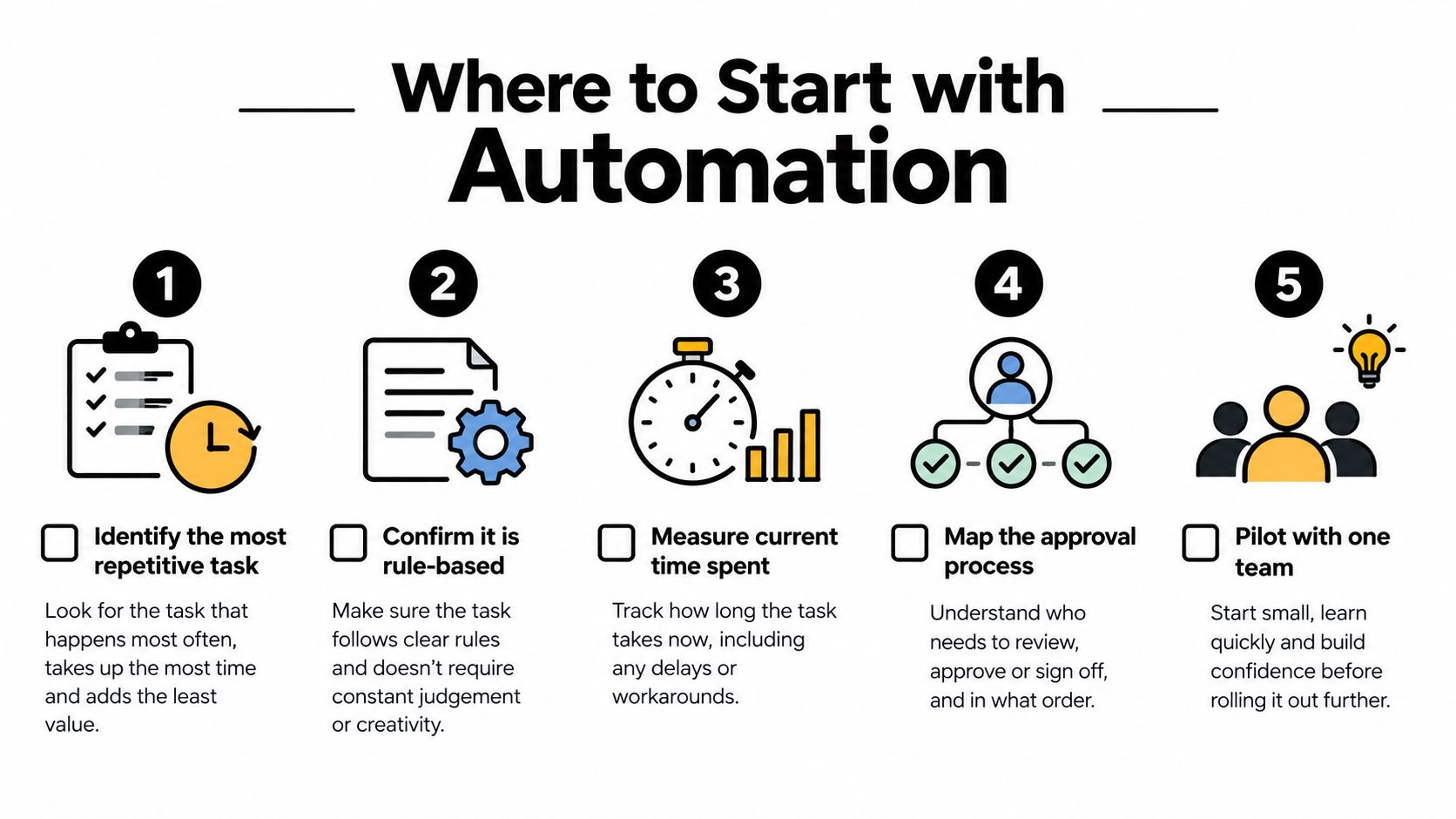
A simple way to test it
- Map it: Write down every step from report received to job closed, including who touches it.
- Measure it: Time ten real cases. Note where data is re-keyed or chased.
- Name the approver: Decide who signs off contractor instruction, cost and tenant wording.
- Pilot it: Run it on one patch or one block, with the old method still available.
- Review it: Compare cycle time, exceptions and corrections against your baseline.
If you can't map it, you can't automate it yet. Fix the process on paper first. That's not a delay, it's the work that decides whether the build pays. The AI adoption roadmap for a staged rollout sets out that sequencing in more detail, and the AI Readiness Scorecard is a quick way to check whether your data, process ownership and team capacity are in shape before you spend anything.
Start with your worst Tuesday morning task and map it this week. If you want a second pair of eyes, book a free discovery call and we'll work out whether it's even a fit, and if it isn't a fit, I'll say so on the call.
I build custom systems at InnovaAI Integration Ltd for letting agents, block and estate managing agents and serviced accommodation operators who want repetitive admin handled inside the platforms they already run, with a person approving anything that reaches a tenant, landlord or leaseholder. Book a free discovery call through the site and we'll look at one workflow in your operation and whether it's worth automating at all, and if it isn't a fit, I'll say so on the call.