10 Workflow Automation Examples for Property Firms
workflow automation examplesproperty automationletting agency systemsblock managementAI workflow automation
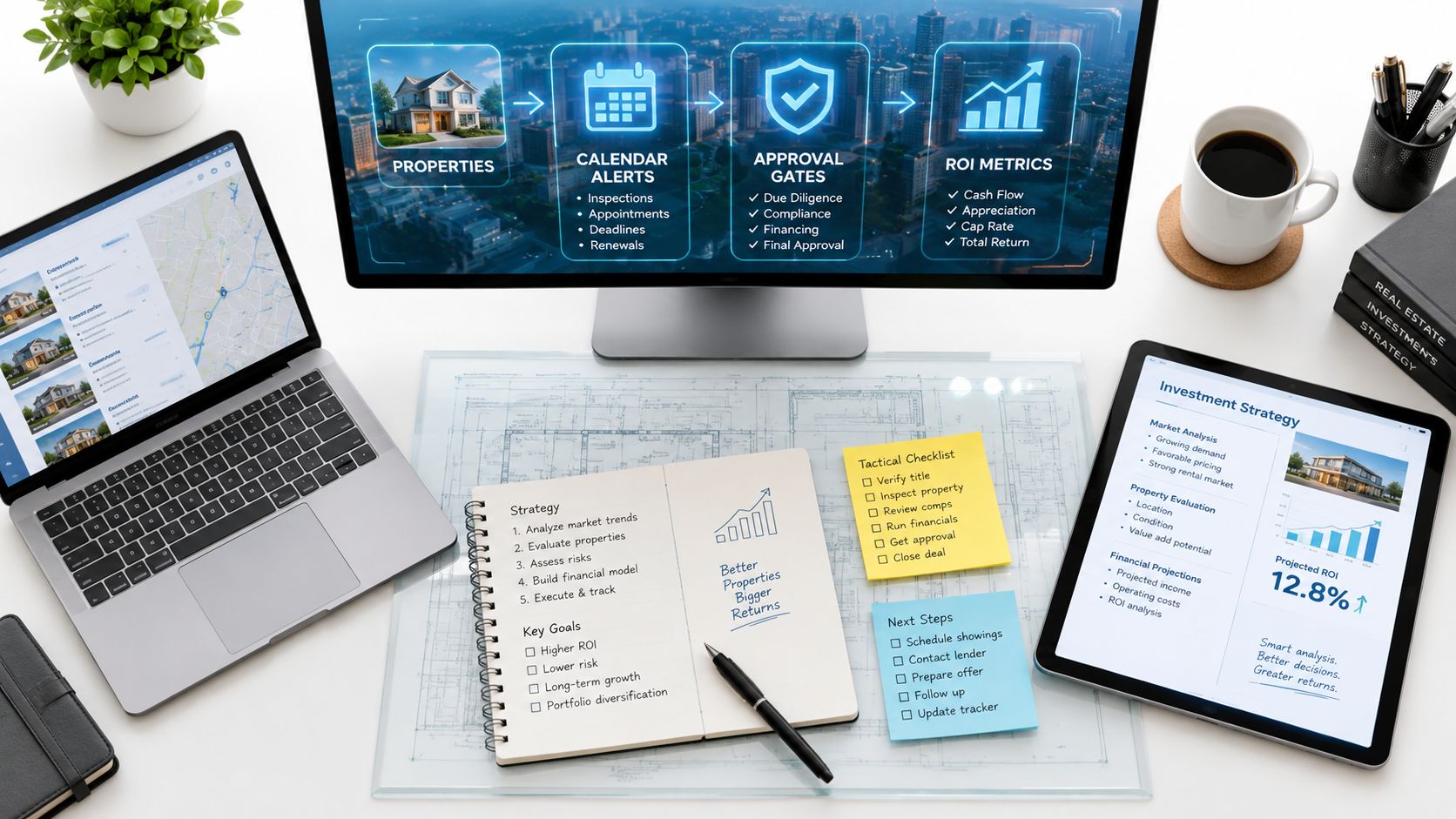
Tuesday morning starts with the shared inbox. There's an 8pm tenant message, a certificate expiry sitting on the wall planner and a rent ledger nobody has checked yet. The team is working, but each job is passing through too many hands.
That's the core problem. It isn't poor effort. It's fragmented hand-offs, duplicated data entry and unclear ownership between Reapit, Alto, Fixflo, Arthur, Qube, bank feeds and spreadsheets.
These workflow automation examples focus on property operations, not software theory. Each one shows where data enters, what the system does, where a person approves the next action, how to assess payroll value and what can go wrong. The core platform stays in place. The system connects to what you already run.
Legal and compliance decisions still belong with your agency. Where a process touches statutory requirements, ask a solicitor or compliance adviser to confirm how it applies in England or Wales.
Table of Contents
- 1. How can rent collection and arrears chasing stop relying on spreadsheets?
- 2. How should certificate renewal tracking work across managed properties?
- 3. How can tenant communication routing prevent messages disappearing overnight?
- 4. How should maintenance requests be triaged before they reach a contractor?
- 5. Can deposit protection administration be made more reliable?
- 6. How can landlord accounting and service-charge reconciliation reduce month-end friction?
- 7. How should Section 20 works be tracked without losing the paper trail?
- 8. How can a team stop urgent tasks getting buried in email?
- 9. How can tenancy progression and renewals avoid last-minute surprises?
- 10. What governance is needed after the workflow goes live?
- Workflow Automation: 10-Example Comparison
- Start with the queue you already hate
1. How can rent collection and arrears chasing stop relying on spreadsheets?
Arrears chasing works well as a controlled workflow because the trigger is clear. A payment is due, the bank feed or ledger shows no matching receipt, and someone needs to review the position before a tenant is contacted.
A sensible workflow looks ahead rather than shouting about every live transaction:
- Check upcoming payments: Pull due dates from Reapit, Alto or the relevant accounting system and create a daily review batch.
- Match payment records: Compare the tenancy ledger with the bank feed before flagging a missed payment.
- Draft the message: Prepare a friendly first reminder, followed by a firmer template where the history supports it.
- Request approval: A property manager approves, edits or rejects the message before it reaches the tenant.
- Escalate the decision: Send older or disputed cases to a team lead for a judgement call, not an automatic threat.
The system handles timing and administration. It shouldn't decide whether a tenant needs a payment arrangement, whether a landlord should be told or whether formal action is appropriate.
Track false alerts, approval overrides, unresolved balances and staff handling time. That tells you whether the workflow is reducing admin or creating another queue. A practical guide to workflow automation software should help you assess the connections, not push you towards replacing your property platform.
2. How should certificate renewal tracking work across managed properties?
A wall planner gives one person a reminder. It doesn't give the whole team a searchable record, proof of upload or a clear owner for an overdue certificate.
Start with one certificate type, such as gas safety, and prove the hand-off before adding EPC, electrical, asbestos, PAT and fire-safety records. The workflow can create staged reminders, provide a landlord upload link and place missing documents in a named compliance owner's queue.
The important steps are:
- Create the renewal record: Use the property and tenancy data already held in Reapit, Alto, Arthur or Qube.
- Remind early: Give landlords enough time to arrange a contractor rather than waiting for the expiry date.
- File the evidence: Require the document to be attached to the correct property record, not left in an email inbox.
- Escalate non-response: Assign one person to chase the landlord and record every contact.
- Review exceptions: Check properties with unusual use, ownership or certificate scope manually.
Automation can show that a document is missing. It can't decide the legal consequence or confirm that a certificate is suitable for a particular property. A solicitor or compliance adviser should confirm the process and wording.
The operational benefit is visibility. Voids are less likely to stall because nobody knows where a certificate is, and managers can see the next renewal date without asking one administrator.
3. How can tenant communication routing prevent messages disappearing overnight?
A tenant message should create an owned task, not sit unread in a shared inbox. That applies whether it arrives through email, SMS, Fixflo or an integrated WhatsApp route.
Begin with two categories, maintenance and everything else. More detailed routing can come later, once the team has learned to use one queue consistently.
A workable flow is:
- Capture the message: Record the sender, property, tenancy and original wording.
- Classify the request: Identify maintenance, rent, access, complaint or general enquiry.
- Create one thread: Add the communication to the relevant record in Fixflo, Reapit, Alto or the property management system.
- Assign an owner: Route the task to the right person and show a response deadline.
- Draft an acknowledgement: A person approves the wording before it is sent to the tenant.
- Escalate exceptions: Send suspected gas emergencies, flooding, safeguarding concerns and complaints to a named senior member of staff.
The workflow can acknowledge receipt outside office hours, but it must not pretend that acknowledgement is resolution. A manager still needs to decide what happens to a complaint, a vulnerable tenant or a disputed repair.
Measure unanswered messages, duplicate requests, response age and the most common property-level issues. That evidence may point to a landlord communication problem, a contractor issue or a need for extra admin capacity.
4. How should maintenance requests be triaged before they reach a contractor?
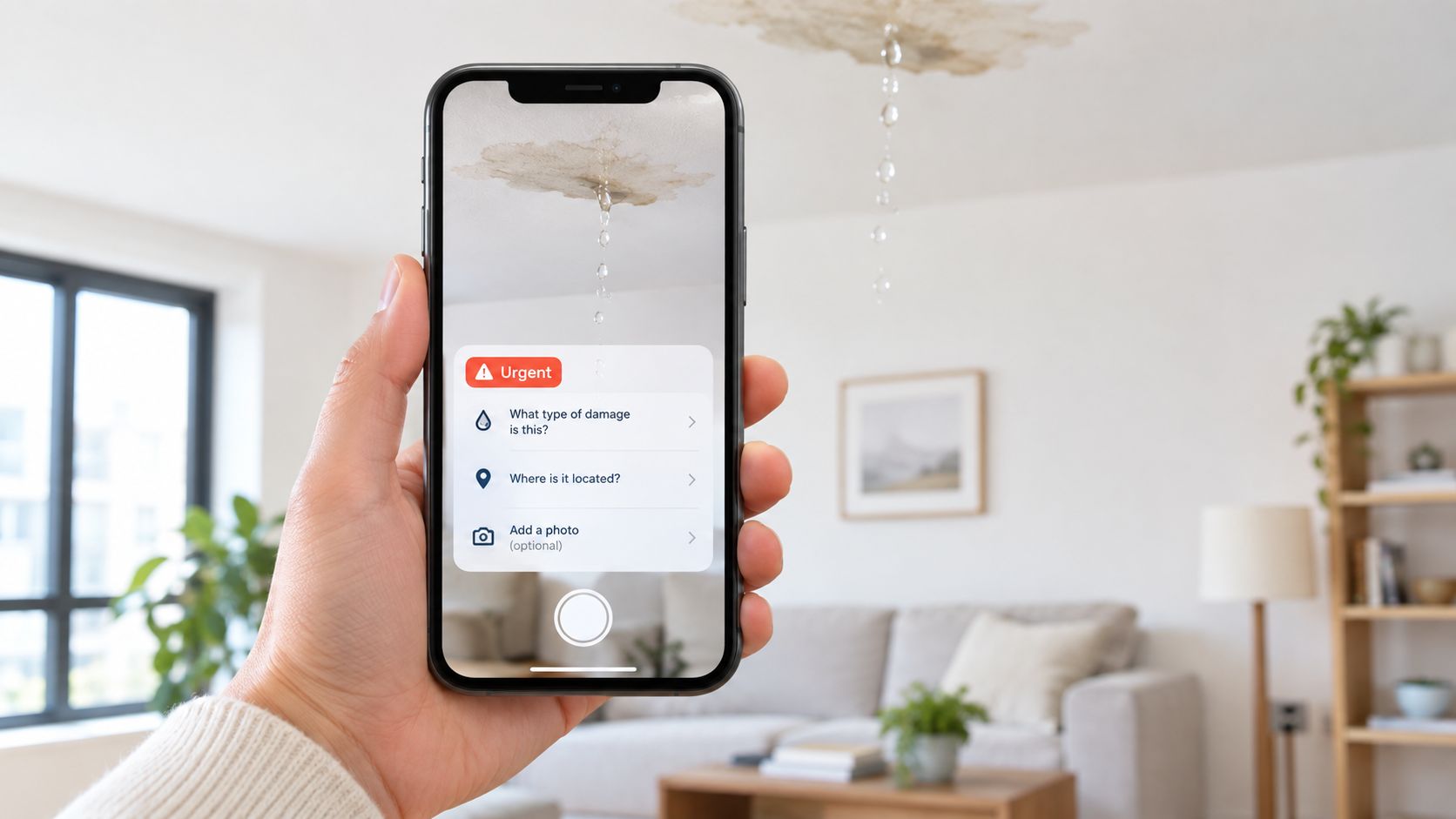
Maintenance triage is valuable when the intake is short and the decision rules are clear. A tenant can provide the property, the fault, whether there is immediate danger and supporting photographs. The workflow then creates or updates a Fixflo ticket and checks the relevant property history.
Practical rule: If the form takes too long, tenants will return to email and your carefully designed queue will become another spreadsheet.
Use separate routes for emergency, routine and landlord-preferred contractors. A rate card can provide a draft cost range for familiar work, but it shouldn't approve spend or decide liability.
- Collect the report: Ask only the questions needed to classify the issue.
- Check safety indicators: Route possible gas, electrical or serious water incidents to immediate human review.
- Prepare the job: Add photographs, access details, contractor preference and property history.
- Request approval: A property manager confirms the route, deadline and communication.
- Track completion: Record contractor updates, tenant contact and the final invoice.
The Department for Levelling Up, Housing and Communities recorded more than 14.3 million responsive repairs in England during 2023/24, with target timescales and completion performance varying between emergency and non-emergency work (official tenant satisfaction measures). That volume makes missed hand-offs expensive, but the system still shouldn't make complex safety or liability decisions.
See how AI systems can support operational workflows, then test the intake with real tenants before rolling it across the portfolio.
5. Can deposit protection administration be made more reliable?
Deposit protection has a clear operational sequence, but the wording and legal application need control. When a tenancy goes live, the system can pull the deposit details from Reapit or Alto, record a DPS, TDS or Capita reference, prepare the prescribed information and place the draft in front of a trained member of staff.
The approval point matters. A person should check the deposit amount, tenant details, dates and template before anything is sent.
- Trigger the record: Start when the tenancy becomes active.
- Check the data: Compare the deposit and tenancy details with the source record.
- Prepare the documents: Generate the agreed template and retain a draft.
- Approve and send: Send only after human review, with a delivery or read record where available.
- File the evidence: Save the final document and reference against the tenancy.
- Review gaps: Produce a report for tenancies with missing protection or prescribed-information records.
Ask a solicitor to confirm the template before automating it. Rules and wording can change, and a copied template can drift away from the current requirement.
This is a good example of automation as evidence management. It doesn't replace judgement. It creates a consistent trail showing what was prepared, approved, sent and filed.
6. How can landlord accounting and service-charge reconciliation reduce month-end friction?
Month-end statements become difficult when rent, service charges, outgoings and bank transactions sit in different places. The useful system doesn't just send statements faster. It pulls the records together, flags variances and gives the accounts team a draft that can be checked.
Start with rent-only statements for a small group of landlords. Add service charges, contractor payments and unusual allocation rules once the matching logic is trusted.
- Set the source records: Define whether the ledger, bank feed or accounting platform is authoritative for each field.
- Apply landlord rules: Keep detailed and summary statement formats separate.
- Create a suspense queue: Send unmatched or unclear transactions to manual review.
- Prepare the draft: Produce the statement with supporting transaction detail.
- Approve before sending: An accounts or property manager checks the draft.
- Log questions: Record landlord queries so repeated missing or late items can be fixed at source.
The NHS Shared Business Services pharmacy-invoice workflow reduced processing time for one invoice from approximately 60 minutes to 2 minutes, with 100% accuracy, reported annual savings of about £40,000 and a 233% return on investment (NHS Shared Business Services RPA example). That's a targeted, rules-based process, not proof that every property accounts workflow will deliver the same result.
For your business, measure reconciliation time, unmatched transactions, statement revisions and landlord queries. Those figures tell you whether the work is worth automating.
7. How should Section 20 works be tracked without losing the paper trail?
Section 20 administration is a project, not a reminder. Notices, estimates, leaseholder comments, surveyor reports, works, invoices and apportionments need to stay connected to the same building and project record.
A workflow can organise the timeline and surface missing documents. It must not decide the correct legal route, interpret a lease or approve a disputed cost. Confirm those points with a solicitor or compliance adviser.
Use the system to:
- Create the project: Add the building, relevant leases, notice dates and responsible manager.
- Store evidence: Attach estimates, reports, contractor details and issued notices to the project.
- Log comments: Capture each leaseholder response with its date and content.
- Monitor deadlines: Alert the manager before each required stage.
- Track the works: Link purchase orders, updates, invoices and completion records.
- Reconcile the outcome: Compare final costs with the approved estimate and record the reason for material changes.
Qube or another block-management platform can remain the system of record, with an orchestration layer moving documents and tasks around it. Lease terms and apportionment rules should be checked before calculations are automated.
The test is simple. Can a manager open one project and see what was issued, when it was sent, who replied, what was approved and what remains outstanding?
8. How can a team stop urgent tasks getting buried in email?
Teams rarely need another task app. They need one view that pulls work from Fixflo, Reapit, Arthur, diary entries and agreed email sources, then shows who owns each item and what deadline applies.
Set three priority levels first, urgent, normal and backlog. Too many categories create arguments rather than clarity.
- Aggregate the tasks: Create one record for each actionable request.
- Remove duplicate alerts: Turn off notifications from the systems feeding the dashboard.
- Show ownership: Give each person a personal queue and a team view.
- Flag risk: Mark tasks near their deadline that haven't started.
- Escalate selectively: Send blocked work to the team lead, not the whole office.
- Review capacity: Compare incoming work with completed work by task type.
The Alan Turing Institute estimated that UK central government handles approximately 1 billion citizen-facing transactions each year, including around 143 million complex and repetitive transactions. Saving one minute per transaction across the assessed opportunity would equal approximately 1,200 person-years annually (AI for bureaucratic productivity). Your portfolio is smaller, but the calculation is the same. Repeated handling time becomes capacity when the process runs often enough.
A dashboard won't fix an understaffed team or an impossible service promise. It will show whether the problem is late work, poor prioritisation or insufficient capacity.
9. How can tenancy progression and renewals avoid last-minute surprises?
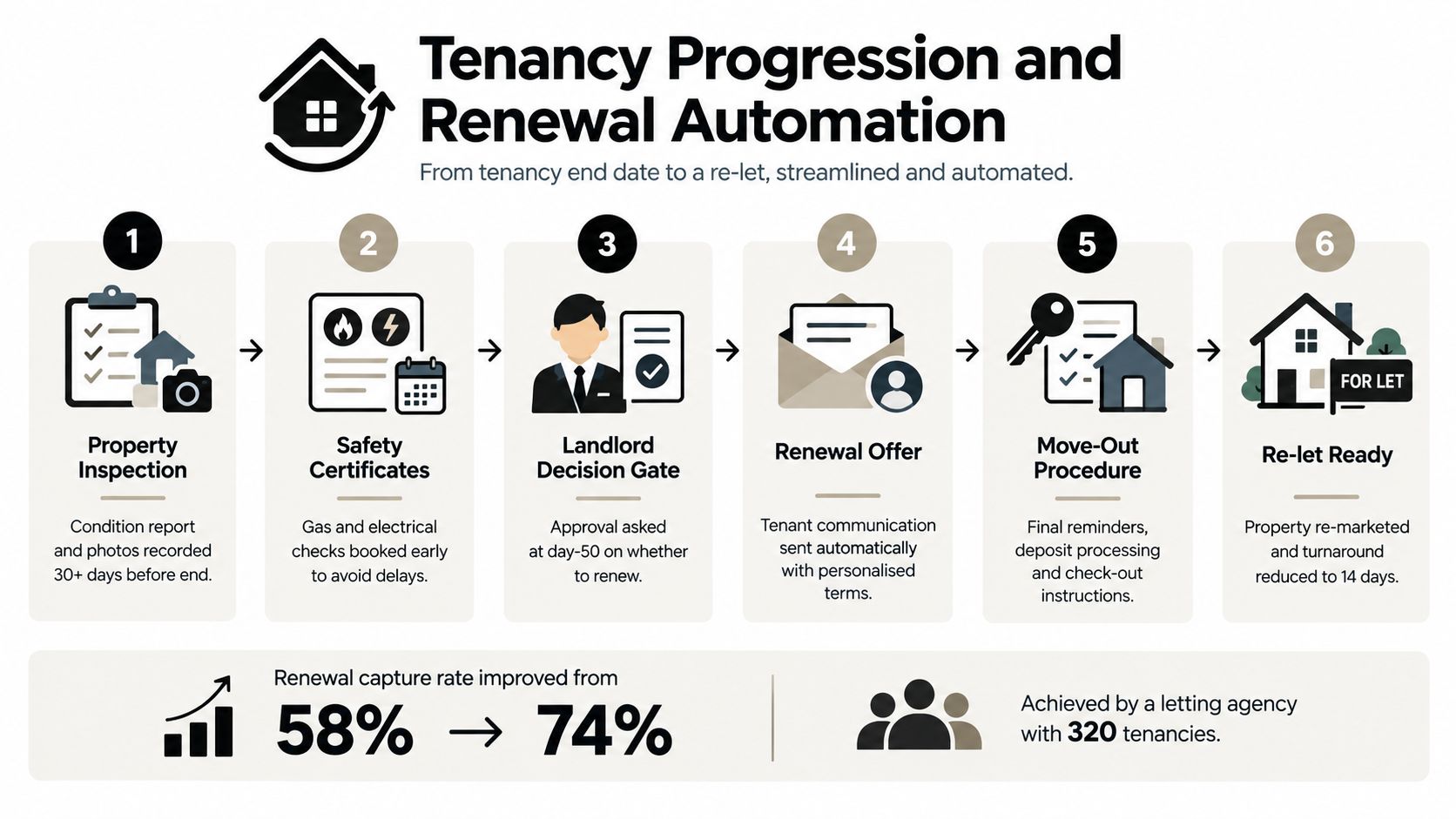
Tenancy progression should run from the end date, not from someone's memory. The workflow can trigger inspection planning, certificate checks, renewal decisions, move-out tasks, deposit processing and final inspection in the right order.
Some work can happen in parallel. Other tasks must wait for a completed inspection, landlord decision or document check.
- Read the end date: Create the tenancy timeline from the platform record.
- Start conditional tasks: Trigger inspection and landlord decision work at the agreed points.
- Request approval: Ask the landlord whether they want to renew before preparing the next route.
- Pivot when needed: Move to notice, move-out and re-let tasks if renewal is declined.
- Capture condition evidence: Use photographs and a structured inspection record.
- Close the tenancy: Reconcile deposit, final readings, repairs and keys before marking the workflow complete.
The NHS recruitment programme shows why elapsed time and management capacity should both be measured. It reduced the interval between conditional offer and completed employment checks from 30 days to 14 days, and released roughly 2,500 hours per year for hiring managers (NHS recruitment automation example). Property firms should apply the same discipline to renewal capture, void days, rework and manager hours.
10. What governance is needed after the workflow goes live?
A workflow linked to Reapit, Alto, Fixflo, Arthur, Qube, accounting software and spreadsheets needs a named owner, a source of truth and a visible queue for failed transfers.
UK lettings research found that 61% of professionals manually transfer, re-enter or duplicate information during a tenancy, while 66% use several disconnected systems (lettings technology and administrative workload research). Integration should remove that duplication, not conceal it behind another dashboard. Map the process first. A practical overview of workflow automation solutions shows how mapping, approvals and governance should fit together before any build starts.
Set the controls before launch:
- Data ownership: Decide which platform wins when records conflict.
- Approval rights: Name who approves tenant, landlord or regulator-facing actions.
- Exception handling: Route failed syncs, uncertain classifications and missing fields to a visible queue.
- Access controls: Restrict confidential client, tenant and financial data by role.
- Testing: Check edge cases, old records, incomplete documents and unusual property types.
- Review cadence: Measure accuracy, overrides, adoption and hours avoided, then confirm the payroll saving justifies maintenance effort.
The Office for National Statistics found that difficulty identifying suitable activities or use cases was the leading barrier to AI adoption among surveyed firms, reported by 39% (ONS research on technology and AI adoption). Naming owners and approval rights is how a firm turns that barrier into a workable first use case.
Workflow Automation: 10-Example Comparison
| Item | 🔄 Implementation complexity | ⚡ Resource requirements | 📊 Expected outcomes | 💡 Ideal use cases | ⭐ Key advantages |
|---|---|---|---|---|---|
| Rent collection and arrears chasing | Medium, bank-feed & platform integrations + approval gate | Reapit/Alto/Arthur/Qube; clean bank feeds; 1 admin for overrides | Faster detection (within 48h); admin −4–6 hrs/week; higher recovery rates | Mid-size letting agencies with recurring rent flows | Early detection, audit trail, frees time for negotiation |
| Compliance & certificate renewal tracking | Medium, calendar, uploads, platform sync; initial data audit required | Reapit/Alto/Qube/Fixflo; person to chase non-responders; document storage | Eliminates missed renewals; saves 3–4 hrs/month; dashboard audit-ready | Estate/block managers with many certificates | Consistent reminders, centralised certificates, reduces void delays |
| Tenant communication routing & logging | Low–Medium, channel integrations + categorisation rules | Fixflo/Reapit/Alto/Qube; team training to reply in-system | Response times cut (34h → 8h); fewer duplicates; SLA visibility | Teams handling multi-channel tenant contact volumes | Unified inbox, coherent threads, SLA tracking for urgent items |
| Maintenance request triage & scheduling | Medium–High, triage logic, contractor booking, rate card | Fixflo/Reapit/Alto/Arthur; pre-loaded rate card; contractor buckets | Urgent dispatch faster (3.5d → 0.5d); saves 2–3 hrs/day; fewer landlord emails | Agencies with frequent maintenance calls and contractors | Rapid safety routing, photo + cost estimates, fewer follow-ups |
| Deposit protection & prescribed information | Low–Medium, tenancy-triggered workflows + legal template checks | Reapit/Alto/Qube; DPS/TDS/Capita integration; solicitor review of wording | 100% logging from day 1; saves ~30 mins per tenancy; compliance proof | Agencies seeking consistent deposit compliance at scale | Guaranteed filing, read-receipts, audit trail for disputes |
| Landlord accounting & service charge reconciliation | High, accounting integrations, per-landlord rules | Reapit/Alto/QuickBooks/Qube; clean ledger & bank feeds; accountant review | Statements same day; reconciliation errors caught; saves days/month | Portfolios with recurring statements and service charges | Automated variance flags, consistent templates, audit-ready statements |
| Section 20 consultation & remedial works tracking | High, statutory timelines, apportionment config, audit capture | Reapit/Alto/Qube; legal sign-off; lease-term data load | No missed deadlines; admin −8–12 hrs/project; fewer post-completion disputes | Block managers running statutory consultations | Full audit trail, deadline alerts, cost vs estimate reconciliation |
| Staff task & priority management | Low–Medium, inbox aggregation + priority rules | Fixflo/Reapit/Alto/Qube; team adoption & discipline; time-tracking optional | Fewer missed tasks; manager time saved 3–5 hrs/week; capacity visible | Small teams needing single task view and capacity planning | Single dashboard, automatic escalation, workload transparency |
| Tenancy progression & renewal automation | Medium–High, conditional workflows, landlord gates | Reapit/Alto; mapped tenancy processes; landlord approval steps | Renewal rates ↑ (58% → 74%); faster re-let (21d → 14d); fewer surprises | Agencies running high-volume renewals and turnovers | Sequential checklists, early renewals, structured deposit processing |
| Cross-cutting implementation & governance | Variable, mostly procedural: data, approvals, audits | Legal advisers, data-cleaning effort, named workflow owners | Lower rollout risk; aggregated admin savings; fewer compliance errors | Programme rollouts and multi-module automation projects | Best-practice controls, approval gates, regular audits and owners |
Start with the queue you already hate
Pick one recurring queue, missed payment checks, certificate renewals, maintenance triage, tenancy progression or month-end reconciliation. Write down where the data enters, where someone rekeys it, where the work waits and where a human must approve the next step.
Then compare the recoverable admin time with the alternatives. Hiring may add capacity but leave the same broken hand-offs in place. Switching platform may create a long migration project. Doing nothing preserves the cost of delay. ChatGPT may draft text, but without integrations it won't check the ledger, update Fixflo, file the evidence or create an accountable exception queue.
The best first workflow is rarely the most impressive one. It's the process with clear ownership, repeatable rules, clean enough data and an expensive delay. Property managers and owners can use this AI readiness scorecard as a tool for baselining process cost and identifying realistic automation opportunities. For a wider view of connected workflows for letting agents, start with the queue that is already consuming attention every week.
If you want to test the idea properly, book a free discovery call with InnovaAI Integration Ltd. We'll work out whether connecting your existing systems is a fit, and if it isn't, Cameron will say so on the call.
InnovaAI Integration Ltd maps and builds custom workflow automation for property firms, connecting systems such as Reapit, Alto, Fixflo, Arthur and Qube without replacing the platform your team already uses. Visit InnovaAI Integration Ltd to discuss maintenance triage, certificate renewals, tenancy progression or another queue that needs clearer ownership.