Property Compliance Software: UK Buyer's Guide 2026
property compliance softwarecompliance software UKletting agent softwareblock management software

Tuesday morning, the shared inbox is already on fire. Someone's chasing a gas safety record, a tenant is complaining about a mould report from last night, and the compliance sheet says the certificate was “handled” but nobody can tell you who saw it, when it was sent, or whether the tenant got the record.
That's the problem. It's not that your team doesn't care, it's that compliance sits across the wall planner, the spreadsheet, the PMS, and whatever half-used module nobody fully trusted in the first place. If you're running Reapit, Alto, Fixflo, Arthur or Qube, the gap usually isn't the system of record, it's the evidence trail and the follow-up discipline around it.
| What you're juggling | What usually breaks | What the software has to do |
|---|---|---|
| Certificates, inspections, hazards, redress, client money | Dates are visible, evidence is not | Tie each obligation to a property and owner |
| Tenant messages, contractor replies, internal handoffs | Response time slips through the cracks | Track who acted, when, and what happened next |
| Landlord queries, local authority requests, insurer questions | People rebuild the file manually | Produce an exception list and audit-ready record |
property management automation has to be judged on that basis, not on whether it can store PDFs. If it can't prove what happened, in what order, and who approved it, it's just a prettier filing cabinet.
Table of Contents
- What Tuesday Morning Actually Looks Like
- What a Working Compliance System Actually Does
- The Four Shapes of Property Compliance Software Compared
- Eight Questions to Ask on the Sales Call
- Why an Expiry-Date Dashboard Is No Longer Enough
- What Software Will Not Fix and When You Should Not Buy It
- Where to Look in Your Own Operation This Week
What Tuesday Morning Actually Looks Like
At 9am, the inbox has already decided your day for you. The gas safety certificate that should've been checked yesterday is sitting in a thread with five other messages, and the tenant who reported a leak at 8pm still wants to know who's dealing with it.
The problem isn't laziness, it's fragmented process
Compliance rarely slips because the rule is unknown. It slips because the work is split between a diary, a spreadsheet, and the PMS, then handed back to people whose job is already full of tenancies, arrears, maintenance triage, and owner calls.
A certificate gets logged, but the next action doesn't get owned. A tenant report lands, but nobody times the response properly. A document exists, yet nobody can evidence that the landlord or agent acted inside the required window. That's where the exposure builds.
Practical rule: if the team can't answer “what happened after the alert?” without opening three systems, the process is already failing.
The cost is mechanical. You spend time reconciling records before a lender, owner, or council asks for them. You create a backlog of exceptions nobody is chasing. You keep paying for admin twice, once when the work is done and again when the file has to be rebuilt.
This is an evidence problem, not a filing problem
A good compliance workflow is about proving sequence, not just storing documents. The record has to show the trigger, the owner, the follow-up, the decision, and the outcome. If you're only collecting a certificate, you're missing the part that usually matters when something goes wrong.
That's why software only works when it sits on top of what you already run. It should connect to your current stack, not force your team into a second operating rhythm. If it doesn't reduce the number of places a compliance task can disappear, it won't hold up under pressure.
What a Working Compliance System Actually Does
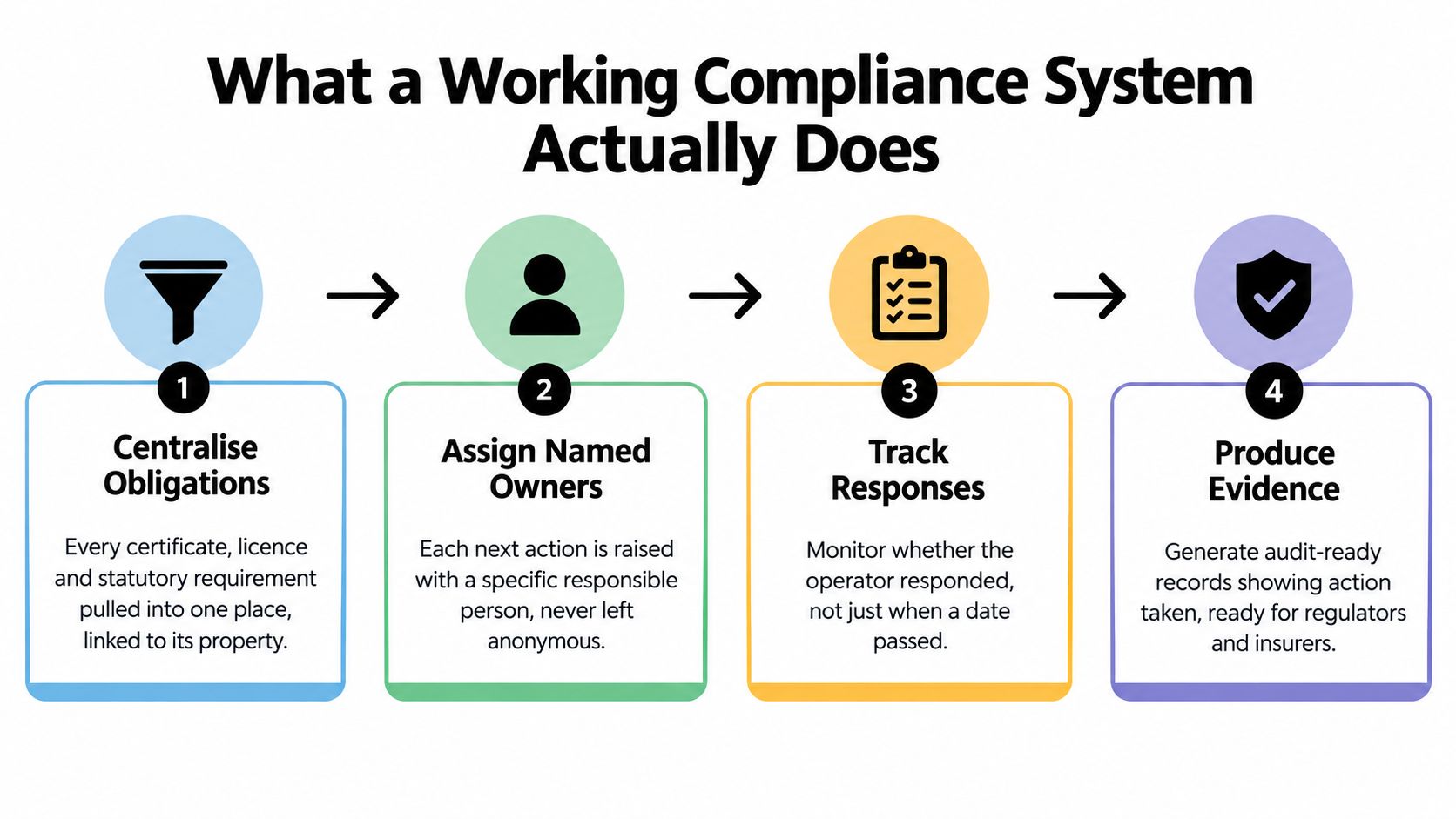
It centralises obligations without flattening them
A working system pulls each obligation into one place and keeps it tied to the right property, block, or tenancy. It doesn't just say “gas check due”, it knows which unit, which owner, which engineer, and which evidence belongs to that record.
It assigns named owners
Every next action needs a person against it. Not a team, not a queue, not “compliance”. The reminder goes to the right operator, the booking request gets reviewed, and any status change from outstanding to closed needs human approval before it sticks.
It tracks responses, not just dates
That matters more than most buyers admit. A system that can't prove a landlord responded within a legally required timeframe is not solving the underlying problem, it's decorating it.
It produces evidence the outside world can use
The output should be an exception list, not a vanity percentage. You need to see what is open, who owns it, how old it is, what evidence is missing, and what was escalated. That's the shape of a file a regulator, insurer, or solicitor can work with.
For the engineering side, think of it as sitting over your existing PMS and communication tools, not replacing them. That's the right place for system integration, because the value comes from joining the workflow, not introducing another silo.
The Four Shapes of Property Compliance Software Compared
The market usually comes in four forms. A standalone compliance product, a module inside your PMS, a connector that joins systems together, or a bespoke build wired around your current operation.
| Shape | Control | Lock-in | Integration risk | Best fit |
|---|---|---|---|---|
| Standalone product | Medium | Medium to high | Medium | Lower complexity, tighter budget, simple obligation sets |
| PMS module | Low to medium | High | Low if native, higher if limited | Teams already getting most of the way there in Reapit, Alto or Qube |
| Workflow connector | High | Low to medium | Medium | Mid-size operators with mixed stacks and messy handoffs |
| Bespoke build | Highest | Low | Higher up front, lower if designed properly | Exceptions, complex escalation rules, and portfolios that don't fit neat defaults |
A standalone product is fine if your needs are narrow and your compliance model is stable. It becomes awkward when your exceptions start multiplying, because the product usually decides the workflow, not you.
A module inside the PMS is attractive when the core platform already carries most of the obligation. That can work well for a letting agency that wants one place to look. It struggles when the actual problem is the gap between the PMS and the wall planner.
A connector is the right middle ground when your stack is mixed and the team won't change how they work. It lets the existing tools keep doing their jobs, while compliance events, reminders, and evidence move between them.
Bespoke wins when the exception is the product. That's true for operators with unusual portfolios, tight escalation rules, or compliance processes that need to match the business rather than force the business to shrink around the software. For letting agencies in particular, this sector page is the cleaner place to start than buying another off-the-shelf tool and hoping it behaves.
Eight Questions to Ask on the Sales Call
Where does the data physically live? A good answer says which system is the source of truth and how records move. A weak answer talks about “the cloud” and dodges ownership.
What happens when an inspection is logged late? A good answer explains how the system records the delay, keeps the history, and flags the exception. A weak answer just changes the status to complete.
Can it distinguish missing evidence from completed work? A good answer separates “done”, “awaiting proof”, and “not recorded”. A soft answer rolls them all into one green tick.
How does it treat a tenant-reported hazard versus a scheduled inspection? A good answer keeps the event timeline separate and routes the issue to the right owner. A weak answer treats both as generic tasks.
Do reminders ever leave the platform without human sign-off? A good answer says no for anything that goes to a tenant, landlord, or regulator. A bad answer says the system can “auto-run” most messages.
How does it handle redress and client-money protection separately? A good answer shows two records, two renewal paths, and two evidence sets. A sloppy answer uses one scheme field for everything.
What does the export look like when a local authority asks questions? A good answer shows property-level history, timestamps, attachments, and status changes. A poor answer shows a spreadsheet dump.
How does it absorb a new obligation without a rebuild? A good answer talks about versioned rules, effective dates, and configurable fields. A bad answer starts talking about “future roadmap” instead of the actual workflow.
The right vendor won't flinch at those questions. If they do, they're selling a demo, not an operating system.
Why an Expiry-Date Dashboard Is No Longer Enough
A calendar of certificate dates used to be enough to keep a lid on the admin. It isn't anymore, because the defensible question has changed from “was the document current?” to “did you respond in time?”
Awaab's Law brought that into sharp focus in social housing from 27 October 2025, with emergency hazards to be investigated and made safe within 24 hours, and significant hazards within 10 working days. That pushes the evidence trail towards response time, triage, contractor action, and closure, not just certificate storage. The Government also says the new council investigatory powers began on 27 December 2025, which makes clean records even more important when someone asks how a hazard was handled.
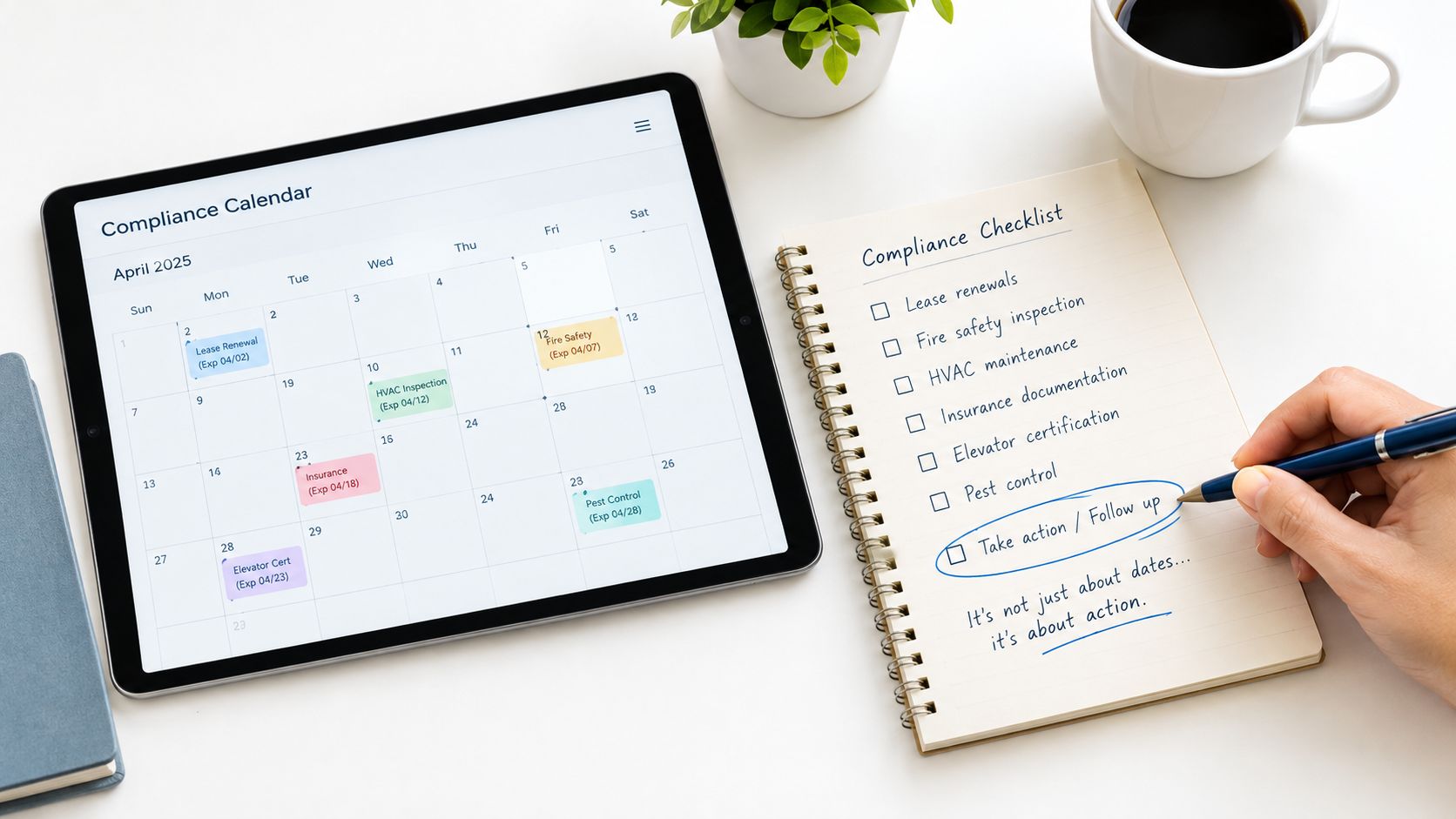
That logic matters outside social housing too. The English Housing Survey found that 9% of dwellings, approximately 2.3 million homes, had at least one HHSRS Category 1 hazard in 2024, and the proportion was 10% in private rented housing compared with 5% in social housing English Housing Survey 2024 chapter. If you manage private rented stock, you're already operating in conditions where a green tick on a dashboard tells you very little.
The procurement test is simple. Ask whether the platform can produce an exception list by property, hazard category, responsible party, due date, and escalation status. If it can't, you're looking at a reporting toy, not property compliance software.
What Software Will Not Fix and When You Should Not Buy It
Doing nothing is a bad plan once the exception list stops fitting in one person's head. Past that point, memory and goodwill become your control system, and that's not a control system.
Hiring another administrator is the right move when the process is sound and the bottleneck is pure capacity. If the work is already defined, the records are already clean enough, and the problem is just throughput, add the person first. Software won't rescue a broken process if nobody knows what “good” looks like.
Switching the entire platform is usually overkill. Your PMS probably already handles most of the obligations, and the core issue is the gap between that system and the way your team works. Changing everything because the compliance process is messy is how you create six months of disruption and a worse inbox.
Using ChatGPT on its own is fine for drafting a reminder email. It's the wrong tool for any compliance decision because it can't evidence when a message was sent, by whom, or what was attached. For anything reaching a tenant, landlord, or regulator, you need logged, auditable workflow with human approval.
If you want to sanity-check the gap before you buy anything, use a scorecard like the AI readiness scorecard as a tool, not a pitch deck. It's useful when you're trying to work out whether the problem is process, data, or software.
Where to Look in Your Own Operation This Week
List every obligation you track, then write down where each record lives. If the same answer appears in a wall planner, a spreadsheet, and the PMS, that is the issue.
Count the open exceptions and sort them by age. Anything without an owner, or with “waiting” as the status, is where your exposure sits.
Map the points where a tenant report can slip past a certificate-based dashboard. If the issue starts with a message, a call, or a maintenance note, the system has to catch that event, not just the expiry date.
If you want a second pair of eyes, book a free discovery call with InnovaAI Integration Ltd. I'll tell you whether software is even the right move, and if it isn't, I'll say so on the call.