Property Management Automation for UK SMEs
property management automationletting agent workflowsproperty compliance trackingmaintenance triageAI for letting agents

Tuesday starts the same way in too many agencies. The shared inbox is already stacked, the gas cert sitting on the wall planner slipped through yesterday, and a tenant has sent a ceiling photo at 11pm that still hasn't been logged properly by breakfast.
That isn't staff laziness. It's what happens when Reapit or Alto is doing one job, Fixflo is doing another, accounts sits somewhere else, and someone in the office is still carrying the entire process in their head. If you want to grow doors without adding another salary, property management automation has to connect that mess, not replace the team.
Table of Contents
- Why the Tuesday Morning Backlog Never Shrinks
- What Manual Admin Actually Costs Your Agency
- Designing Workflows That Connect Your Existing Platforms
- Choosing Between Hiring, Switching Software or Automating
- Rolling Out the System and Measuring Real ROI
- Where to Start Your Automation Audit Today
Why the Tuesday Morning Backlog Never Shrinks
The backlog doesn't persist because people aren't trying. It persists because the work is split across channels that don't agree with each other, and the handoffs live in spreadsheets, inboxes, and memory.
A landlord-led market makes that worse, not better. The English Private Landlord Survey 2024 found that 52% of landlords who registered a deposit directly with a tenancy-deposit protection provider did not use an agent to let or manage their properties, and that share was broadly stable over time, 49% in 2021 and 52% in 2018 (government report). That tells you the operating model hasn't become neat and centralised just because the software got better.
The real bottleneck is the handoff
A wall planner can remind someone that a gas certificate is due. It can't move the certificate into the right record, alert the right person, and show what was sent to whom.
Practical rule: if a task needs someone to remember a second step after they've already left the inbox, the process is already broken.
The operational problem is not the volume of messages on its own. It's the friction between message, record, action, and proof. If a repair comes in by WhatsApp, gets copied into a spreadsheet, then has to be re-entered into Fixflo or the CRM, the team isn't doing “admin”, they're acting as the sync layer.
That's why buying another platform rarely fixes the queue. If the agency already runs a CRM, a maintenance tool, and an accounting package, but the workflow still depends on manual copying, the backlog just changes shape. A proper workflow automation overview only matters when it changes the path of the work, not when it adds another place to look.
What Manual Admin Actually Costs Your Agency
The cost of manual admin shows up in the corners first. Replies happen after hours, certificates get chased late, and the same detail is typed twice because no one trusts the previous version.
A 2026 report citing survey findings says 46% of property managers and letting agents regularly handle paperwork in the evenings, while another 25% do administrative work at weekends, and that agents lose about eight hours each week to tasks that could already be automated, which works out at roughly 384 hours a year (industry report). That's not a theoretical efficiency gap, it's the week being eaten in real time.
The cost shows up as delay, not just labour
When the team spends the evening copying data between systems, the delay moves downstream. A renewal reminder goes out late. A contractor isn't chased until the next morning. A tenant waits longer than they should for an acknowledgement.
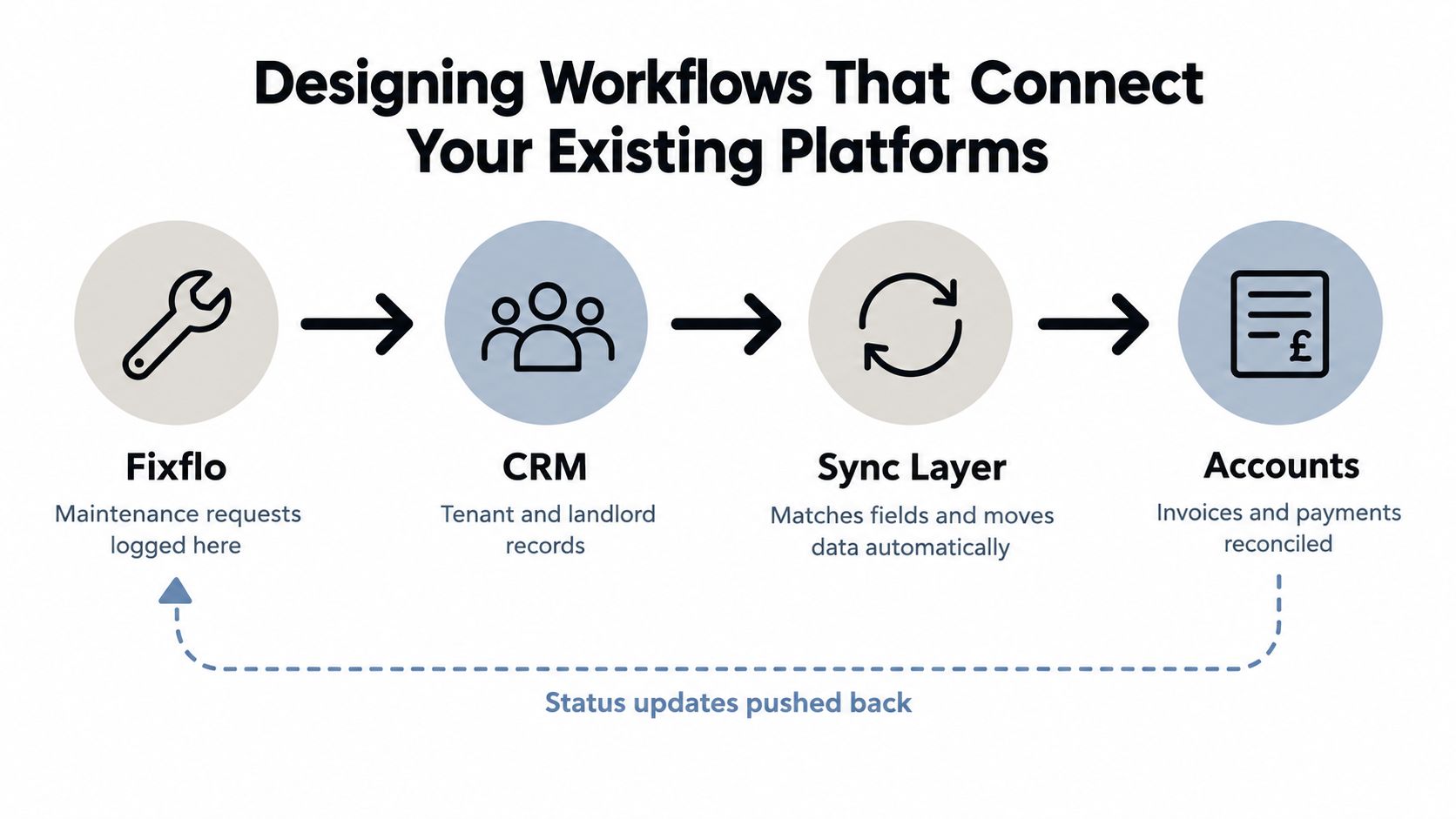
The margin hit comes when you try to add doors on top of that. If the process still needs a human to move every note from inbox to system to spreadsheet, more instructions just mean more chasing. The answer is not "work harder", it's to remove the duplicate entry and build a record that starts once and stays live.
Designing Workflows That Connect Your Existing Platforms
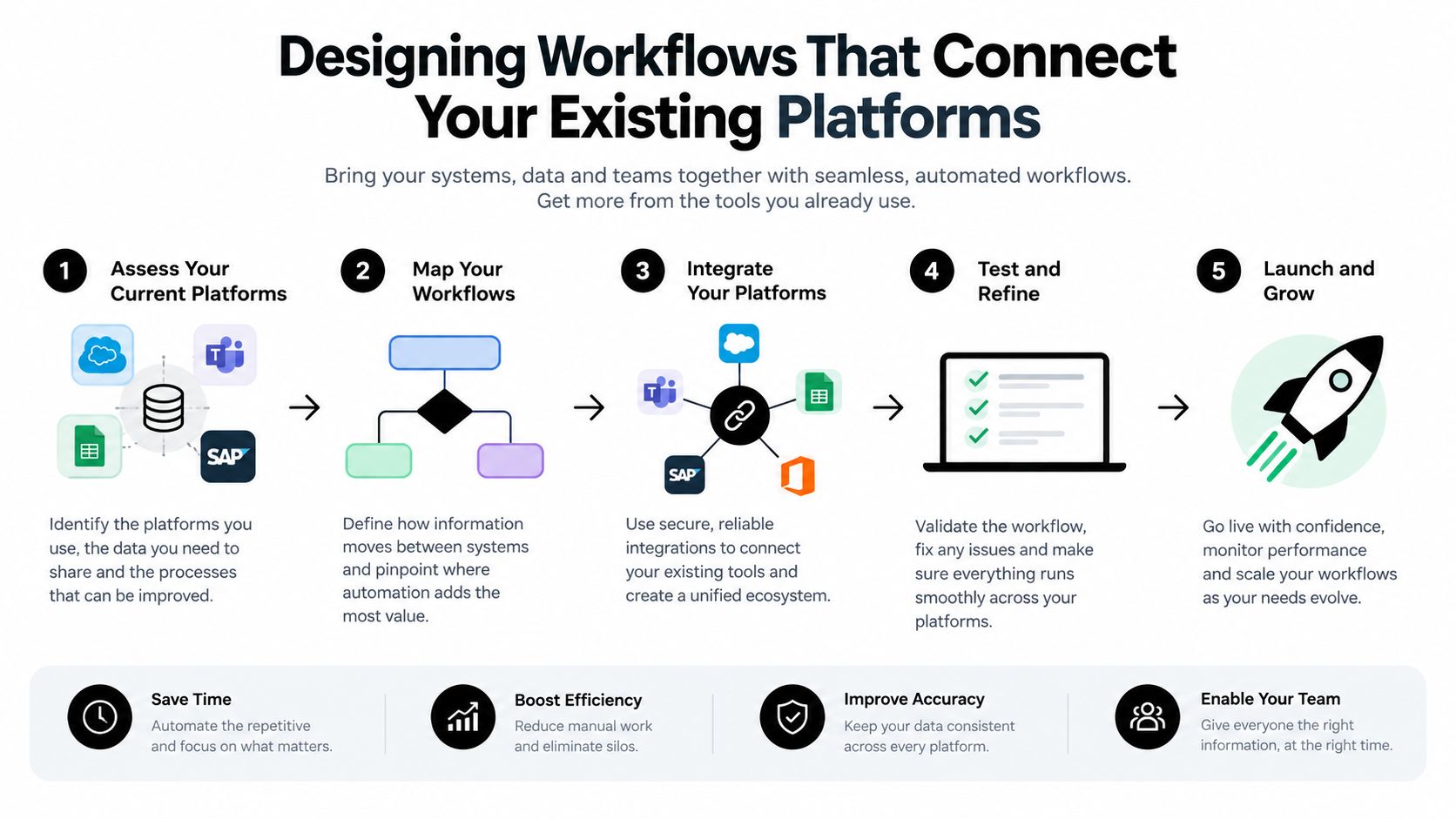
A proper workflow starts with the stack already in the office. If the team uses Reapit, Alto, Arthur, Qube, Fixflo, spreadsheets, or a mix of all of them, the job is to connect those records, automate the repetitive middle, and keep human review where compliance or judgment is involved.
That usually means building around real triggers, not office habits. A repair should move the moment it is reported. A certificate reminder should come from the property record and tenancy dates, not from someone remembering to check a calendar.
Build the intake layer first
The first step is to capture every request in one place, whether it arrives by email, text, WhatsApp, phone note, or portal.
- Timestamp the report: Keep the original message and time so the trail stays clear.
- Classify the issue: Separate emergency, urgent, and routine before anything is assigned.
- Attach evidence: Store photos, attachments, and message history against the right unit or tenancy.
- Route to the right queue: Send the job to the contractor list, the property manager, or compliance review.
- Hold human approval: Anything that goes to a tenant, landlord, or regulator gets checked by a person first.
That intake layer matters more than the visible automation. A chatbot that answers politely but drops the audit trail becomes a problem the moment a complaint turns into a dispute.
Put compliance on property-level rules, not a single reminder
England's gas and electrical checks need separate handling. Gas appliances and flues must be checked by a Gas Safe registered engineer at intervals of no more than 12 months, and records must be given to tenants before move-in and within 28 days of each annual check. Fixed electrical installations must be inspected at least every five years unless the report sets a shorter interval, and the report must be supplied to the right tenant at the right time (NRLA checklist).
A generic calendar reminder does not know who the tenant is, which document applies, or whether the property has changed hands.
The same applies to smoke and carbon-monoxide alarms. The England rules require working smoke alarms on every storey with living accommodation, and carbon-monoxide alarms in rooms with a fixed combustion appliance, excluding gas cookers. The landlord must check prescribed alarms on the first day of a new tenancy and repair or replace faulty alarms once told about them (government guidance).
For that reason, the system should trigger from the tenancy start date and the property's appliance data, then stop for a human sign-off before anything is sent out. See how to connect Reapit, Alto, Fixflo and accounting tools without a rebuild in our guide to system integration. A solicitor or compliance adviser should confirm how that setup applies in your operation.
Choosing Between Hiring, Switching Software or Automating
When the backlog bites, agency owners usually face the same three choices. Hire another administrator, replace the current system, or add generic AI and hope it fits the workflow.
Hiring is the easiest option to understand, and often the weakest fix. It adds more capacity to the same broken handoff, so the queue still slips through the same gaps.
The three options do not carry the same risk
| Option | What it fixes | What it doesn't fix |
|---|---|---|
| Hiring | More hands on the inbox | The same fragmented process |
| Switching software | Might modernise part of the stack | Disruption, retraining, and data migration |
| Automating the workflow | Removes repeated admin across existing tools | Only works if the process is mapped properly |
Switching software can work, but ripping out Arthur or Qube because the admin is messy can create more disruption than the backlog itself. Records still need moving, staff still need retraining, and every tenancy, certificate, and account trail still needs checking.
Generic AI has a different problem. The 2025 UK lettings-industry survey report said 47% of agencies were experimenting with AI, but only 22% used it in daily operations. That is the gap between testing a tool and building a repeatable workflow. ChatGPT can draft an email, but it does not know your tenancy, your compliance log, or your approval path unless you build those rules in.
For a small or mid-sized agency, the sensible route is a connected workflow that sits on top of what already exists. Custom software development in the UK is the route to examine when a specific build is more cost-effective than hiring more admin or forcing a platform switch. A build like the one InnovaAI Integration Ltd creates for letting agents and managing agents can connect existing records and automate the repetitive middle without asking the office to start again. If your team already works with spreadsheets alongside Reapit or Alto, that is usually where the value shows up.
Rolling Out the System and Measuring Real ROI
A workflow only sticks if the office trusts it. The cleanest rollout I've seen is boring on purpose, run the new process in parallel, compare the output, and let staff see where it helps and where it still needs a person.
Start with one painful process, not five. If repairs are the worst offender, map the intake, approval, and follow-up first. If compliance chasing is the problem, start with certificates and reminders.
Roll it out in stages
- Run parallel for a short period: Keep the old method live while the new workflow proves itself.
- Test edge cases early: Check what happens with vulnerable tenants, incomplete addresses, late-night reports, and missing attachments.
- Train around decisions, not buttons: Show staff where human approval sits and what they're responsible for checking.
- Track the operational output: Look at void turnaround, out-of-hours messages, and whether certificates are landing on time.
- Review weekly with the team: Fix the parts people are working around before you call it live.
The measure of success is not whether the demo looked clever. It's whether the property manager can trust the record, the landlord gets the right update, and the team stops retyping the same thing in three places.
Where to Start Your Automation Audit Today
Pick the process that causes the most Friday afternoon panic and draw it out properly. For most firms, that's arrears follow-up, inspection scheduling, or maintenance triage, because those are the jobs where one missed step turns into a weekend problem.
Use the scorecard as a quick baseline, then look for the process with the most copying, chasing, and manual checking. If you want to know whether a custom build makes sense for your portfolio, start there.
InnovaAI Integration Ltd builds connected automation for letting agents, block managers, and serviced accommodation operators who need their existing systems to do less manual work. If you want a workflow around repairs, compliance dates, or tenancy progression that fits the way your team already operates, visit InnovaAI Integration Ltd and book a free discovery call. If it isn't a fit, I'll say so on the call.