Lease Management Software UK: How to Choose
lease management softwareUK property softwarelease administrationproperty compliancerent review tracking

Tuesday morning starts with an 8pm tenant message still sitting in the shared inbox. A gas safety certificate hasn't been checked, and a rent review date is marked on a wall planner nobody updated after the last office move. The team is busy, but the dates, documents and next actions live in different places.
That's a process problem, not a people problem. Lease terms sit across Reapit or Alto, a spreadsheet, PDFs in a shared drive and someone's memory. Before choosing lease management software in the UK, check whether the underlying lease data is complete enough to trust.
Table of Contents
- Why Lease Admin Breaks at 400 Doors
- What a Lease Management System Has to Hold
- Comparing the Main UK Lease Management Options
- Getting Your Lease Data Ready Before You Buy
- Doing Nothing, Hiring, Switching Platform or Building a Layer
- Implementing Lease Management Without Replacing Your Stack
- What Lease Management Software Will Not Fix
- What to Look at First in Your Own Operation
Why Lease Admin Breaks at 400 Doors
At this scale, the admin doesn't fail because people don't care. It fails because nobody can see the same reliable record. A colleague updates the rent in the property-management platform, someone else changes a spreadsheet, and the signed variation stays in a folder with a filename that doesn't identify the unit.
The problem gets worse when responsibility is unclear. A property manager may know about a renewal, finance may have the payment schedule, and a director may be the only person who knows why the tenant's service-charge allocation differs from the last demand. When one of them is away, the next action can disappear.

The cost is mechanical. Staff spend time searching, checking which file is current and reconciling differences before they can act. A missed date can mean a delayed rent review or renewal decision. A missing certificate can become a compliance concern. An unanswered tenant message can turn a manageable maintenance issue into a complaint.
Hiring another administrator may clear the inbox for a while, but it won't make scattered records consistent. Switching platforms can move the same gaps into a new system. The first decision is whether your lease data is reliable enough to migrate, and whether the team has a clear way to deal with records that aren't.
What a Lease Management System Has to Hold
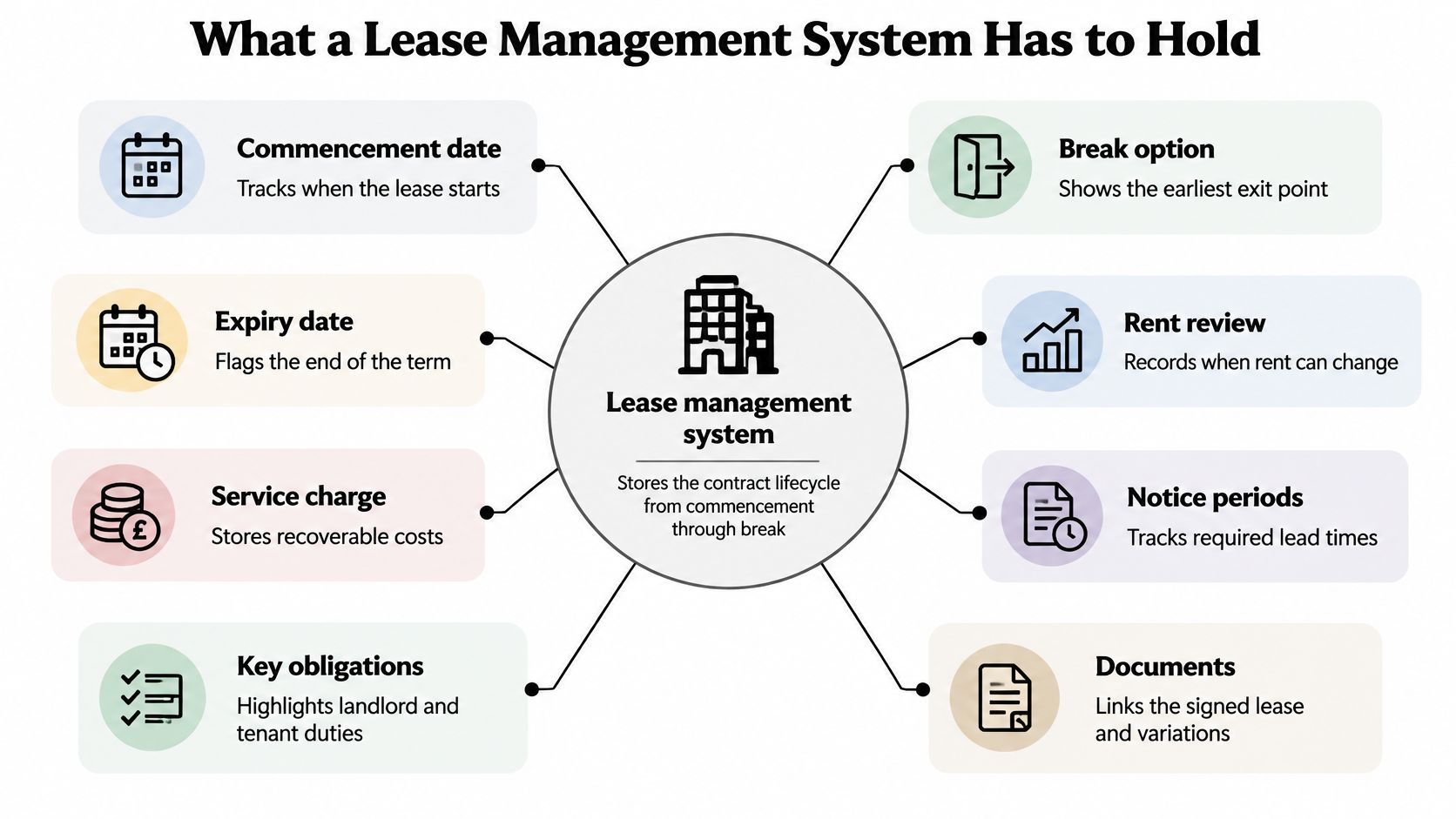
A system needs to hold the lease lifecycle, not just a rent amount and a PDF. That means commencement and expiry dates, break options, rent reviews, renewal terms, payment schedules, rent-free periods, indexation, modifications and end-of-term obligations. For accounting teams, it may also need discount rates and information about how lease changes affect financial records.
The reason is practical as well as financial. IFRS 16 became effective for annual reporting periods beginning on or after 1 January 2019 and replaced the previous distinction between operating and finance leases with a single lessee accounting model. Lessees generally recognise a right-of-use asset and lease liability for leases longer than 12 months, except where the underlying asset is of low value. The IFRS 16 standard makes clear why a record of rent payments alone isn't enough.
A document store isn't a control system
A document store helps someone find a signed lease. A control system connects that document to the property, unit, legal entity, responsible owner, obligation and next action. It should make it possible to see what is due, who needs to act and which source record supports the entry.
For block managers, the record may also need to connect service-charge components, administration charges, works and consultation evidence to the relevant units. A rent review date without its clause is not enough. A charge without a source ledger or supporting document is difficult to explain when challenged.
The property compliance workflow guide is a useful companion when mapping these records to wider compliance processes.
A spreadsheet and wall planner tend to break down because dates are duplicated, owners are unclear and evidence is hard to retrieve. That creates a risk of omitted leases, incorrect liability calculations, missed renewal decisions and inconsistent information between property, finance and legal teams.
Comparing the Main UK Lease Management Options
Commercial leasing is not a niche admin issue. RICS has reported that about 55% of commercial property is leased, and that IFRS 16 would affect about 50% of listed UK companies. A South East office-property report recorded an average lease length of 4.4 years to the first break in 2026. Rightmove reported that in the fourth quarter of 2025, demand to lease industrial property rose 11% year on year, office demand rose 2%, and leisure demand rose 1%, while retail demand fell 4%. These figures underline why alerts need to follow contractual events and portfolio needs, rather than rely on static records. See the RICS account of lease accounting and commercial property.
| Option | Contract lifecycle | Critical date tracking | Obligations and rent reviews | Compliance records | Accounting integration | Implementation effort |
|---|---|---|---|---|---|---|
| Property-management platform | Often suited to tenancy and property workflows | Useful if dates are recorded consistently | May not cover complex lease clauses in depth | Can hold operational records, depending on setup | Varies by platform and configuration | Lower if already in use, but data cleanup still matters |
| Dedicated lease-administration tool | Typically focused on lease terms and events | Usually a core use case | Better suited to structured terms and reviews | Can provide traceable records if configured | Check the accounting outputs and connections | Requires abstraction and migration work |
| Enterprise asset-management suite | Broad portfolio and asset coverage | Often configurable across asset types | Can suit complex estates | May support wider governance needs | Potentially extensive, but needs testing against your accounting setup | Can be heavy for an independent operator |
| Connected layer over existing systems | Built around the current workflow | Can bring dates together across tools | Depends on the data model and rules built | Can route evidence and exceptions | Connects existing systems where appropriate | Focused if scoped tightly, but needs clear ownership |
Choose by the gap, not the feature count
Reapit, Alto, Fixflo, Arthur and Qube may already handle important parts of your operation. The question is whether the lease record in your current setup connects terms, evidence, dates and ownership well enough for the decisions your team makes. A platform's lease module may cover routine records but fall short on accounting detail, complex event rules or cross-system reporting.
A dedicated lease tool can suit a portfolio where accounting and lease clauses are the central problem. An enterprise suite may be justified for a complex estate, but can be more system than a 10–60-person business needs. A connected layer is worth considering when the core platforms work well enough, but staff still maintain shadow spreadsheets to bridge gaps. The UK property management software overview helps frame that distinction.
Take each option through the same test: show how a lease moves from signed document to a tracked event, who owns the next action, and how the record links to the relevant unit and accounting entry. Don't accept a feature slide as proof that the workflow fits.
Getting Your Lease Data Ready Before You Buy
Buying software before checking the records is a reliable way to move old problems into a new interface. Start with lease abstraction, the process of pulling key terms out of PDFs, spreadsheets and variations, then checking those terms against the source documents.
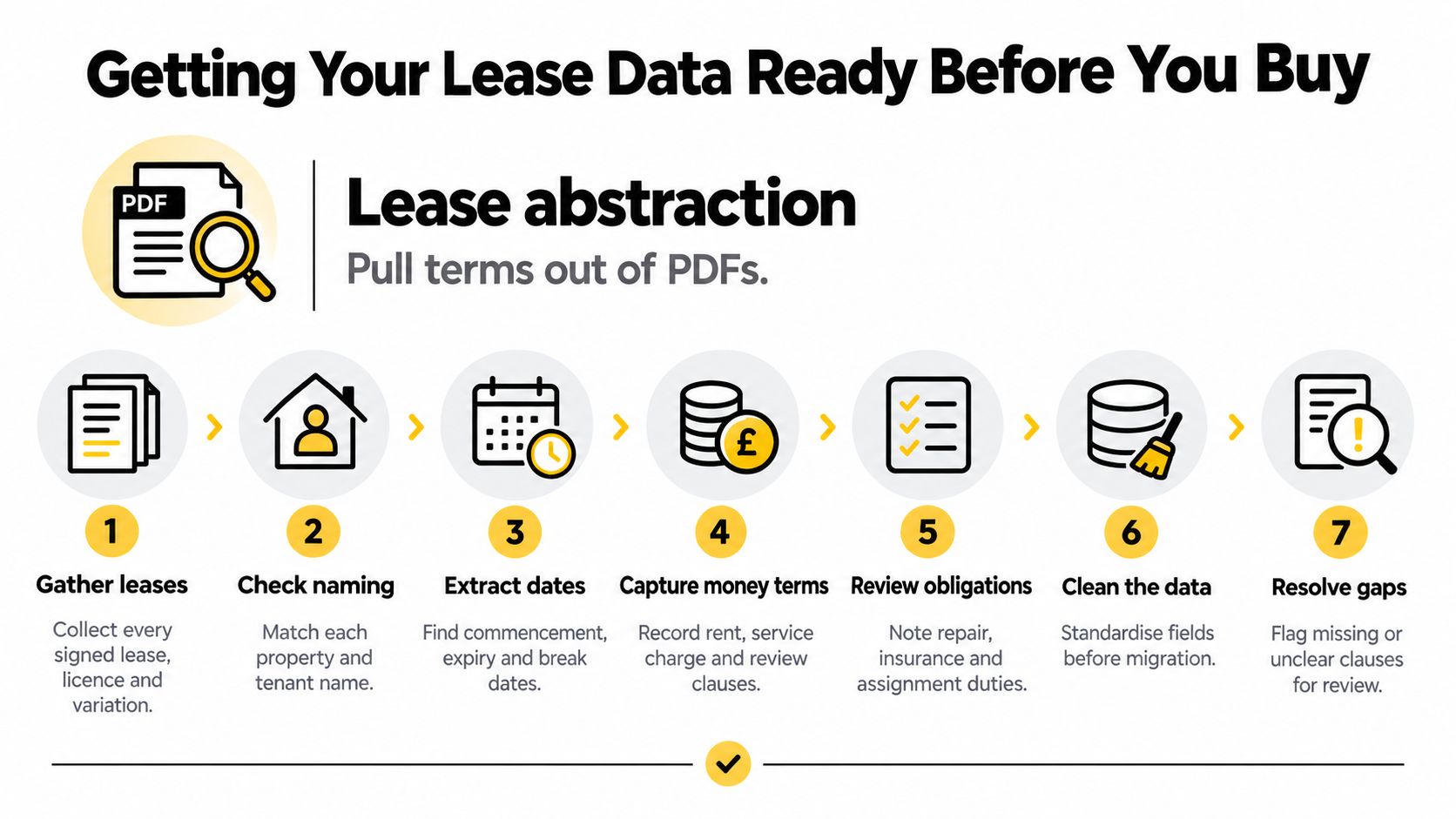
A workable preparation pass can follow this sequence:
- Gather the documents: Collect signed leases, licences, side letters and variations, then link them to the correct property and unit.
- Check the names: Match property, tenant, landlord and legal-entity names across the source documents and current systems.
- Extract the dates: Record commencement, expiry, break, review and renewal dates, including any notice periods.
- Capture the money terms: Separate rent, service charges, incentives and other occupancy costs. Note the clauses that explain how amounts change.
- Assign ownership: Decide who in property, finance or operations is responsible for confirming each kind of information.
- Create an exception queue: Send unclear clauses, missing dates and uncertain property matches to a named person for review.
The need to do this carefully is sharpened by revised FRS 102 lease requirements for accounting periods beginning on or after 1 January 2026. The requirements generally bring lessee right-of-use assets and lease liabilities onto the balance sheet, subject to exemptions. The ICAEW FRS 102 lease briefing discusses the preparation work. Software can organise and process information, but it can't make incomplete records compliant or replace accounting judgement.
Approval rule: AI extraction can speed up the first pass, but a person must check the source document before extracted figures feed accounting or audit outputs.
A practical acceptance benchmark is simple: every active lease has an auditable record for contractual dates, rent and occupancy-cost components, responsible owner, source document and next action.
Doing Nothing, Hiring, Switching Platform or Building a Layer
There are four realistic paths, and none is automatically right. Doing nothing avoids an implementation, but the team continues to absorb the cost of checking records, chasing dates and reconciling spreadsheets. That may be acceptable if the backlog is small and the records are dependable. It's a poor fit when the same exceptions keep returning.
Hiring another administrator can work when the problem is a lack of capacity. It doesn't, by itself, fix unclear ownership or duplicated data. If the new person has to search the same folders and update the same competing records, the backlog may reappear.
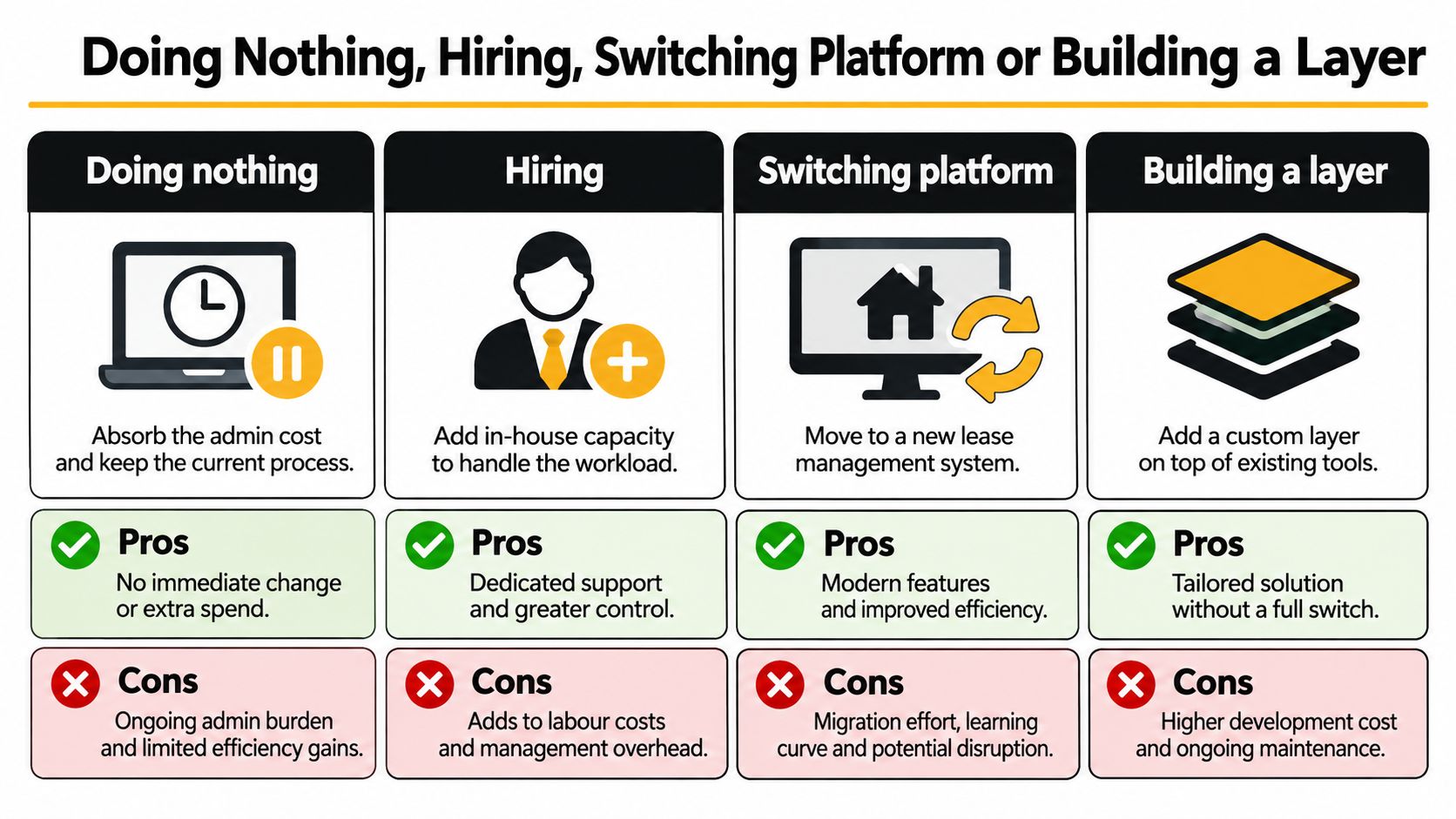
Switching platforms can make sense when the current system cannot support essential workflows and the replacement has been tested against real records. But a move won't correct missing dates or resolve uncertain clauses unless the team does that work as part of the change. It's also the most disruptive route because staff must adapt while the records are being moved and checked.
ChatGPT can help draft a letter or summarise a clause for a person to review. It isn't a lease register, an event-control system or a safe substitute for recording who approved a notice. It can also produce a confident-looking answer from incomplete information.
A connected layer sits between “do nothing” and “replace everything”. It can link lease data to the systems already used for accounting, CRM, documents and reporting, while retaining the source and sending uncertain records to a human. The trade-off is that it needs careful scoping and clear rules. For smaller teams, that can be more useful than buying a large platform whose features they won't maintain.
Government work on private-rented-sector data collection also points to unresolved questions about future database scope and data quality. The government data-collection strategy reinforces a practical point: reliable evidence depends on the records an organisation can match and verify, not the number of fields on a dashboard.
Implementing Lease Management Without Replacing Your Stack
Start by choosing one workflow, not by trying to redesign the whole operation. Expiry, break and rent-review alerts are often a useful first release because the team can see whether the data, ownership and notification rules work before accounting outputs are involved.
Make the test reflect the working portfolio
Write down the fields the system must hold, who owns them and which events need an alert. Then use a representative slice of your records to test the workflow, including awkward PDFs, incomplete lease details and units that have changed occupiers.
A practical rollout looks like this:
- Map the current process: Follow a real lease record through Reapit, Alto, Arthur, Qube or the other tools in use. Note where staff copy information by hand.
- Set the data model: Agree the property, unit, tenant, legal entity, dates, money terms, owner, source document and next action fields.
- Abstract and review: Extract terms, record uncertainties, and send exceptions to the person responsible for resolving them.
- Connect the systems: Link the approved data to accounting, CRM and document repositories where that removes duplicate entry. A plain-English introduction to API integration can help teams understand how data moves between systems.
- Test the workload: Check search across the full register, dashboard refresh after batch imports, alert accuracy and the proportion of legacy records that map correctly.
- Release one workflow: Start with a visible operational use, then expand only after staff can follow and maintain it.
JLL's UK asset-management specification describes rent-roll visibility from portfolio to unit level, including occupier details, lease terms, payment status, expiries and customisable reporting. Use those as comparison points, not as a substitute for testing your own records. The JLL asset-management product description is relevant when assessing whether a system can show the detail your finance and property teams need.
Any alert or generated communication reaching a tenant, landlord or regulator needs a named human to review and approve it. Keep accounting outputs behind a separate review gate until the source data and configuration have been checked.
What Lease Management Software Will Not Fix
Software won't tell you whether a clause has been interpreted correctly, decide an accounting treatment or turn incomplete evidence into compliance. It can store the source, calculate a reminder and route an exception. A solicitor or compliance adviser should confirm how a legal requirement applies to your circumstances.
For leasehold block management in England, Section 20 consultation rules need more than a generic reminder. Consultation is normally required before qualifying works where any leaseholder's contribution exceeds £250. It's also required before a qualifying long-term agreement lasting more than 12 months where the cost to any leaseholder exceeds £100 in an accounting period. Without compliance or tribunal dispensation, contributions are capped at those respective amounts. The government guidance on service charges and other expenses sets out the requirements.
A system can store estimated costs, each leaseholder's allocation, contract duration, consultation stage, notices and evidence of any dispensation. It can't decide whether a particular job or agreement falls within the rules. Have a solicitor or compliance adviser confirm the correct treatment.
Store evidence, not just a green tick
Service-charge administration has its own date and evidence requirements. Government guidance says a demand must normally be issued within 18 months of the landlord incurring the relevant costs, unless the leaseholder has been notified of the costs and why they weren't demanded earlier. The guidance also states that landlords must publish an administration-charge schedule, including the amount where known or the method used to calculate it where it can't be fixed in advance. Store the cost-incurred date separately from the invoice and demand dates, and retain the supporting ledger.
Where a property agent in England holds client money, the Client Money Protection rules require membership of an approved scheme. The agent must publish its certificate, provide a copy free of charge to someone who may reasonably require it, and notify clients in writing within 14 days of a membership change. The operational record should include the certificate, scheme details, publication status and notification evidence. Confirm the application with a compliance adviser.
Relevant property agents in England must also belong to an approved redress scheme and publish the required scheme statement alongside fee information. A system can assign an owner, hold membership evidence and prompt a check after a website change. It can't establish the legal position for every service or portfolio. Automation is a risk if it treats uncertain data as fact, so preserve document provenance and route low-confidence records for approval.
What to Look at First in Your Own Operation
Pick one slice of the portfolio: a single block, one office building or the next leases due for review. Check whether each active lease has its contractual dates, rent and occupancy-cost components, responsible owner, source document and next action in one auditable record.
Write down the gaps before deciding what to buy. If terms are missing, property names don't match or nobody owns the next step, resolve those issues on the sample first. Use the lease operations scorecard as a tool to assess where the process is breaking down, and see the letting agent workflow information if tenancy progression is the main pressure point.
Start with the records your team already has to touch, then decide whether a platform change, a connected layer or better data discipline would address the actual problem. I offer a free discovery call to work out whether a system build is even a fit, and if it isn't, I'll say so on the call.
InnovaAI Integration Ltd builds custom workflows and integrations around the property systems your team already runs, including lease-data abstraction, exception queues and human approval steps. Visit InnovaAI Integration Ltd to arrange a free discovery call and work out whether that approach fits your operation.