Property Management Software UK: A Buyer's Guide
property management software ukuk letting agentscompliance automationai for agentssoftware selection

Tuesday starts the same way in too many agencies. The shared inbox is full, a gas certificate hasn't been checked, a tenant has messaged at 8pm again, and someone has opened the spreadsheet because the platform only covers part of the job.
That's the problem with property management software UK buyers live with. Reapit, Alto, Fixflo, Arthur and Qube can all do useful work, but if the process around them is messy, the team still ends up copying data, chasing dates and guessing who owns the next step.
| Platform | Best fit for | Typical gap agencies report |
|---|---|---|
| Reapit | Larger residential operations and block-heavy portfolios | Teams still bolt on manual reporting or spreadsheet checks |
| Alto | Branch-led lettings and sales businesses | Workflow depth can run out when the operation gets more complex |
| Fixflo | Maintenance triage and contractor routing | It doesn't run the whole business, just the repair side |
| Arthur | Agency workflows with compliance and multi-user control | Smaller operators often find it more system than they need |
| Qube | Block and estate management at scale | Some teams still maintain side spreadsheets for exceptions |
A lot of firms blame staff when the underlying issue is process design. If you run a portfolio with recurring fees, the money leaks through small delays, bad handoffs and incomplete records, not through one dramatic failure. The software only matters once you know exactly where the queue is forming.
Table of Contents
- What a Tuesday Morning Looks Like With Half a System in Place
- Why Hiring Has Not Solved It and What the Process Is Actually Doing
- What the Main UK Platforms Are Actually Built For
- Compliance and Tenant Workflows That Have to Be Configurable
- What Connecting AI to the Stack Actually Changes
- Selection Checklist and a First Set of Evaluation Steps
What a Tuesday Morning Looks Like With Half a System in Place
The inbox opens first. Someone has replied to a contractor, someone else has chased arrears, and a third person has asked for a certificate that should have been visible in the system already.
That is a file structure problem, a handoff problem and a record-keeping problem. If rent, maintenance, compliance and tenant comms sit in different places, the team does the same work twice and still misses edge cases.
The hidden admin sits between the tools
A decent platform stores tenancies, notes and tasks. The trouble starts when one person reads the platform, another updates the spreadsheet and a third answers the tenant. The workflow then depends on memory, and memory fails at busy times.
I have seen this pattern in firms running Reapit, Alto, Fixflo, Arthur or Qube alongside spreadsheets. The software is there, but the process is still manual at the joins. That is where the backlog lives.
Practical rule: if a task depends on someone remembering to move a record from one system to another, it is not automated yet.
The same problem shows up in certificate renewals, arrears follow-up and contractor updates. The system may hold the record, but the action still waits on a person checking a wall planner or an Outlook reminder. That is why the operation feels busy even when the team has “good software”.
If you want a simple comparison of how connected workflows should behave, start with a plain process map. Our guide on property management automation shows what that looks like in practice (https://www.innovaaiintegration.com/blog/property-management-automation). The moment you see the same action appearing in two places, you have found the drag.
Why Hiring Has Not Solved It and What the Process Is Actually Doing
The team isn't lazy. The process is structured in a way that creates repeat work.
Tenancy progression needs one person to start the paperwork, another to check the data, and another to chase missing replies. Certificate renewals sit on a planner until someone notices. Service charge and Section 20 admin in blocks adds another layer of dates, notices and evidence. Voids, arrears chasing, contractor triage and daily tenant messages all arrive in the same queue.
What repeats, what needs judgement, what must stay human
Some tasks are repetitive and should be system-led. Rent reminders, task allocation, renewal prompts and document filing all fit that category. Others need judgement, like a disputed repair, a tenancy exception or a service charge query. Those should stay with a named person.
The mistake is treating every item as if it needs the same level of attention. That's how firms end up paying for more admin without reducing the backlog. You just get a bigger queue with more people touching it.
For an independent agency, that can feel like one full-time admin role for roughly every extra hundred doors once the operation gets messy. I'm stating that as a working pattern, not a law of physics, because the number depends on how clean your records are and how much the team keeps doing outside the system. The point stands, though, more headcount doesn't fix broken handoffs.
Operational truth: if the same issue keeps returning after a hire, the job isn't under-staffed. It's under-designed.
A better process makes the work visible before it becomes urgent. That means one owner for each task, one place for the record and one clear point where the human signs off. When that's missing, the backlog grows even if everyone is busy all day.
What the Main UK Platforms Are Actually Built For
The right question isn't which platform is "best". It's what each one is built to carry without breaking your operation.

Match the tool to the job you already have
Reapit suits larger residential businesses that need a proper core system. It's the sort of platform where portfolio reporting, branch control and longer-running workflows matter more than a clean sales pitch.
Alto is more comfortable in high-street agency life, where branch teams need to move quickly and the focus is lettings and sales at local level. It works well until the operation starts asking for deeper operational control than the basic workflow gives you.
Fixflo is a repair engine. If your biggest pain is maintenance triage and contractor communication, it earns its place fast. It won't solve rent follow-up, compliance ownership or the wider administrative stack.
Arthur and Qube sit closer to structured operational management. Arthur is useful where workflow control and multi-user visibility matter. Qube is a serious fit for block and estate work, especially where service charge and portfolio control need proper order.
| Platform | Best fit for | Typical gap agencies report |
|---|---|---|
| Reapit | Larger residential portfolios and branch control | Extra reporting or side processes still needed |
| Alto | Branch-led residential operations | Less suited to deeper operational complexity |
| Fixflo | Maintenance and contractor routing | Not a full operating system |
| Arthur | Workflow-heavy agency operations | Can be more than a small firm needs |
| Qube | Block and estate management | Teams still use spreadsheets for exceptions |
Don't buy a platform because it has a long feature list. Buy it because it matches the way the work moves through your business. If it doesn't, you'll pay for the software and keep paying for the spreadsheet.
Compliance and Tenant Workflows That Have to Be Configurable
Compliance isn't a tick-box. It's a sequence of records, dates, ownership and evidence.
A platform that handles client money must separate funds properly, hold auditable balances and keep scheme details ready for inspection. In England, a letting or property-management agent that holds clients' money must belong to an approved client money protection scheme, and failure to join can lead to a fine of up to £30,000 (gov.uk client money protection scheme). The software needs to store membership details, certificate evidence and a clean audit trail, because those records can't live in someone's head.
The workflow has to match the rule
Redress membership is separate. Residential letting agents in England and Wales must belong to an approved redress scheme, and the Consumer Rights Act 2015 requires the scheme name to sit alongside fees information (HMRC guidance on redress schemes, Consumer Rights Act 2015 disclosure rules). That means your system should hold the current scheme, the publication location and the version in use.
For Wales, the registration side is different again. Rent Smart Wales records landlords and registered properties, which makes portfolio-level compliance tracking a practical necessity rather than a nice extra. If you operate across the border, your software has to support different rule sets and different evidence trails, not just a generic “compliance” label. For that specific Welsh registration framework, see the operational context in our property compliance software guide.
The Consumer Rights Act also means fee information and scheme details have to stay accurate wherever they're published. That matters because old website copy and old office notices create risk. The system should control fee versions, approval dates and where each version is shown.
The same logic applies to England's short-term-let rules. Planning position, registration status, local authority requirements and tax treatment are separate controls, not one compliance flag. A good system stores each one separately and alerts a human before anything goes out to a tenant, landlord or regulator.
A solicitor or compliance adviser should confirm how each rule applies to your portfolio. The software should organise the evidence, not make the legal call.
What Connecting AI to the Stack Actually Changes
AI is not the fix on its own. It only helps when it sits on top of systems you already run and moves the repetitive first pass out of the inbox.
A tenant message at 8pm should land in one place, get categorised, and be routed to the right queue. A maintenance request at the weekend should be triaged against the tenancy record, then passed for human approval before any contractor is booked. An upcoming gas certificate or Section 20 deadline should trigger an alert, create a task and show the named owner.
That's the difference between a chatbot and a working system. The bot can sort, draft and route. A person still signs off before anything goes to a tenant, landlord or regulator.
The same approach can sit beside your existing stack through integration. If you already run Reapit, Alto, Fixflo, Arthur or Qube, the point is to connect the data flow, not throw the stack away. This system integration guide is the sort of thing worth reading before anyone promises a full replacement.
AI is the wrong tool for legal interpretation, disputed compliance cases and anything that needs a solicitor's view. It's also the wrong tool if the team hasn't agreed who owns the decision. If you let it act without approval, you've just automated a mistake faster.
Selection Checklist and a First Set of Evaluation Steps
Draw your current process on one page before you speak to a vendor. Then mark where the work stalls, where data gets copied, and where a human has to approve the next step.
Use the scorecard as a simple baseline tool, not a sales pitch. It's there to show you where the backlog, compliance gaps and repeated manual checks sit.
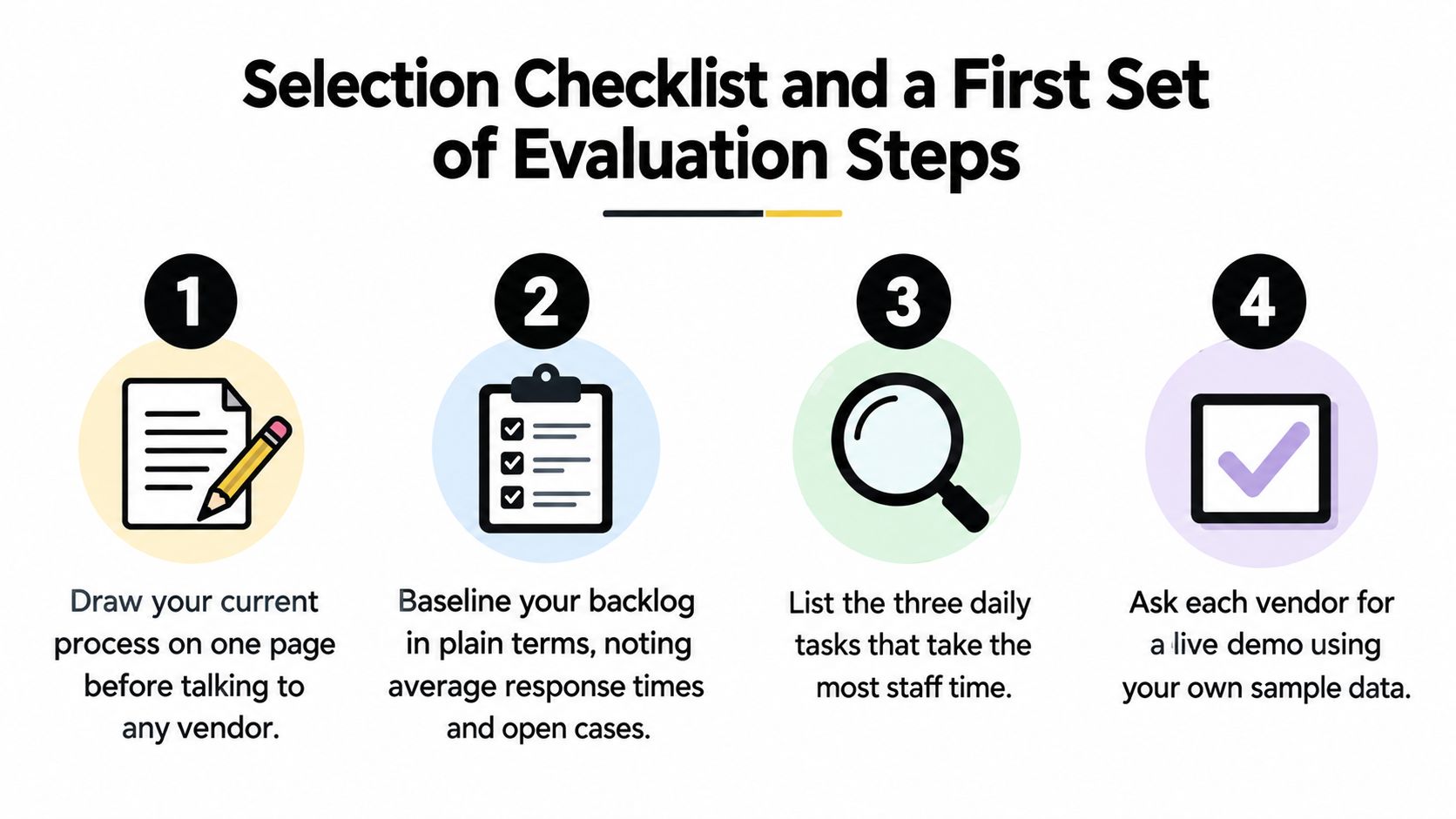
- Draw the workflow: Put tenancy progression, maintenance, arrears, compliance and reporting on one page.
- Baseline the backlog: Note open cases, aged issues and the points where staff have to chase each other.
- Pick the daily pain: Choose the three tasks that burn the most time and test software against those first.
- Use your own data: Ask every vendor to demo with your sample records, not a polished sandbox.
Do nothing, hire again, switch platform, or let staff use ChatGPT on their own. Those are the options. Doing nothing keeps the same queue, hiring again increases cost without fixing the joins, a full platform switch is expensive and disruptive, and unmanaged ChatGPT use creates more risk than control.
Start with the inbox, the renewal dates and the maintenance queue in your own operation. If those three aren't clean, no platform will save you.
I build custom systems for letting agents, block and estate managing agents and serviced accommodation operators, and I connect them to the platforms they already use. If you want to work out whether that would fit your setup, visit InnovaAI Integration Ltd for a free discovery call, and if it isn't a fit, I'll say so on the call.