Letting Agent Software That Actually Saves You Hiring
letting agent softwareAI for letting agentsproperty management softwareagency automationUK letting agents

It's Tuesday morning. The shared inbox has a tenant message sent at 8pm, now waiting for a 9am reply, and someone's asking whether the gas certificate on the wall planner was checked. You've hired twice already, but the backlog still looks familiar.
Table of Contents
- Your Tuesday Morning Already Tells You the Answer
- What Is Actually Causing the Backlog
- The Software Categories Agencies Actually Choose Between
- What a Well-Wired System Actually Does Step by Step
- Why Hiring or Switching Platform Is Usually the Wrong First Move
- What to Look at First in Your Own Operation
Your Tuesday Morning Already Tells You the Answer
The frustrating part isn't that your team's doing nothing. They're answering calls, chasing contractors and moving tenancies forward. Yet you still can't confidently accept another hundred doors without discussing another salary.
A property manager opens the message, finds the tenancy, checks the previous repair and asks a colleague whether anyone contacted the landlord. Before they can answer, they've reconstructed information the business already holds.
The work behind the work
That reconstruction is what to examine before buying more letting agent software. The visible task is replying to a tenant. The hidden task is finding enough reliable information to reply safely.
I'm Cameron Atwal, a founder based in Wolverhampton. I run a property portfolio myself and have personally done the admin I now automate for letting agents, block and estate managing agents, and serviced accommodation operators across the West Midlands and UK.
Practical rule: Watch how someone finishes a task, not just which screen they open first.
I'm not a software vendor or a consultant. I build working systems around the platform an operator already runs, but sometimes the useful change is a named owner and a clearer handover. Software isn't the answer to an instruction nobody agreed.
What Is Actually Causing the Backlog
The bottleneck sits between records and responsibility. Tenancy progression stalls when nobody owns the next handoff. Certificate renewals become chasing exercises when the reminder exists but the certificate, booking and responsible person don't sit together.
Maintenance triage exposes the same weakness. A message gets read, forwarded and marked as dealt with, even though nobody has accepted the job.
These are the handoffs worth tracing:
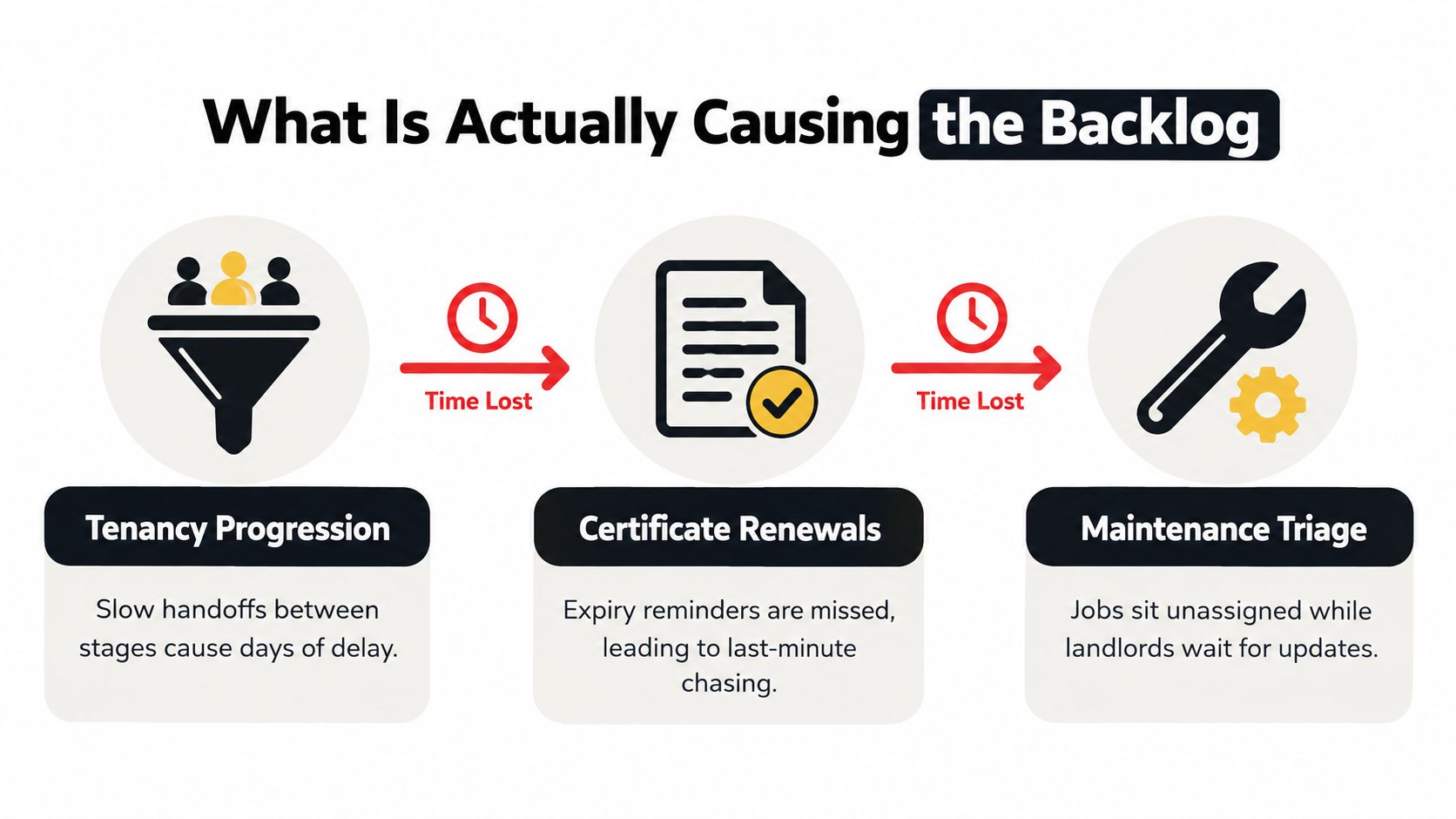
Why managed doors generate repeated work
The English Private Landlord Survey 2024 found 43% of landlords used agent letting services, while 18% used management services. That distinction matters: management-fee income comes with continuing tenant communication, contractor coordination, landlord reporting and compliance follow-ups after move-in.
Reapit, Alto, Fixflo, Arthur or Qube might hold the relevant record. But if staff still maintain a separate spreadsheet, inbox folder and wall planner, they must reconcile conflicting versions before acting.
The cost isn't just typing twice. While someone checks whether a contractor attended, another colleague answers the tenant's follow-up and the landlord asks for an update. You've created additional work around an unfinished job.
A forwarded email isn't an assigned repair. An expiry reminder isn't evidence that a certificate was checked.
Landlord statements and contractor follow-ups need explicit ownership too. Legal paperwork, including any Section 21 material still held in legacy files, belongs with a solicitor or compliance adviser for confirmation of its relevance and treatment, not an AI-generated assumption.
The Software Categories Agencies Actually Choose Between
The useful comparison isn't which product has the longest feature list. It's whether you need a better core record, a specialist function or a connection between systems you already pay for.
Letting Agent Software Options at a Glance
| Category | What it covers | Typical pricing model | Common gap |
|---|---|---|---|
| Full agency platform | Core property records, tenancy progression, rent administration and reporting, depending on configuration | Check the quote for subscription basis, modules, migration and support | Work arriving outside the platform |
| Specialist bolt-on | A defined function such as maintenance, referencing, compliance tracking or accounting | Check for subscription, usage charges and integration costs | Handoffs back to the core record |
| Connecting layer | Intake, matching, routing, approval queues and write-back across existing tools | Ask for scoped build costs and ongoing support, hosting and usage terms | Cannot repair poor source data or unclear responsibilities |
Pricing needs an actual quote. Don't compare a headline subscription with a scoped build and assume either includes configuration, training or ongoing changes.
Change the missing component
A full platform review makes sense when your core system can't support the records or accounting controls your service requires. For a newer agency, establishing that foundation may matter more than connecting a collection of loosely maintained tools.
A specialist product makes sense when a defined function is missing. But adding a maintenance portal without deciding who accepts each job can give staff another inbox rather than a better repair process.
For an established independent agency, inspect the existing setup first. Check whether the required connection is available through supported interfaces or exports, whether access is included in your contract, and who maintains it when a field changes.
Buying test: Ask the supplier to demonstrate an awkward handoff using your process, not just a clean demonstration record.
Integrated buying preferences aren't merely a technical concern: an industry PropTech survey found 67.7% preferred end-to-end technology rather than specialist platforms. My recommendation is narrower: connect what works, and replace only what demonstrably prevents the job being completed.
What a Well-Wired System Actually Does Step by Step
A connected system should assemble the case before asking someone to make a decision. AI can classify and draft; a named person approves anything reaching a tenant, landlord or regulator.
The workflow below should be read with that approval gate in place, including before an acknowledgement is sent:
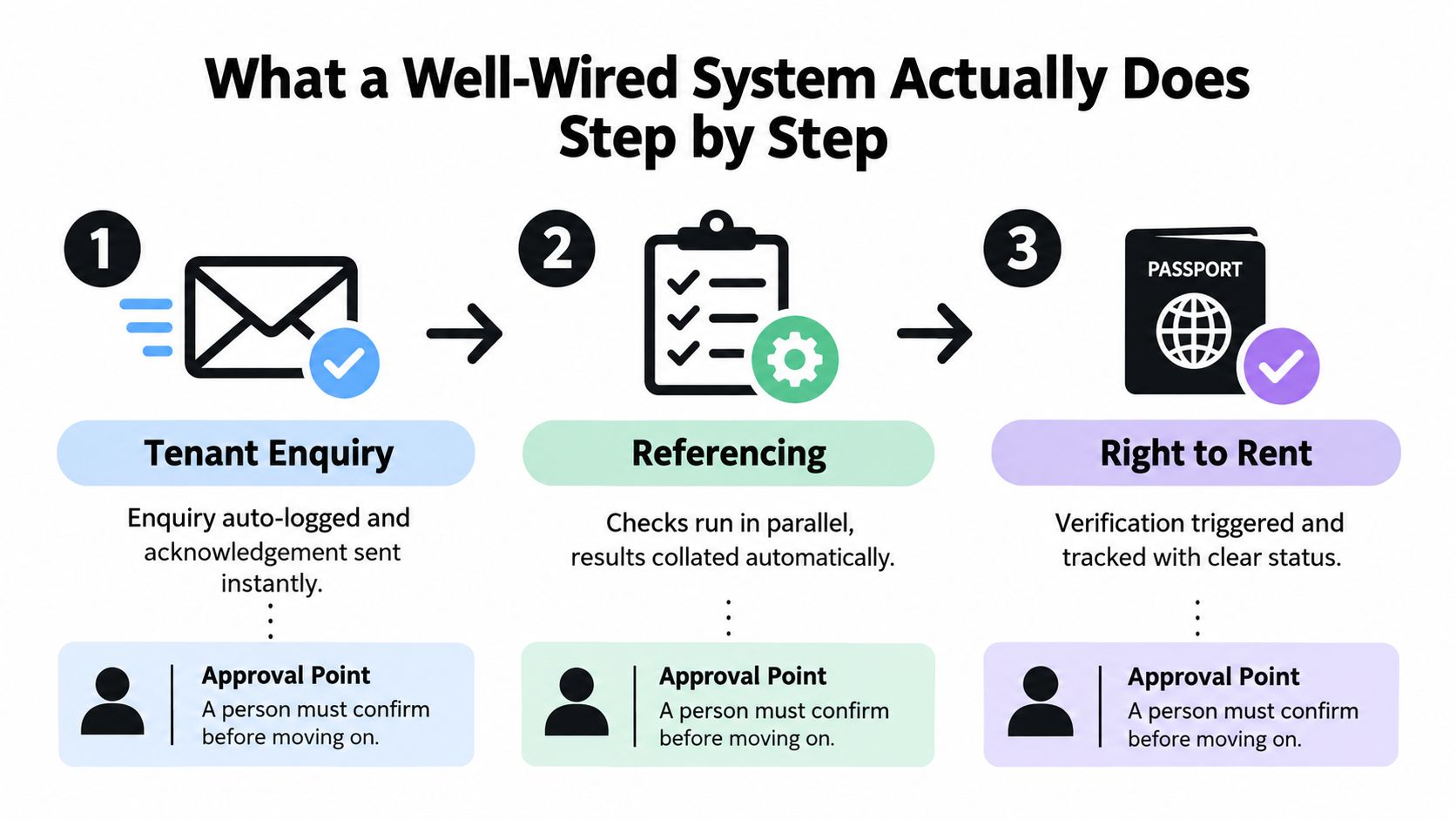
Move the case, preserve the evidence
- Capture and match. Log the enquiry against the correct property and applicant. Put uncertain matches into a staff queue rather than attaching identity documents to a guessed record.
- Collate referencing. Gather authorised checks and distinguish verified facts from risk scores. A tenancy-progressor reviews the evidence, approves communications and refers selection decisions to the authorised decision-maker.
- Track Right to Rent. Store the occupier, check type, evidence, completion date, follow-up date and responsible person. A trained colleague verifies the check; the system doesn't decide eligibility.
- Control renewals and repairs. Link certificate reminders to documents and owners. Extract repair details from messages, photographs and call notes, flag possible emergencies or damp and mould, and require manager approval of priority and contractor dispatch. Keep urgent human escalation available.
- Close the loop. Draft landlord updates and statements from checked records. Finance staff approve statements without giving the AI authority to move client money. Log complaints separately, with an owner, deadline and approved response.
Government compliance research identifies Right to Rent as an England-specific checkpoint. A solicitor or compliance adviser should confirm how each requirement applies; don't copy an England workflow into Welsh lettings.
Referencing needs particular care. University of York research on digital tenant profiling identifies exclusion risks from algorithmic classification. Keep input provenance, explainable reasons, human overrides and tamper-resistant decision logs, with restricted access and retention controls.
These workflow automation examples provide a practical way to examine individual handoffs. The video is another starting point for discussing the process with your team:
An approval queue needs cover and escalation. Otherwise, you've merely moved the backlog onto a different screen.
Why Hiring or Switching Platform Is Usually the Wrong First Move
Hiring is right when the remaining work requires another person's judgement or physical presence. Inspections, difficult conversations and contractor management don't disappear because the inbox is better organised.
But hiring someone to reconcile the same duplicate records adds salary and onboarding without removing the cause. Doing nothing can be sensible for an infrequent exception; it's harder to justify when staff repeatedly reconstruct the same cases.
Test the alternatives against the job
Switching platform deserves consideration if the existing system lacks a necessary capability. Otherwise, migration introduces record checking, retraining and interruption, while unresolved ownership problems follow you into the new software.
ChatGPT can help staff practise drafting with invented or suitably anonymised material. Unmanaged use with live applicant documents isn't a substitute for controlled permissions, recorded approvals and an auditable tenancy file.
Don't automate a process you wouldn't trust a new property manager to follow from written instructions.
Nor will software make a contractor attend or persuade a landlord to authorise expenditure. It can expose the delay, preserve the evidence and put the decision in front of the right person. It can't supply missing authority.
The Property Ombudsman's lettings audit reports 73,035 consumer enquiries in 2024, with repairs and maintenance the most common lettings subject. That makes operational control a more useful starting point than automated marketing copy.
A sensible property management automation approach tests a bounded workflow, including failures and staff adoption, before expanding it.
What to Look at First in Your Own Operation
Start with a recent unfinished repair. Follow it from the original tenant message through the spreadsheet, property record and contractor correspondence.
Establish the baseline
- Find duplication. Identify where staff re-enter information and decide which record should be authoritative.
- Find unsupported deadlines. Match wall-planner entries to evidence, an owner and a follow-up action.
- Find waiting decisions. Separate unassigned work from cases waiting for approval or external action.
Use the AI Readiness Scorecard to baseline current costs, then specify an operational KPI dashboard around response time, overdue repairs, repeat contact and complaints. Measure service, not just messages processed.
The letting agents page sets out the relevant build approach. Leave wider automation alone until the first workflow has reliable records and staff use it.
Look first at the handoff that forces your team to reconstruct the same case repeatedly. I build approval-gated systems that connect to your existing letting agent software; visit InnovaAI Integration Ltd for a free discovery call to work out whether it's even a fit. If it isn't, I'll say so on the call.