Property Management System Software: What Actually Works
property management system softwareletting agentsblock managementserviced accommodationPMS comparison

Tuesday morning starts with the shared inbox already busy. A certificate renewal is sitting on a wall planner, nobody's confirmed it, and the tenant who messaged at 8pm is still waiting for a reply. The team has Reapit, Alto, Fixflo, Arthur or Qube open, plus the spreadsheet that supposedly keeps everything straight.
I'm Cameron Atwal, founder of InnovaAI Integration Ltd in Wolverhampton. I build and connect systems for letting agents, block and estate managing agents, and serviced accommodation operators across the West Midlands and UK. I also run a property portfolio, and I've done the admin I now automate. The issue usually isn't that the team is lazy or the platform is bad. It's that the process stops at the edge of the platform, and people have to bridge the gap by hand.
Table of Contents
- Why Is My Team Still Running Spreadsheets?
- What Is the Backlog Really Costing Me?
- What Should a Property Management System Actually Do?
- Which Platform Fits the Way We Work?
- Where Does Property Management Software Fall Short?
- What Should I Look at First in My Own Operation?
Why Is My Team Still Running Spreadsheets?
Property management system software can hold tenancy records, repair requests and payment information. But when a task starts in one place and finishes in another, the system doesn't own the whole workflow. Someone copies a repair detail from an email into Fixflo, adds a note to a spreadsheet, then remembers to update the landlord. Each step feels small. Together, they create a second, unofficial operating system.
| Where work slips back to manual | What usually happens |
|---|---|
| Data entry | Staff re-key tenant or property details between platforms |
| Ownership | A task has no named person responsible for the next action |
| Follow-up | Reminders depend on a wall planner or someone's memory |
| Communication | Messages arrive outside the workflow and wait for a reply |
That's a process gap, not a character flaw. It tends to show up at hand-offs: tenancy progression from application to move-in, maintenance triage from tenant report to contractor, and certificate renewals from diary reminder to checked evidence. If the platform records the task but doesn't assign, escalate and close it, the spreadsheet returns.
The size of the operating environment changed, too. Between 1996/97 and 2016/17, the UK private rented sector more than doubled, from approximately 2 million households, around 10% of all households, to 4.7 million, more than 20%. That growth created a larger administrative load for landlords and agents, as described in University of Cambridge research on renting and property management.
Start by naming the hand-off that fails, rather than blaming the person who's covering it. This guide to mapping property management workflows is a useful way to make those gaps visible.
What Is the Backlog Really Costing Me?
The cost isn't just the time spent typing. It's the work that gets delayed because the person who needs the information can't see it, or doesn't know they own the next step.
A certificate date on a wall planner only helps if someone checks it, confirms the renewal is booked, files the new document and records that the record is current. If one of those actions falls through, the team has to chase it later, often with less time and less context. A tenant message that sits overnight can lead to a second message, a phone call and a strained conversation that could have been avoided with a clear acknowledgement and a named owner.
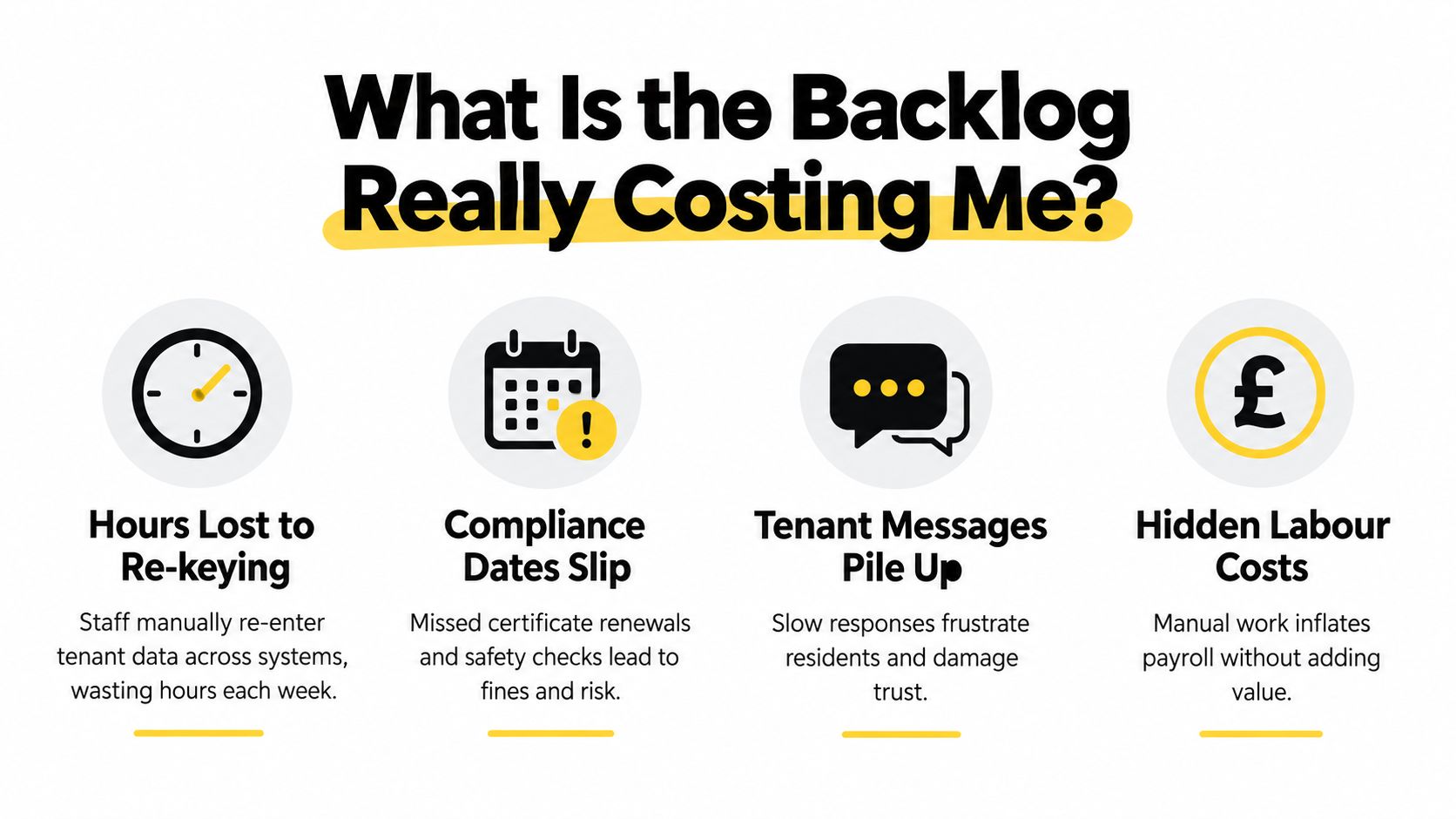
Disconnected systems add another cost: moving information between them. A 2025 Access Hospitality study covering 1,000 hospitality businesses found that UK and Irish operators lost an average of 286 hours a year switching between disconnected systems, and 70% said consolidated, real-time data would materially improve peak-period decisions (Access Hospitality's study of disconnected hotel systems). That's hospitality evidence, not a property-lettings forecast, but the operational mechanism is familiar: every manual transfer creates work and another chance for a mismatch.
Put a rough value on your own backlog without pretending to know the answer in advance. Track who re-keys information, how often tasks need chasing, which messages wait, and what gets carried forward at the end of a shift. Include payroll time spent correcting or reconciling records, not just the first data entry. That gives you a baseline for deciding whether to reconfigure, integrate or leave the process alone.
What Should a Property Management System Actually Do?
A useful system connects the work your team already does. It doesn't need to replace Reapit, Alto, Fixflo, Arthur or Qube. It needs to make the hand-offs between them visible and repeatable, with a person approving anything that goes to a tenant, landlord or regulator.
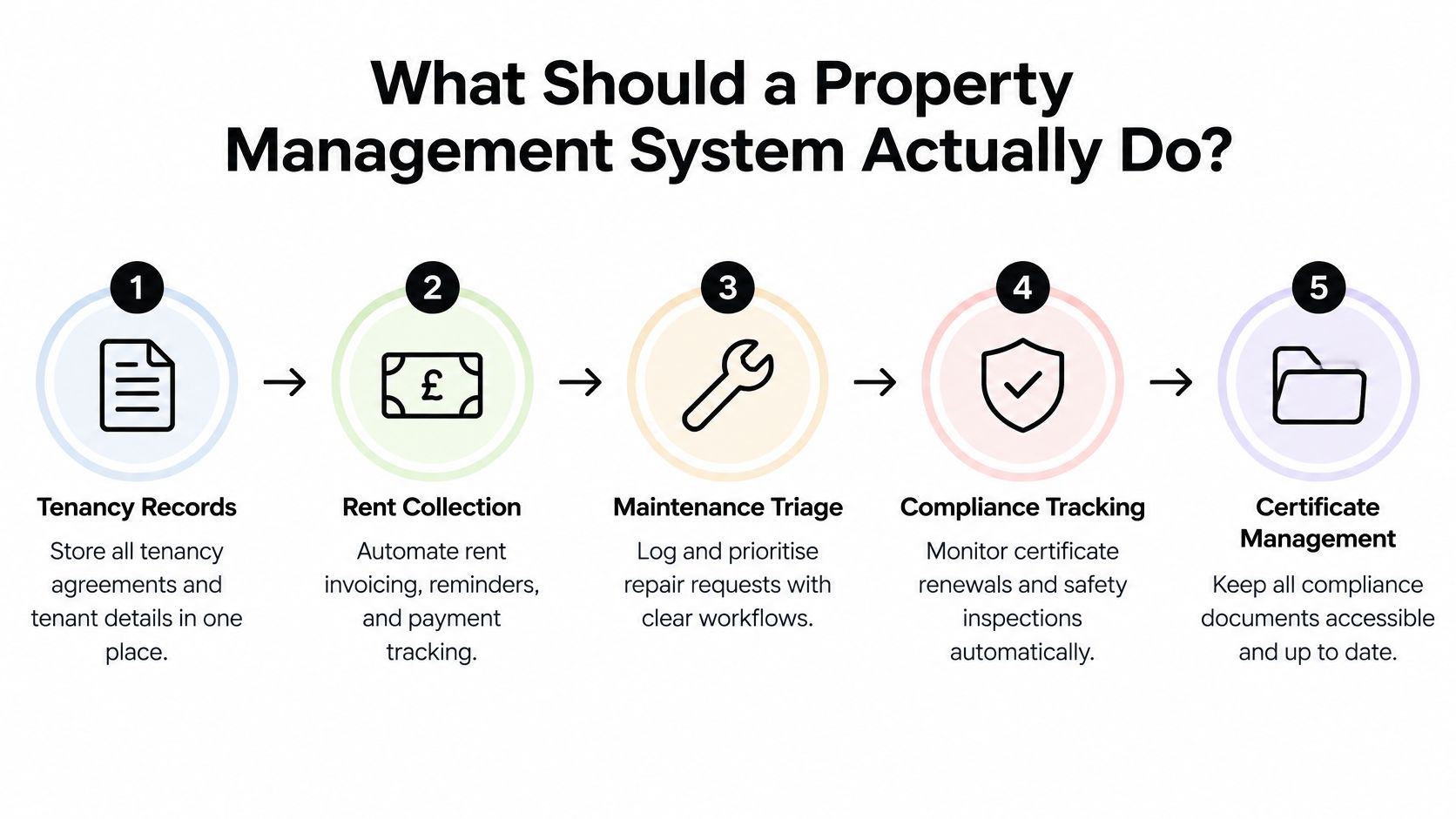
A practical workflow should do the following:
- Create a reliable record: Keep tenancy details, property information, documents and changes together, with a clear history of what was updated and by whom.
- Route the next action: When a repair is logged, assign it for maintenance triage, record its status and put the right person in charge of follow-up.
- Make renewals actionable: Flag certificates coming due, identify missing or outdated evidence, and send exceptions to a named staff member. A reminder is not proof that a renewal happened.
- Prepare communications for review: Draft a tenant update or landlord report from the recorded facts, then require a staff member to check and approve it before sending.
For block management, service charges need a different workflow from rent collection. GOV.UK says a service charge is payable only where the lease requires it and the freeholder issues a formal demand. The lease should specify what can be charged, expenditure must be reasonably incurred, and services must be of a reasonable standard (GOV.UK guidance on owning a leasehold home). Software should help link the charge, lease terms, costs and evidence. A person still needs to check the facts and approve the demand.
For hospitality operators, reported cloud PMS outcomes include a 40% reduction in check-in time and a 12% reduction in staff workload. The same UK-focused summary says 68% of hoteliers reported a positive effect on guest satisfaction and 54% improved profitability (UK hospitality technology summary). Treat these as directional benchmarks, not guaranteed results. A pilot should compare your own workflow and staffing conditions before and after implementation.
Which Platform Fits the Way We Work?
A feature list won't tell you whether a platform fits your operation. A lettings team cares about tenancy progression and certificate renewals. A block manager needs lease-specific service charges, client money records and Section 20 workflows. Serviced accommodation depends on the channel manager, booking updates and turnaround tasks reaching the right person.
| What to Check | Why It Matters | Red Flag |
|---|---|---|
| Integration and data flow | Your existing system should remain the record of authority, with agreed updates passing between tools | Staff must export and re-key data to keep records aligned |
| Compliance evidence | A reminder should lead to checked evidence and an auditable action | The platform shows a date but not who followed up |
| Mobile access and task ownership | Staff need to update repairs and inspections where work happens | Mobile access shows information but can't record progress clearly |
| Data access and exit | You should know how to export records and who can see sensitive information | The supplier can't explain permissions or data export |
| Support and workflow changes | The system has to keep working as your process changes | Every small adjustment requires a new workaround |
Ask Reapit, Alto, Fixflo, Arthur or Qube to demonstrate your actual workflow, not a polished tour. Show them a certificate renewal, a repair with landlord approval, or a service-charge query. Ask what happens when an event fails, where the audit record sits and who can correct a mistake.
The right answer may be better configuration, a custom connection or a switch. Switching is sensible when the platform can't support a core process or its limits create unacceptable risk. It's wasteful when the same unclear ownership and duplicate records would just follow the team to a new system. For a plain-English explanation of how platforms pass information between each other, see how system integration works.
Where Does Property Management Software Fall Short?
A calendar alert is not compliance management. If a property, tenancy or responsible person changes, the system has to show which records are affected, keep earlier versions and let someone see what happened next. The government's private rented sector data strategy pushes in the same direction: track evidence and change, rather than only storing documents (private rented sector data collection strategy).

Referencing needs the same discipline. Automated checks can pull financial and administrative data into housing decisions, which makes a repeatable process useful and risky at the same time. It can reduce inconsistent handling, yet it can also repeat bad data or hidden bias at scale. Ask what information is used, how an applicant corrects errors, how long records are kept and who reviews an adverse outcome. Responsibility stays with the landlord or agent, with a solicitor or compliance adviser confirming how the rules apply.
Doing nothing avoids a new bill and keeps the manual work. Hiring helps when the business needs more capacity, but it will not fix double entry or unclear hand-offs. Switching platforms makes sense when the current one cannot support the work, not because nobody has shown staff how to configure it. ChatGPT can draft or summarise, but it is not a safe place to run client money, make legal decisions or send unreviewed tenant messages.
Custom automation is also the wrong choice if the process itself is unsettled. Agree who owns each action and what evidence closes it before anyone builds anything. For a practical starting point, see property management automation. Then decide whether your platform can handle the workflow with configuration or needs a connection to another system. InnovaAI Integration Ltd builds custom systems that connect to existing property platforms; the right scope still depends on the process and the data.
What Should I Look at First in My Own Operation?
Pick the task that creates the most repeated manual handling. Don't start with an ambitious AI project or a long list of software features. Start with a job people already do every day, such as logging repairs, checking certificate renewals, progressing a tenancy or reconciling a booking.
Write down where the task begins, which systems it touches, who approves the next step and where the final evidence is stored. Then ask your supplier to show how that exact workflow works in the platform you already pay for. If it can be configured, fix the configuration. If the data needs to move between platforms, assess an integration. If the system can't support a core requirement, then consider switching.
For new assured tenancies and existing assured tenancies in the private rented sector, the first phase of the Renters' Rights Act applies from 1 May 2026, according to the government implementation roadmap. Operationally, that means checking whether your records can handle effective dates, tenancy status, document templates and audit history. Ask a solicitor or compliance adviser to confirm how the requirements apply to your portfolio.
If you run a lettings agency, see the work covered on the letting agents page. You can also use the AI Readiness Scorecard as a tool to organise manual tasks and identify where a process may be suitable for automation.
This week, choose one workflow and trace a real task from the first message to its final record. If the system isn't the bottleneck, don't buy another system to solve it.
I build custom systems and integrations for property operators, connected to the platforms they already use, with human approval kept in the workflow. Visit InnovaAI Integration Ltd to arrange a free discovery call; if it isn't a fit, I'll say so on the call.