Property Management Workflow: A UK Operator's Guide
property management workflowUK letting agentsblock managementmaintenance triageworkflow automation

The team isn't short of effort. Your property management workflow is short of memory, ownership and a record that survives handover between people and systems.
Table of Contents
- Tuesday Morning at 8.47am
- Why the Backlog Never Shrinks Even When You Hire
- The Five Workflows That Make Up Your Day
- Hiring, Switching Platform or Using ChatGPT Why None of Them Fix It
- What a Connected Workflow Looks Like Step by Step
- Where AI Helps and Where It Stays Out of the Way
- What to Look at First in Your Own Operation
Tuesday Morning at 8.47am
The shared inbox is carrying yesterday's unread threads, a tenant who messaged at 8pm is still waiting, and a gas certificate reminder that fired on Saturday hasn't been picked up. Three jobs in the maintenance log are tagged urgent. None of them has a named owner.
Your senior negotiator is checking Reapit. Someone else is in Fixflo. A third person has the compliance spreadsheet open because that's where the dates they trust live.
Nothing here is a people problem. Everyone arrived early and went straight to a screen. The work still starts the day behind because overnight messages, weekend reminders and contractor updates landed in four places, and no single record pulled them together.
A case held in someone's head, inbox or handwritten note isn't in the workflow. It's a risk waiting for that person to be busy, ill or on leave.
By 9.15am the first chase call arrives. The tenant doesn't care which system failed to show their message. They care that nobody answered, nobody can tell them what's next, and nobody seems to own it.
That's the shape of the problem. Not effort. Not headcount. A property management workflow with no reliable memory, no clean transfer of ownership, and no automatic way to surface what was missed while the office was closed.
Why the Backlog Never Shrinks Even When You Hire
Most independent agencies run the same case across at least four places. The property management system might be Reapit, Alto or Qube. Maintenance might sit in Fixflo or Arthur. Then there's email, then the spreadsheet half the team keeps because they don't trust the dates in the main system.
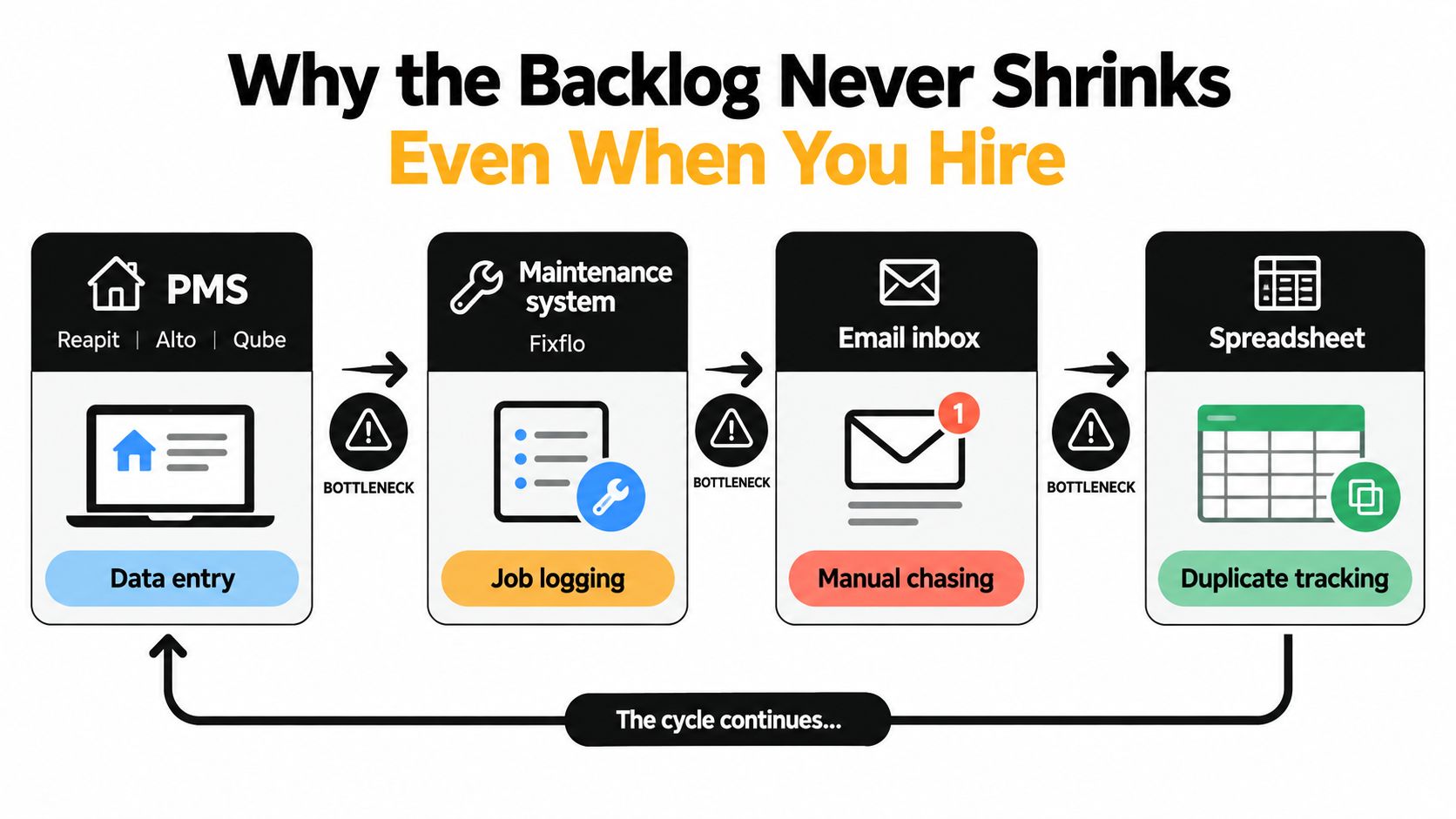
Where Ownership Disappears
A tenant emails about a leak. That email becomes something to remember, not a case with a timestamp, category, urgency and named owner. If the person who read it is pulled into a viewing, the clock is running but the delay is invisible.
Compliance dates fail the same way. A date on a wall planner has no escalation rule. It can't chase the contractor, tell the manager the certificate is now overdue, or prove who approved the booking.
Contractor work breaks at the handoff too. A job is closed in one system, but the invoice, photos and completion note never travel back to the tenancy record. Someone reopens it from memory, asks for evidence again, and types details the business already had.
The consequence shows up in complaints. Repairs were the subject of 79% of private renter complaints in the English Housing Survey 2022 to 2023 satisfaction and complaints fact sheet, with 29% of dissatisfied households saying the landlord was slow to act and 26% saying the landlord did not bother.
Hiring into that shape adds another person checking the same list. They learn the undocumented workarounds, carry cases in their head, and take that knowledge with them when they leave. The list doesn't get smaller. It just gets checked by more people.
The Five Workflows That Make Up Your Day
A useful property management workflow isn't five separate processes. It's one case lifecycle used five ways, with the same core record each time: property, tenancy or block, trigger, deadline, owner, evidence and approver.
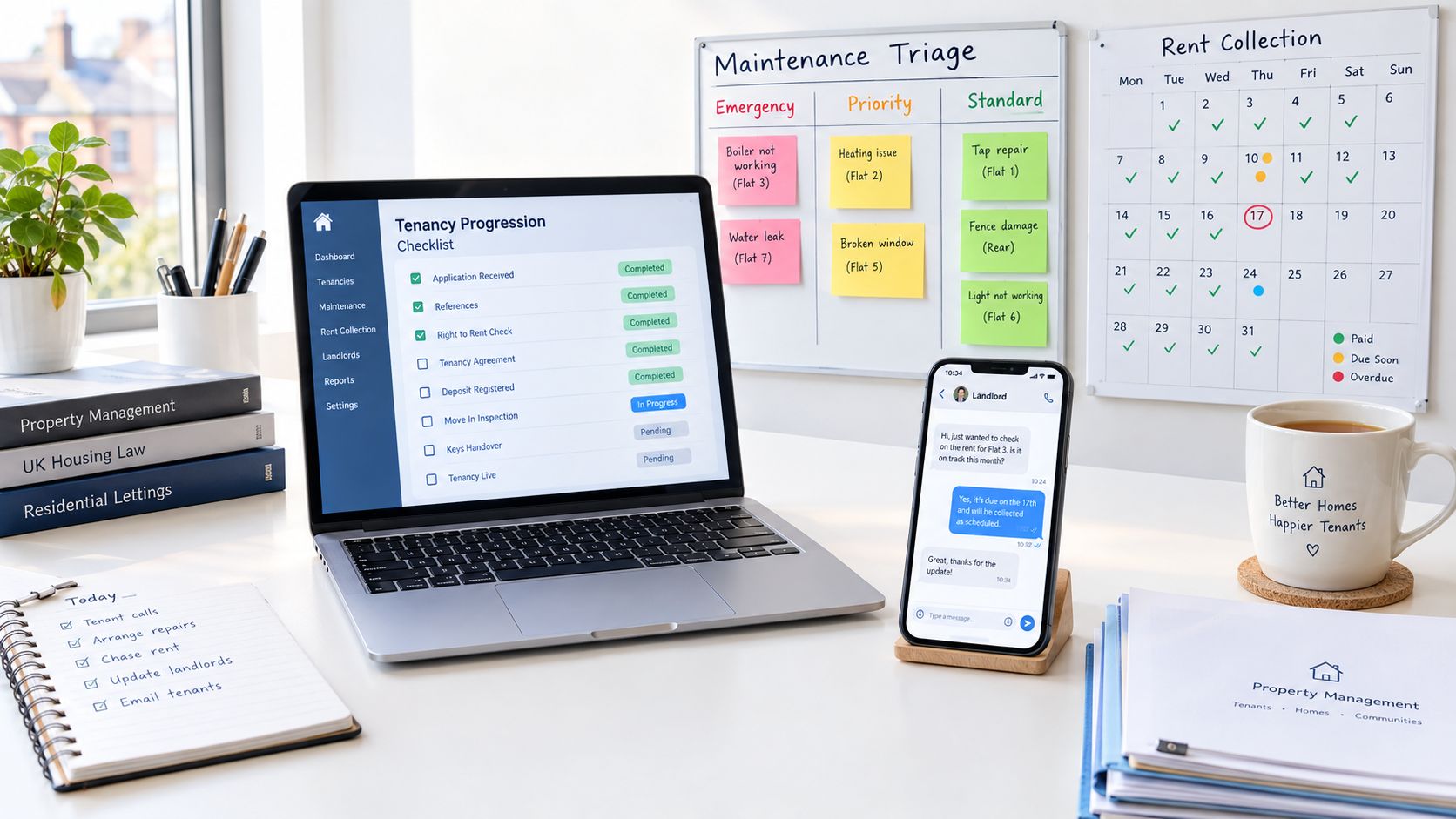
- Tenancy progression: Triggered by an agreed let. Capture applicant details, Right to Rent evidence, references, holding deposit receipt, agreement deadline and prescribed information. A named person approves anything sent to the tenant or landlord.
- Maintenance triage and repairs: Triggered by a tenant report. Capture the defect, timestamp, urgency, access permission, contractor, cost approval, completion evidence and tenant confirmation before closure.
- Rent collection and arrears: Triggered by a due date or missed payment. Capture the balance, contact attempts, payment plan discussions and landlord updates. A person approves every arrears letter or notice related step.
- Inspections: Triggered by schedule or a reported defect. Capture findings, photos, follow up actions and dates. Recurring damp, mould or safety issues escalate instead of sitting in a report nobody reopens.
- Compliance and certificates: Triggered by expiry dates and legal events. Gas, electrical and EPC renewals sit alongside deposit protection, Client Money Protection and redress scheme membership evidence.
The inspection workload is not optional admin. The English Private Landlord Survey 2024 found 86% of landlords inspected their most recent let to confirm it was fit for human habitation, 91% provided an Energy Performance Certificate, and 79% carried out Right to Rent checks. It also found 26% had identified damp or mould in at least one property in the previous year.
That mix is exactly why memory fails. High activity, incomplete coverage, and recurring defects need dates and evidence linked to the property, not scattered across inboxes. If you're reviewing how those dates and records should be held, our guide to property compliance software sets out the operational side. A solicitor or compliance adviser should confirm how any legal requirement applies to your portfolio.
The short walkthrough below shows the same principle applied to day to day case handling.
Use the same fields every time and reporting stops being a monthly rescue job. You can see open cases by age, owner and deadline because the record was built that way from the start.
Hiring, Switching Platform or Using ChatGPT Why None of Them Fix It
You've probably already considered the four obvious routes. Each one has a logic to it. None of them changes the shape of the work on its own.
Doing Nothing and Hiring Again
Doing nothing is honest if the portfolio is stable and the team can absorb the chasing. It stops working when you add doors. Every new tenancy adds reports, dates, rent events and inspections to a process that already loses ownership at handover.
Hiring helps if the job is well defined and the process is written down. In most agencies I've seen, the new starter is trained by shadowing the busiest person. They copy the spreadsheet habit, learn which inbox to watch, and become another human reminder system.
Switching Platform
Moving from Alto to Reapit, or adding Arthur alongside Qube, can be the right call for accounts, block management or reporting reasons. It won't fix workflow by itself. Staff carry their habits across, old data arrives messy, and the email to case handoff still depends on someone remembering.
Practical test: If a case can sit unread overnight with no owner and no escalation, a new platform licence won't change that. The rule underneath is missing.
Bolting on ChatGPT
ChatGPT is useful for drafting, summarising and tidying text. Used well, it saves typing. It doesn't know that a certificate expires on Friday, that a contractor hasn't uploaded evidence, or that a tenant case has had no update since Tuesday unless it's connected to your records, rules and approval steps.
That's the distinction. Faster drafting is not a workflow. A workflow decides what happens next, who owns it, what counts as evidence, and what happens when a deadline is missed.
What a Connected Workflow Looks Like Step by Step
Take a tenant reporting a leak at 6pm. In a connected property management workflow, that report doesn't wait in an inbox until morning and it doesn't trigger an unsupervised message either.
- Capture: The report arrives through one traceable route and creates a case in the system you already run, whether that's Reapit, Alto, Fixflo, Arthur or Qube. It gets a case ID, timestamp, property and tenancy link straight away.
- Classify: AI reads the report and photos, suggests a category and urgency, and flags missing information such as access availability or whether the water is isolated. A named team member checks that classification.
- Acknowledge: A draft acknowledgement is prepared with the case reference and next action date. A human approves it before it reaches the tenant, unless you've agreed a narrow, pre approved wording for simple receipt only.
- Approve cost and contractor: The case is routed against your contractor rules and landlord authority limits. Anything above the agreed threshold waits for landlord approval. No instruction goes out automatically.
- Arrange access: The workflow records tenant permission, the proposed visit time and the 24 hours' notice check described in the government How to rent checklist. Failed access attempts are logged against the case, not buried in call notes.
- Track completion: Contractor updates, invoices and before and after photos attach to the same case. If the appointment date passes with no evidence, the owner gets an escalation task.
- Close properly: The tenant is asked to confirm the repair is done. Only then does a person close the case, with cost and evidence ready for the landlord record.
That recognition matters commercially. UK tenant research found 67% of renters raised maintenance issues directly with landlords rather than via an agency, and only 56% of agency customers were satisfied with the agency response to maintenance issues, compared with 65% for direct landlords, in the UK Government private rented sector tenants research report.
None of this requires ripping out your platform. The work is in connecting intake, case record, contractor updates and reporting. If you're weighing up how systems pass data between each other, this explainer on what API integration means in practice covers the basics without the jargon.
Approval Points in a Connected UK Property Workflow
| Action | What AI does | Human approves |
|---|---|---|
| Tenant acknowledgement | Drafts wording and inserts case details | Sending the message |
| Urgency classification | Suggests emergency, urgent or routine | Final severity and next action |
| Contractor instruction | Matches trade, area and authority limit | Contractor choice and spend |
| Landlord update | Summarises case history and cost | Anything sent to the landlord |
| Case closure | Checks evidence and invoice are present | Confirming completion with tenant |
The system earns its place by removing retyping, chasing and searching. The judgement stays with your team.
Where AI Helps and Where It Stays Out of the Way
AI is good at reading, sorting and noticing gaps at volume. It's a poor substitute for judgement where safety, money or legal consequences sit behind the decision.
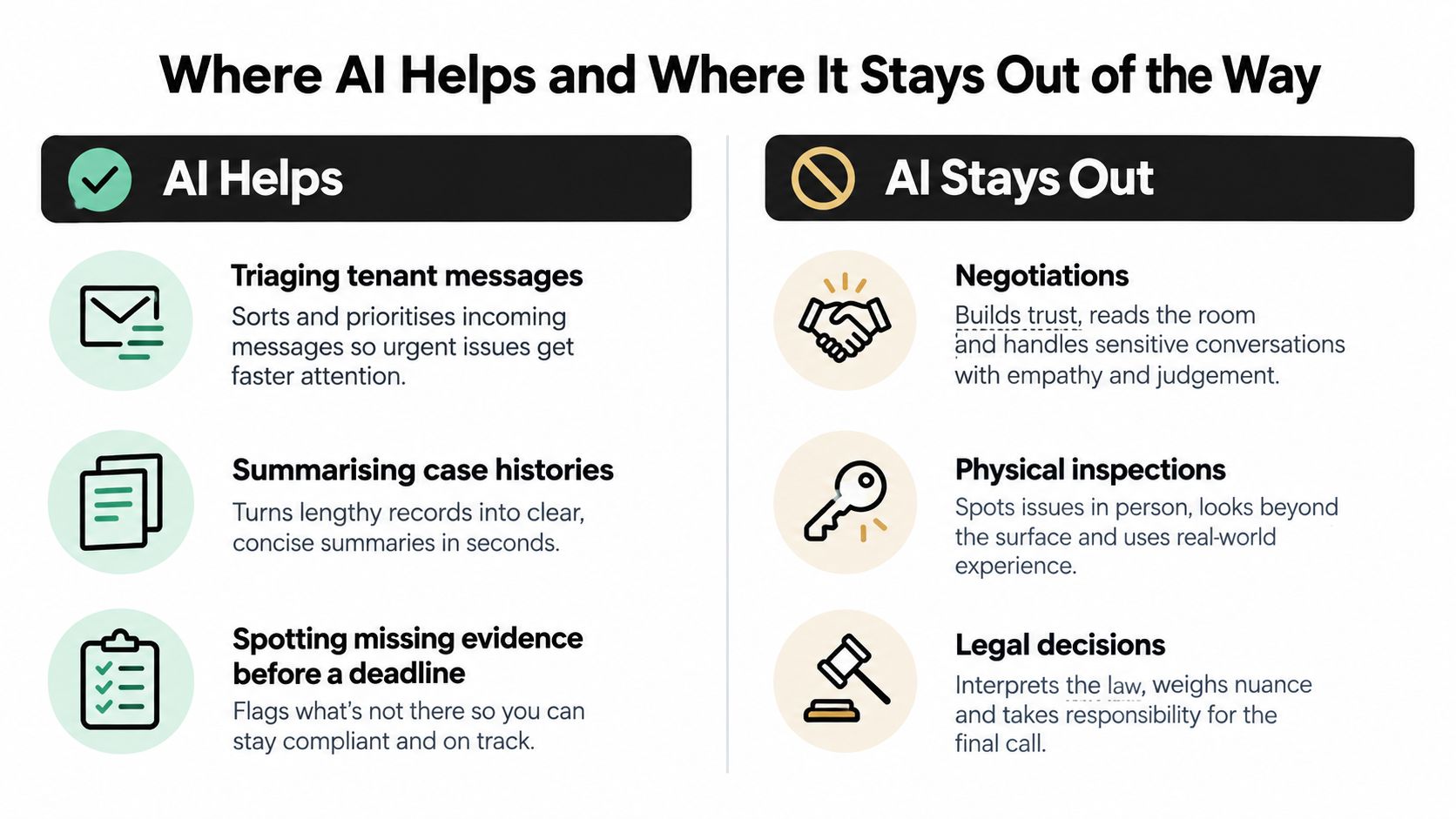
Use it first for maintenance triage, summarising long case histories, spotting missing evidence before a deadline, drafting reminders, reconciling records between your property system and finance, and building management views from data you already hold. Those tasks are repetitive, text heavy and easy for a person to check.
Keep it out of the final decision on legal notices, hazard and damp assessments, vulnerability related decisions, contractor authorisation beyond pre set limits, and anything that could end a tenancy. AI can assemble the file for those decisions. It shouldn't make them.
If the underlying dates, tenancy records and contractor evidence are wrong, AI will simply process bad data faster. Fix the source of truth first.
Adoption is still early. The MRI Voice of the Property Manager 2025 report found only around 10% of surveyed property managers had adopted AI or automation tools, 37% saw AI as an efficiency driver, and only 17% recognised its potential for decision making and analysis.
That gap isn't mainly about model quality. It's about data readiness. Clean property records, clear approval limits, retention rules and an audit trail come first. The tool choice comes second.
What to Look at First in Your Own Operation
Start with three checks this week. First, pick ten recent maintenance cases and find where each one lost its owner between intake and closure. It's usually the email to property system handoff.
Second, list every compliance date that lives outside your system of record. Wall planners, personal diaries and side spreadsheets count. Third, mark where your team types the same information twice, usually between the property system and the maintenance tool.
If you want a structured way to score those gaps, use the AI readiness scorecard as a working tool, then compare it against the reporting view you need each Monday. Our piece on building an operational KPI dashboard shows which measures are worth surfacing. Owners running lettings portfolios can also see how this applies on our letting agents page.
I build connected property management workflow systems for letting agents, block managers and serviced accommodation operators, linking the platforms you already pay for and keeping a named human in control of tenant, landlord and regulator facing decisions. If you want to work out whether that's a fit for your operation, book a free discovery call via InnovaAI Integration Ltd. If it isn't a fit, I'll say so on the call.