Residential Property Management Software for SMEs
property management softwareletting agentsmaintenance triagetenancy progressionclient money

It's Tuesday morning. The shared inbox holds a tenant's message from 8pm, nobody owns it until 9am, and a certificate renewal is still sitting on the wall planner. Your negotiator needs an answer on tenancy progression while a landlord chases a repair update.
Table of Contents
- What Does Tuesday Morning Actually Look Like
- Why Does the Backlog Stay After You Hire
- What Should Tenancy Repairs and Accounts Record
- Should You Switch Platform or Connect What You Run
- What Must Still Wait for a Person to Decide
- What Should You Check First in Your Own Office
What Does Tuesday Morning Actually Look Like
You're running an independent agency, not a software department. You've come up through the industry, built recurring management-fee income and hired twice, yet the backlog still looks familiar.
You might have hundreds of doors, a substantial leasehold book or a busy serviced-accommodation operation. You already pay for Reapit, Alto, Fixflo, Arthur or Qube, but half the office keeps a spreadsheet beside it.
The office behind the portfolio
There's a void waiting for a works update, a move-in waiting for a document and a landlord expecting a call. In blocks, the same morning includes service-charge queries and leaseholder correspondence; in serviced accommodation, it includes turnaround work alongside the channel manager.
The practical test: Can the person answering the phone see what was promised without asking somebody else?
I'm Cameron Atwal, based in Wolverhampton. I run a property portfolio myself, and I've personally done the admin I now automate.
This is about the daily work of managing homes in England and Wales, not shopping for another product category. A useful property-management workflow starts with the desk your team works from every day.
Your ambition isn't particularly technical. You want to take on another hundred doors without automatically taking on another salary, while keeping the existing landlords and tenants properly looked after.
Why Does the Backlog Stay After You Hire
Hiring adds capacity. It doesn't assign ownership to a broken handoff. A new administrator can work hard all morning and still inherit the same gaps between the inbox, property record and accounts screen.
A tenant message has no named owner. A repair has no received timestamp. A certificate expiry is a date on paper rather than evidence attached to a unit.
Follow the handoffs
The diagram shows the administrative joins to inspect, not a claim that every task follows a fixed sequence.
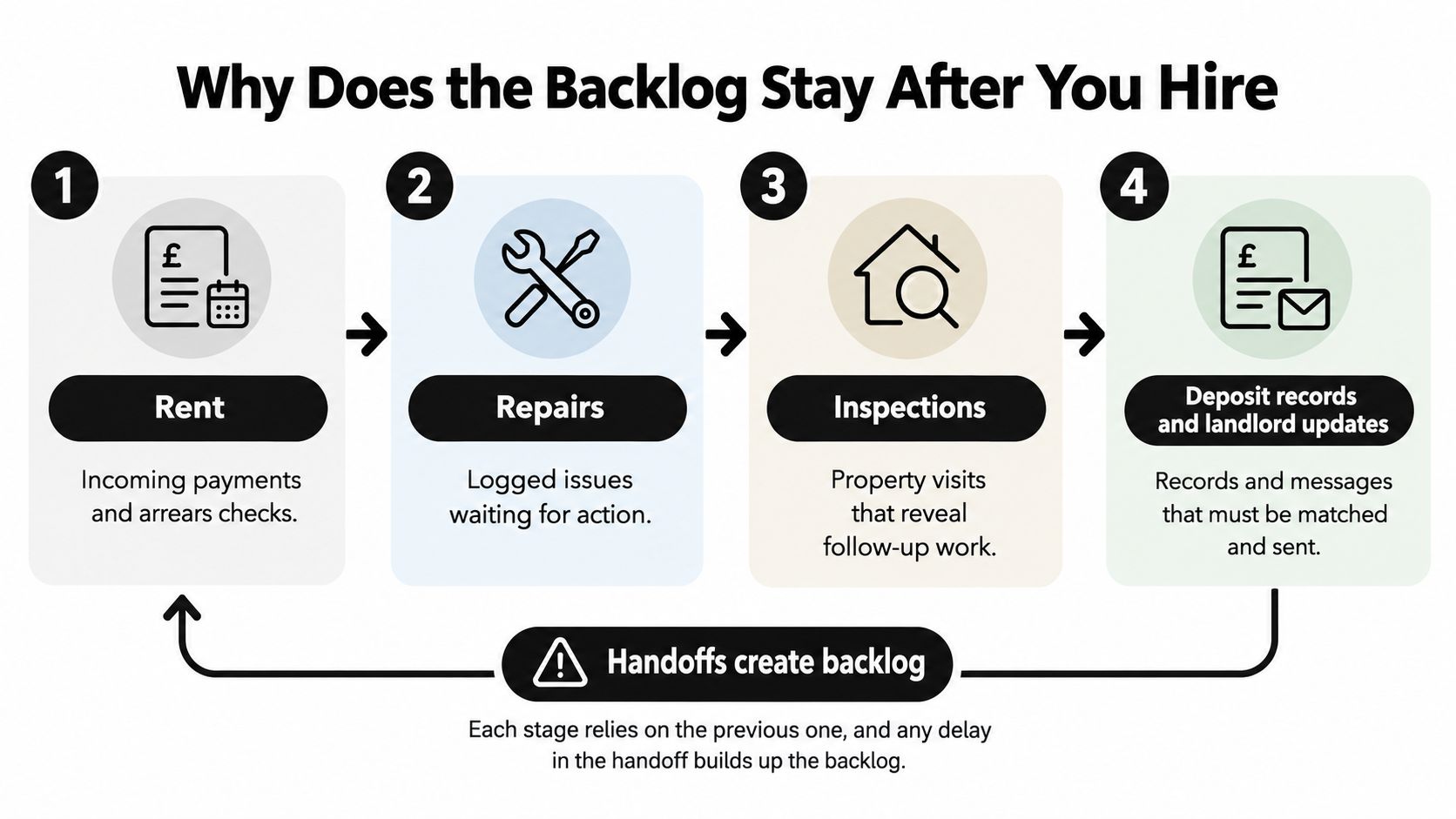
Accounts staff then re-key information the platform already holds. A property manager checks whether an inspection produced follow-up work, while someone else asks whether the landlord has approved it.
The scale makes consistent records important: privately rented homes represented 19% of UK households in the year ending March 2024, and the English Private Landlord Survey recorded just over 4.2 million live protected tenancy deposits, according to the ONS private rented sector overview.
Another person shouldn't have to reconstruct the history before they can do the next job.
The cost is mechanical. Staff read the same correspondence, copy the same details and interrupt each other to establish what happened.
Meanwhile, tenants chase because nobody has confirmed the next action. Owners can't get a reliable report of what's late because the dates sit in different places.
That's a process diagnosis, not a criticism of your team. More effort won't make an unrecorded handoff visible.
What Should Tenancy Repairs and Accounts Record
The useful record is the one that lets the next person act without rebuilding the history. Link the tenancy, repair and financial records to the correct property and unit, whether the source system is Reapit, Alto, Fixflo, Arthur or Qube. Keep a named person responsible for approving anything sent to a tenant, landlord or regulator.
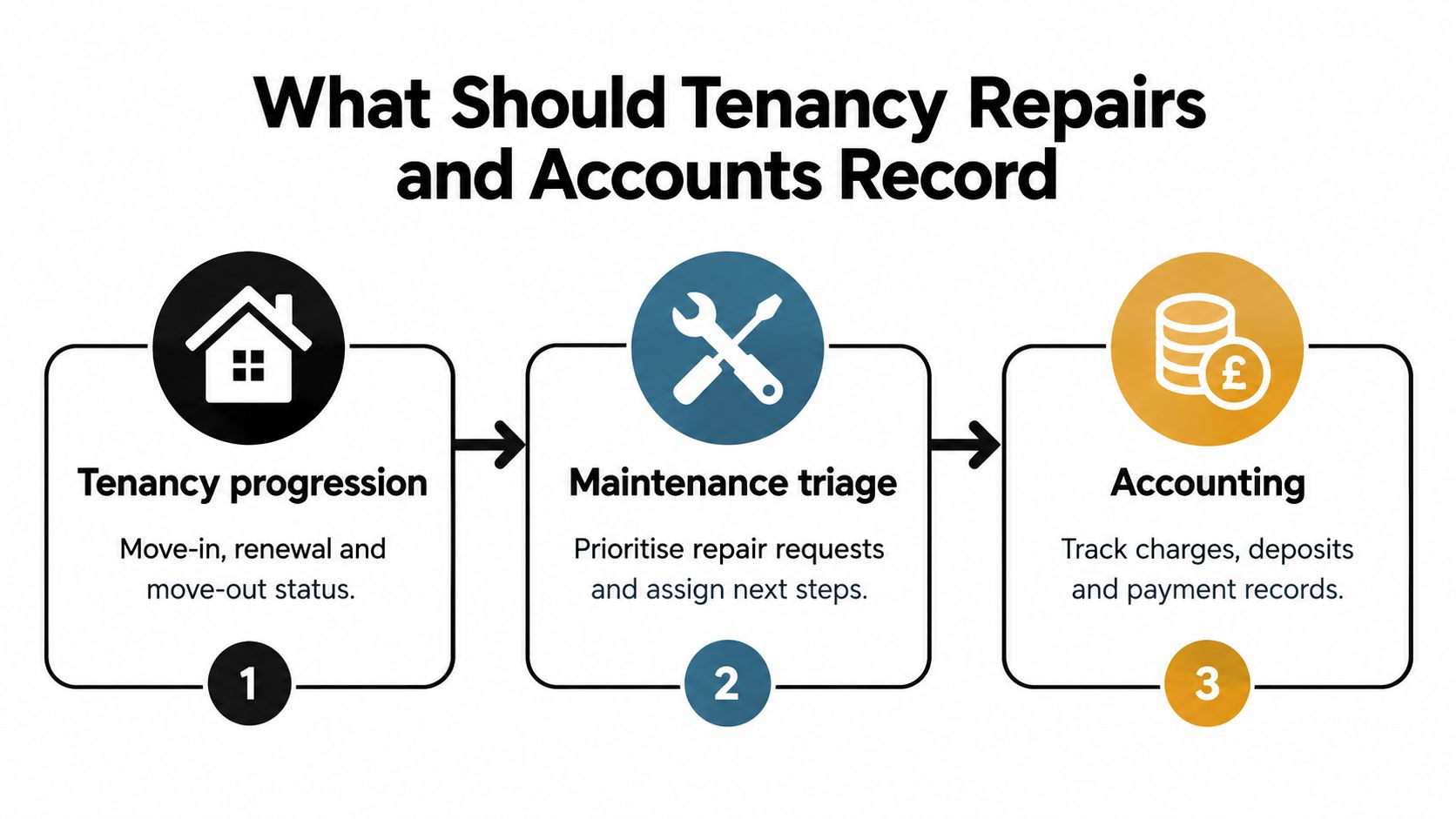
Keep decisions attached to the record
- Record the tenancy. Link the occupants to the unit, note move-in and move-out status, promises made, outstanding documents and the next action owner. The assigned property manager approves tenant or landlord correspondence before it is sent.
- Track each repair from report to completion. Record when it arrived, its reported urgency, the person responsible, contractor, appointments, evidence and completion. Attach complaints to the same history. The maintenance manager confirms priority and approves instructions before they reach a contractor.
- Reconcile the financial position. Link relevant charges, deposits, arrears, approvals and payment records, while keeping the client-money ledger in its proper system. The accounts lead checks statements and demands before they go to a landlord or leaseholder.
For context, England's 2023/24 tenant satisfaction measures recorded more than 14.3 million responsive repairs. The figures also reported that 77% of non-emergency repairs and 89% of emergency repairs met landlords' target timescales. These are not private-agency targets, but they show why your own records should make timeliness reportable (government tenant satisfaction measures).
Keep evidence against the unit
Gas, electrical, energy and fire-safety records need the evidence, responsible person and next review date recorded against the relevant unit. Reminders alone will not show whether a check happened or a defect was resolved. Property compliance software should expose missing evidence and overdue actions for a named person to review.
London Fire Brigade's landlord responsibilities guidance illustrates why recurring checks need retained records. Ask a solicitor or compliance adviser to confirm which duties apply to your properties.
Should You Switch Platform or Connect What You Run
Connect what you already run unless there's a specific reason you can't. Don't mistake frustration with a process for proof that Reapit, Alto, Fixflo, Arthur or Qube must go.
The alternatives deserve a fair hearing. Sometimes the office needs another experienced property manager, and sometimes the existing platform cannot support an essential requirement.
What each option changes on Monday
| Option | What changes | What stays broken |
|---|---|---|
| Leave it | No implementation work | Existing delays and duplicated admin |
| Hire again | More staff capacity | Unowned work unless responsibilities change |
| Switch platform | Different screens and capabilities | Side spreadsheets unless the process changes |
| Use ChatGPT | Help drafting or summarising | No managed case ownership or approval trail by itself |
| Connect the current platform | Shared visibility and controlled handoffs | Missing source records and decisions nobody owns |
A chat window is useful for a draft. It isn't a dependable operating record just because somebody pasted the latest email into it, and sensitive tenant information shouldn't be copied into an unapproved account.
Buying rule: Define the handoff you need to fix before asking anyone to demonstrate software.
As founder of InnovaAI Integration Ltd, I build custom workflow tools, dashboards and connections for letting agents, block and estate managing agents, and serviced-accommodation operators across the West Midlands and UK. I'm not a software vendor or a consultant; I build working systems around the team's existing process, with training included.
For letting agents, that means checking permitted access before promising a connection. An API integration must respect platform permissions, handle failed updates and avoid duplicate records.
Use the admin-cost scorecard as a tool to identify where repetitive work sits. If your current platform already does the job, configure it properly before commissioning anything.
What Must Still Wait for a Person to Decide
A green dashboard isn't proof of legal completeness. It might only mean that somebody entered a date and uploaded a file.
Use this dashboard image as a reminder to inspect the underlying evidence, not just the status colour.

An alert isn't a legal judgement
England's Private Rented Sector Database arrangements involve registration and compliance information, but implementation detail matters; don't treat planned functionality as an already completed obligation (government explanatory memorandum).
The system can draft an acknowledgement, identify missing photographs and route a report internally to the on-call person. The named duty manager must approve anything sent to a tenant, including an acknowledgement or follow-up request.
A person also decides whether a report is urgent, authorises spend and signs off safety actions. Serving a notice, approving Section 20 correspondence or submitting information to a regulator requires the responsible manager's approval and appropriate professional advice.
Software can't supply missing capacity
A connection won't produce an available contractor from a short contractor list. It won't create a sensible works plan for a void or prove that an unrecorded fire-door check happened.
Keep that distinction in mind when viewing a software demonstration.
Full automation of compliance or tenant outcomes is the wrong tool. Ask your solicitor or compliance adviser how England and Wales duties apply, rather than treating an alert, draft or dashboard as legal advice.
What Should You Check First in Your Own Office
At 9am on Tuesday, an older repair report is still unassigned, a certificate has no file attached, and the property manager is searching an inbox for the complaint history. Start with those live cases, not a wish list of features.
Inspect the work nobody can explain
- Open unowned messages. Find tenant reports that have waited since the previous working day. Check who owns each one and whether the received time is recorded in Reapit, Alto, Arthur or Qube.
- Inspect missing evidence. Find certificates and fire-door checks with no supporting file linked to the right property or block. Separate missing paperwork from checks that were never completed.
- Review delayed repairs and complaints. Identify jobs with no clear target date, repeated chases or a complaint already in progress. Confirm staff can see the full history without searching separate inboxes.
Build the first useful view
The English Housing Survey found that renters' satisfaction with repairs varied, and slow action and poor landlord responses featured among reasons for dissatisfaction (English Housing Survey findings). Use that as a prompt to check how quickly your own team acknowledges, assigns and updates a repair.
If staff cannot group jobs by age, urgency, contractor and property, specify that view before shopping for a new platform. First check whether the dates and ownership fields already exist in your current system. Residential property management software should connect to the records you run, with a named manager approving anything before it reaches a tenant, landlord or regulator.
I build working connections and dashboards around the residential property management software your office already uses. Visit InnovaAI Integration Ltd to arrange a free discovery call and assess whether a connection fits. If it doesn't, I'll say so on the call.